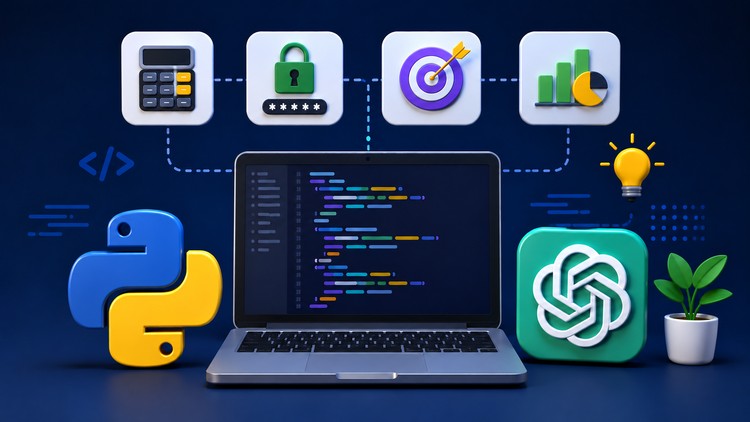
Learn Python fundamentals, build 4 projects, and use ChatGPT to code, debug, and learn faster.
What You Will Learn:
- Understand Python fundamentals including variables, data types, input/output, loops, functions, and conditional statements.
- Build 4 practical Python projects from scratch: Smart Calculator, Password Generator, Number Guessing Game, and Expense Tracker.
- Use ChatGPT effectively to learn Python faster, generate code, solve problems, and improve programming skills.
- Debug Python programs, identify common errors, and fix bugs using AI-assisted development techniques.
- Review and improve Python code by applying best practices, code organization, and feature enhancements.
- Write and understand beginner-friendly Python programs with confidence and continue learning independently after the course.
- Show more
Alright, let’s talk about ‘Learn Python Fast with ChatGPT: Build 4 Projects’. In a world saturated with “learn Python” courses, this one stands out not just for *what* it teaches, but *how* it teaches it. As an experienced tech professional, I’ve seen countless training modules, and the integration of AI tools like ChatGPT into a foundational curriculum is, frankly, a sign of intelligent design. This isn’t your grandma’s Python course; it’s built for the modern developer who understands that AI isn’t just a gimmick, but a powerful co-pilot.
The premise here is brilliant: merge core Python literacy with practical application, all while leveraging an industry-standard tool like ChatGPT for accelerated learning and problem-solving. It’s less about memorizing syntax and more about developing a workflow that mirrors what you’d find in a junior dev role today. The focus on hands-on labs through building four practical projects means you’re not just passively consuming information; you’re actively creating, debugging, and refining. This approach directly translates to developing genuine job-ready skills, moving you from a theoretical understanding to practical competence much faster than traditional methods.
Prerequisites
One of the beauties of this course is its accessibility. You genuinely need no prior coding experience whatsoever. If you can operate a computer, browse the internet, and have a basic grasp of file management, you’re good to go. The course starts from the absolute ground floor, making it ideal for complete beginners looking to dip their toes into programming or switch careers into tech without feeling overwhelmed by complex prerequisites.
Skills & Tools
By the end of this course, you’ll be surprisingly well-equipped. You’ll master Python fundamentals like variables, data types, control flow (loops, conditional statements), and functions – the absolute bedrock of any programming language. More importantly, you’ll gain proficiency in using ChatGPT not just for code generation, but for deeper understanding, error identification, and solution brainstorming. This isn’t just about Python; it’s about learning AI-assisted development techniques. The four projects (Smart Calculator, Password Generator, Number Guessing Game, Expense Tracker) are well-chosen to cover diverse fundamental concepts and provide tangible portfolio pieces. You’ll also learn critical debugging strategies and best practices for writing clean, maintainable code, which is an often-overlooked but incredibly valuable skill for any aspiring developer.
Career Benefits & Job Roles
This course is a fantastic launchpad for anyone eyeing a career in technology. The combination of Python fundamentals and practical AI tool usage makes you highly marketable. For individuals seeking career growth, this course provides tangible skills that are immediately applicable. You’ll gain entry-level job-ready skills for roles such as a Junior Python Developer, Scripting Specialist, Data Analyst Assistant, or even QA Engineer where automation scripting is required. The ability to articulate how you’ve used ChatGPT to accelerate development and debug code is a powerful differentiator in interviews. While it’s a ‘beginner’ course, it sets a solid foundation for further specialization, whether that’s in web development (Django/Flask), data science (Pandas, NumPy), or machine learning. It’s a stepping stone that could even contribute to initial certification prep for broader programming or data analysis certifications.
Pros
- Modern Learning Approach with AI Integration: This is the biggest differentiator. Learning how to effectively prompt and utilize ChatGPT for coding, debugging, and understanding complex concepts is a meta-skill for today’s and tomorrow’s tech landscape. It significantly reduces the learning curve and boosts productivity.
- Project-Based, Practical Learning: Theory is great, but building four real-world projects is where the rubber meets the road. These aren’t just toy examples; they’re functional applications that give you concrete experience and something to showcase. This hands-on experience is invaluable for solidifying understanding and building confidence.
- Focus on Debugging and Best Practices: Many beginner courses gloss over debugging, but this one emphasizes it, leveraging AI as an assistant. Understanding how to identify and fix errors, along with adopting good code organization, moves you beyond just “coding” to actual “software development.”
- Accelerated Learning and Confidence Building: The “Fast” in the title isn’t just marketing. By integrating ChatGPT, learners can get immediate answers, explanations, and code suggestions, speeding up the process. This, combined with successful project completion, builds genuine confidence to continue learning independently.
Cons
- Limited Advanced Python Depth: While excellent for beginners and covering fundamentals, the “fast” nature and project scope mean it doesn’t delve deep into more advanced Python concepts like object-oriented programming (OOP) in extensive detail, advanced data structures, or specific framework usage (e.g., web frameworks, data science libraries). It’s a fantastic starting point but shouldn’t be mistaken for an all-encompassing ‘beginner to advanced’ Python masterclass. Further dedicated study would be necessary to truly become an expert in specific Python domains.