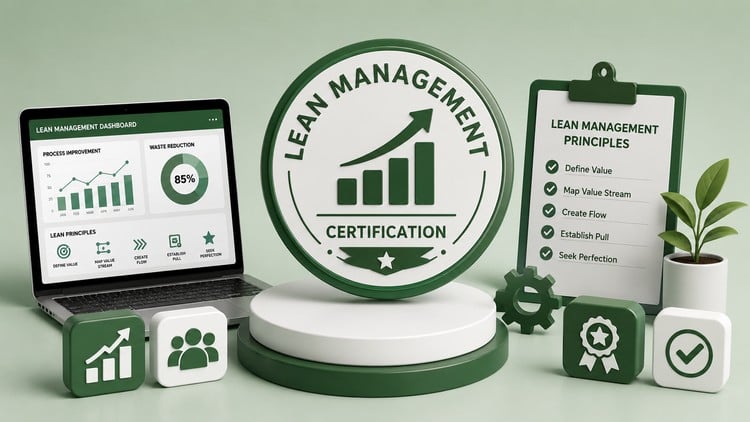
Master Lean Thinking & Get Certified | Kaizen, 5S, Value Stream Mapping, Waste Elimination & Continuous Improvement
What You Will Learn:
- Master Lean Management concepts and certification objectives
- Practice with realistic certification-style mock exams and quizzes
- Understand Lean principles, Kaizen, and continuous improvement methodologies
- Learn waste reduction, value stream mapping, and workflow optimization techniques
- Improve analytical thinking and operational problem-solving skills
- Strengthen understanding of customer-focused process improvement strategies
- Gain confidence to pass Lean Management certification exams
- Learn operational excellence practices used in modern organizations
Alright, so I recently dove headfirst into the ‘Lean Management Certification: Complete Training 2026’ course, and as a seasoned tech pro who’s seen more than a few methodologies come and go, I’ve got some thoughts. The title promises a lot – mastering Lean thinking and getting certified – and generally, it delivers, but with a few caveats.
Overview
Let’s cut to the chase. This isn’t just another theoretical deep dive into Lean principles. What sets this training apart is its laser focus on certification prep. They’ve really structured the content to align with what you’d expect to see on actual Lean Management exams, which is a huge win if your primary goal is that piece of paper. The course walks you through the core tenets – the “why” behind Lean – but then quickly pivots to the “how.” We’re talking practical application, not just abstract concepts. The inclusion of realistic certification-style mock exams and quizzes is a game-changer. It’s one thing to read about Kaizen, it’s another to tackle questions that mimic the pressure of a formal assessment. They emphasize waste elimination (Muda, Mura, and Muri, for those keeping score) and practical tools like 5S and Value Stream Mapping with a clear objective: making you more efficient and effective in your role. The ultimate aim is operational excellence, and the course consistently drives that home.
Prerequisites
Honestly, this is designed to be pretty accessible. You don’t need a degree in industrial engineering to jump in. If you have a basic understanding of business operations or a desire to improve processes, you’re good to go. For folks already in a professional setting, any experience with project management or operational roles will give you a leg up, but it’s not a hard requirement. Think of it as a course that bridges the gap from curious beginner to certified professional.
Skills & Tools
This course equips you with a robust toolkit. You’ll gain a solid grasp of Lean principles, the philosophy of Kaizen, and various continuous improvement methodologies. The practical elements shine here, with detailed explanations and exercises on waste reduction techniques, how to conduct a thorough Value Stream Map, and strategies for workflow optimization. The focus on improving analytical thinking and operational problem-solving skills is evident throughout. You’ll learn to dissect processes, identify bottlenecks, and implement solutions that actually stick. While it doesn’t delve into highly specialized, industry-standard tools like Six Sigma software in depth, it provides the foundational knowledge to leverage them effectively. The course content effectively moves you from beginner to advanced understanding of Lean concepts.
Career Benefits & Job Roles
This is where the rubber meets the road. Getting certified in Lean Management opens doors. It’s highly valued across numerous sectors – manufacturing, IT, healthcare, finance, you name it. You’ll be a more attractive candidate for roles like Process Improvement Specialist, Operations Manager, Continuous Improvement Lead, Business Analyst, and even project management positions where efficiency is paramount. The skills you acquire are directly applicable to driving job-ready skills and contributing to significant career growth. Organizations are actively seeking professionals who can streamline operations, reduce costs, and boost productivity, and a Lean certification signals that you possess these capabilities. It’s a solid investment in your professional development and a tangible differentiator in the job market.
Pros
- Comprehensive Certification Focus: The course is meticulously designed for exam success, making it an excellent choice for those prioritizing certification.
- Practical Application Emphasis: It goes beyond theory, focusing on hands-on learning and actionable techniques like VSM and 5S.
- Broad Applicability: The principles learned are transferable to a wide range of industries and job functions.
- Confidence Booster: The mock exams and structured learning build genuine confidence for tackling real-world challenges and formal assessments.
Cons
My one honest critique is that while it covers the ‘what’ and ‘how’ of Lean extremely well, the ‘real-world projects’ aspect could be more deeply integrated. While there are exercises, actual case studies with detailed problem statements and solutions that mirror complex, messy organizational scenarios would elevate it further. It’s still excellent, but for those looking to simulate the full lifecycle of a complex Lean transformation from day one, a bit more grit in the case studies would be beneficial.