Learn any language faster with AI: conversations, stories at your level, quizzes and feedback, based on research
What You Will Learn:
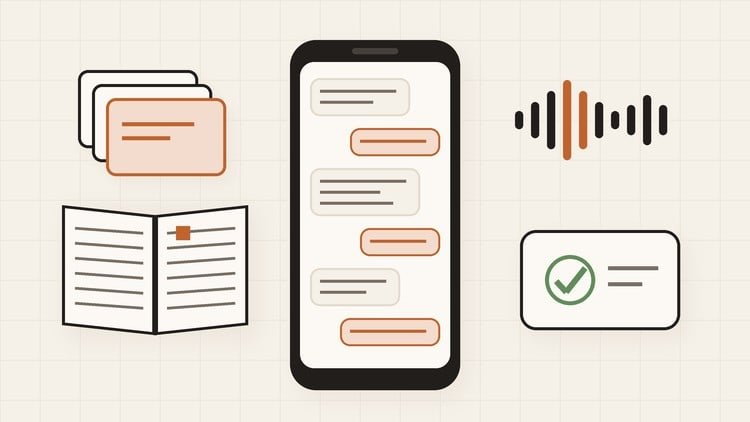
- Use an AI assistant as a conversation partner for role-plays, voice conversations, games and debates in any language
- Get stories and real texts rewritten at exactly your level, using your own list of known words
- Remember more words with AI quizzes, flashcards made in seconds, memory hooks and spaced reviews
- Get feedback on your writing that makes you think, and choose how you want to be corrected
- Turn photos of menus and signs into lessons, and rehearse real conversations before they happen
- Build a 20-minute daily routine and a weekly plan around your goals, and check your progress honestly
- Apply research on how people learn languages: recall, spacing, reading at your level and feedback
The Shift from Passive Apps to Generative Mastery
As someone who has spent the better part of a decade navigating the tech industry, I’ve seen my fair share of “game-changing” tools. Usually, they’re just rebranded versions of old ideas. But after diving into Language Learning with AI: Your Personal Language Partner, I realized we’ve finally hit a tipping point. For years, the industry standard was the “gamified” approach—clicking colorful buttons and matching pictures to words. It felt like a hobby, not a path to job-ready skills. This course flips the script by treating language acquisition like a hands-on lab for your brain.
The core philosophy here isn’t just about “learning a language”; it’s about prompt engineering your way to fluency. Most people use AI as a glorified search engine, but this course teaches you to use it as a high-fidelity simulator. Instead of static textbook dialogues, you’re building real-world projects out of your conversations. Whether you’re a beginner to advanced learner, the focus is on active output. It’s the difference between reading a manual on Python and actually shipping code. This is certification prep for the real world, minus the boring lectures.
Prerequisites
You don’t need a PhD in linguistics to get started, but you do need a foundational level of tech-savviness. If you can navigate a browser and understand the basics of interacting with a chatbot, you’re halfway there.
- A basic understanding of industry-standard tools like ChatGPT, Claude, or Gemini.
- A clear objective—whether it’s for career growth or personal travel.
- A willingness to move past the “fear of being wrong” that plagues traditional classrooms.
- A mobile device or laptop with a stable internet connection for voice-to-text interactions.
Skills & Tools You’ll Master
This isn’t just about vocabulary; it’s about building a modern workflow for self-improvement. You’ll be using AI-driven frameworks to dismantle the barriers that usually stop people at the “intermediate plateau.”
- Prompt Engineering for Linguistics: Learning how to “prime” an AI to act as a specific persona (e.g., a demanding boss or a friendly barista).
- Adaptive Reading Environments: Using tools to scrape real-world texts and instantly simplify them to your exact CEFR level.
- Spaced Repetition Systems (SRS): Integrating AI-generated flashcards into your daily routine for maximum retention.
- OCR for Real-World Context: Leveraging image-to-text technology to turn physical environments (signs, menus, documents) into interactive hands-on labs.
- Feedback Loop Optimization: Configuring AI to provide “scaffolded” corrections that explain the *why* behind your mistakes.
Career Benefits & Job Roles
In our increasingly globalized economy, being “monolingual” is becoming a technical debt. This course provides the career growth leverage that many professionals overlook. Being able to communicate across borders isn’t just a “soft skill”; it’s a high-value asset in international business.
- International Project Manager: Lead cross-functional teams across different time zones and cultures with localized nuances.
- Global Sales Executive: Close deals by building authentic rapport in a client’s native tongue, showing a level of effort that automated translators can’t replicate.
- Localized Support Engineer: Troubleshoot technical issues in specific regions using industry-standard tools and terminology.
- Expat Professional: Transition into roles in tech hubs like Berlin, Tokyo, or Mexico City with the job-ready skills needed to navigate local bureaucracies.
What I Loved (The Pros)
- The Customization is Unmatched: Traditional courses are “one size fits all.” This approach is a bespoke learning experience. If I want to learn French specifically for a technical interview at a SaaS company, I can pivot the entire curriculum in thirty seconds. It’s hyper-efficient.
- Zero Judgment Environment: We’ve all felt that “freeze-up” when trying to speak to a native speaker. The AI allows for unlimited rehearsal. You can fail, stutter, and mess up your tenses a thousand times without the social anxiety, which ironically builds the confidence you need for real-world conversations.
- Research-Backed Methodology: I appreciated the deep dive into Comprehensible Input and Active Recall. The course doesn’t just give you a tool; it explains the cognitive science of why these methods work, making you a more effective learner in any discipline.
The Reality Check (The Cons)
- The “Hallucination” Factor: While AI has come a long way, it can still be confidently wrong about obscure grammar rules or local slang. Without a human “sanity check” occasionally, you might pick up a few quirks that aren’t quite industry-standard. You have to learn to treat the AI as a junior partner rather than an infallible god.
Overall, if you’re tired of the snail’s pace of traditional apps and want to treat language learning like the technical skill it is, this course is a must-have. It’s an investment in your global mobility and your ability to leverage the most powerful tools in our current tech stack.