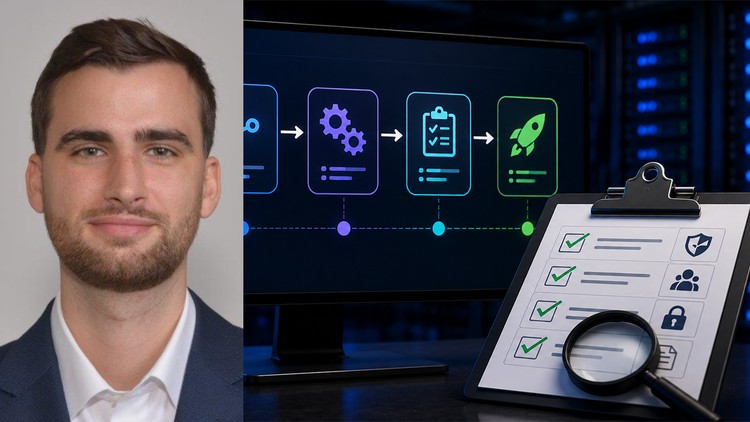
Master IT Auditing: ITGC, Access Management, Change Management, IT Controls, SDLC, CI/CD, and Real-World Audit Reporting
What You Will Learn:
- Understand IT audit as a profession, including common career paths, auditor responsibilities, required skills, and what the role looks like in practice.
- Perform an IT audit from planning through reporting, including identifying risks, evaluating controls, conducting walkthroughs, testing, and reaching conclusion
- Apply a risk-based approach to technology audits by understanding processes, identifying what could go wrong, evaluating controls, and designing audit tests.
- Audit Access Management in Azure DevOps by evaluating privileged access across organizations, projects, repositories, branches, and CI/CD pipelines.
- Audit Change Management in Azure DevOps by evaluating code changes, approvals, testing, segregation of duties, and controls over production deployments.
- Evaluate datacenter operations and controls, including power and cooling resiliency, hardware repairs, logistics, and handling of data-bearing devices.
- Show more
Overview: Bridging the Gap Between Theory and The Audit Trail
Let’s be honest: most IT audit training feels like someone is reading a 500-page compliance manual directly into your soul. It’s dry, academic, and usually leaves you wondering how to actually do the job on a Monday morning. I picked up ‘IT Audit: From Fundamentals to Real-World Auditing’ with a healthy dose of skepticism, but I was pleasantly surprised. Instead of just droning on about COBIT frameworks, this course actually puts you in the driver’s seat of a risk-based approach.
What sets this apart from your standard certification prep is the focus on modern environments. We’re not just auditing physical file cabinets and server rooms from 1998. The course leans heavily into Azure DevOps, which is a breath of fresh air. It treats IT auditing as a craft rather than a checklist exercise. You start by understanding why we even bother with controls—looking at “what could go wrong” (WCGW)—and then transition into the nitty-gritty of hands-on labs that simulate a real audit cycle. It’s about building a narrative for your audit, from the initial walkthrough to the final reporting phase, which is where most beginners usually trip up.
Prerequisites: Who Should Sign Up?
You don’t need to be a coding wizard or a seasoned CISSP to get value out of this. It’s designed to take you from beginner to advanced, but having a baseline comfort level with how computers work is a must. If you know what a server is and you’ve heard the term “cloud” once or twice, you’re ready. It’s particularly potent for those already studying for their CISA (Certified Information Systems Auditor) or someone looking to pivot from a general accounting or IT support background into a more lucrative career growth path in compliance and GRC (Governance, Risk, and Compliance).
Skills & Tools: The Auditor’s Toolkit
This isn’t just a “lecture and forget” setup. You’re going to be working with industry-standard tools and methodologies that are actually used by the Big Four and internal audit teams globally. You will dive deep into:
- Azure DevOps: Learning how to scrutinize CI/CD pipelines, branch protections, and repository access.
- ITGC (IT General Controls): Mastering the pillars of logical access, change management, and technical operations.
- Risk Assessment: Developing the “auditor’s eye” to identify vulnerabilities in SDLC (Software Development Life Cycle) processes.
- Evidence Gathering: Knowing exactly what to ask for during a walkthrough so you don’t get ghosted by the engineering team.
- Data Center Operations: Evaluating the “bricks and mortar” of IT, from power resiliency to how data-bearing devices are shredded.
Career Benefits & Job Roles
In the current market, job-ready skills in IT audit are essentially recession-proof. Companies are terrified of data breaches and regulatory fines, which means they are hiring auditors at a record clip. Completing this course positions you for several high-paying roles, including:
- IT Auditor / Senior IT Auditor: The standard path, focusing on internal or external audits.
- Compliance Manager: Ensuring the organization stays on the right side of SOC2, ISO 27001, or SOX requirements.
- Internal Controls Analyst: Working within a company to keep their IT controls tight before the external auditors even show up.
- GRC Consultant: A high-billable-hour role helping various clients build out their audit frameworks.
The Pros: Why This Course Hits the Mark
- Modern Tech Stack: Most courses ignore CI/CD and DevOps. This one embraces them. Auditing code changes and automated deployments is the future, and this course gets that right.
- Real-World Projects: The transition from “theory” to “practice” is seamless. You aren’t just learning what an audit is; you are performing one. The real-world audit reporting section is gold for anyone who struggles with professional writing.
- Practical Risk Mapping: It teaches you how to map risks to controls. This is the “secret sauce” of being a good auditor, and the course explains it in a way that actually clicks.
The Cons: A Small Reality Check
If I have one gripe, it’s that the course is very Azure DevOps centric when it comes to the technical deep-dives. While the principles of auditing Access Management and Change Management are universal, if your specific workplace uses Jira, GitLab, or AWS-native tools, you’ll have to do a little bit of mental translation to apply the specific steps to those environments. I’d love to see a “competitor” module added in the future to round that out.
Overall, if you’re looking to stop being a “check-the-box” auditor and start being a high-value technology advisor, this is a solid investment in your career growth.