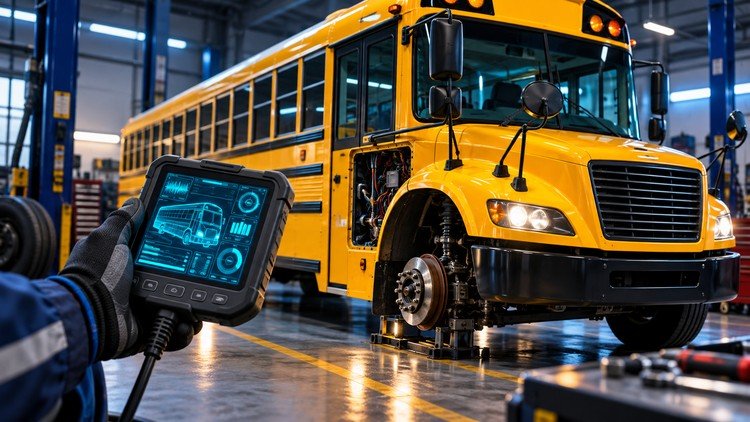
6 timed practice tests, 350 questions, and detailed explanations aligned to the ASE School Bus Study Guide 2026.
What You Will Learn:
- Practice timed, exam-length simulations for ASE School Bus S1 through S6.
- Identify weak diagnostic areas through section-specific test results and explanations.
- Apply multiple-choice diagnostic reasoning to school bus service and repair scenarios.
- Review major S1–S6 systems, including brakes, electrical systems, diesel engines, and steering.
- Build pacing habits for the published ASE School Bus test time limits.
The Reality of the “Yellow Bus” Grind: Why This Prep Matters
If you’ve spent any time in a fleet shop, you know that school bus technicians are a different breed. We aren’t just swapping parts on a commuter car; we’re responsible for the most precious cargo on the road. I’ve seen plenty of talented “parts changers” walk into the testing center thinking they’ll breeze through the S-series because they’ve done a few brake jobs, only to get humbled by the specific safety regulations and intricate electrical layouts unique to these rigs. The ASE School Bus S1–S6 Practice Tests course is essentially a reality check for anyone serious about career growth in the heavy-duty sector.
What I appreciate about this specific 350-question set is that it doesn’t just throw random trivia at you. It mirrors the 2026 certification prep standards, which are increasingly focusing on diesel diagnostics and complex multiplexing systems. If you’ve ever stared at a schematic for a bus’s flashing light system or a wheelchair lift and felt your brain melt, you know why simulated practice is a life-saver. This isn’t just about memorizing answers; it’s about training your brain to think like an ASE examiner, which—let’s be honest—is a skill in itself.
Prerequisites: Who Should Be Turning These Virtual Wrenches?
Don’t expect to jump into these 350 questions if you’ve never touched a torque wrench or seen a diesel particulate filter in person. While the course is marketed from beginner to advanced, I’d argue it’s most effective if you have at least a year of hands-on labs or shop experience under your belt. To get the most out of this, you should have:
- A foundational understanding of heavy-duty vehicle systems (Class 5-8).
- Basic familiarity with industry-standard tools like digital multimeters and scan tools.
- The patience to read long-winded scenarios—ASE loves to bury the real problem in a paragraph of “fluff” data.
- A goal of reaching ASE Master School Bus Technician status.
The Toolkit: Skills You’ll Sharpen
This isn’t just a “test prep” course; it’s a mental gym for job-ready skills. You’re forced to apply multiple-choice diagnostic reasoning to scenarios that actually happen in the bay. You’ll be diving deep into:
- S1 & S2 (Body & Brakes): Mastering the nuances of air brake timing and the structural integrity of the passenger cage.
- S3 & S4 (Drivetrain & Chassis): Understanding the “why” behind steering geometry and Allison transmission shift patterns.
- S5 & S6 (Suspension & Electrical): This is where the money is made. You’ll refine your advanced diagnostics for electrical ghosts and air suspension leveling valves.
- Pacing and Strategy: Learning how to manage your time so you don’t panic when you’re 40 questions deep and the clock is ticking down.
Career Benefits & Real-World Job Roles
Let’s talk brass tacks: certifications equal leverage. In the world of fleet maintenance, an ASE patch on your sleeve is a signal to management that you’re worth the higher hourly rate. Completing this course and passing the S1–S6 exams opens doors to high-level roles such as Lead Fleet Mechanic, Shop Foreman, or even a Service Manager for major school districts or private contractors like First Student.
Beyond the paycheck, it’s about career growth. The industry is moving toward “green” fleets and high-tech safety sensors. By mastering the 2026 standards now, you’re positioning yourself as a tech who can handle real-world projects involving modern telematics and integrated safety systems. It moves you from the guy who just does oil changes to the specialist the shop calls when the “check engine” light is baffling everyone else.
Pros: Why This Course Hits the Mark
- The “Why” Factor: The detailed explanations don’t just tell you that “C” is the right answer; they explain why “A” and “B” are traps. This builds diagnostic reasoning that you can actually use at the bench.
- Timed Simulations: Most techs fail because they overthink. These 6 timed tests build the “test stamina” needed to keep your cool during the actual certification prep.
- Current Content: Aligning with the 2026 Study Guide means you aren’t wasting time on obsolete tech. It focuses on what’s actually on the road today.
Cons: An Honest Critique
The only real downside is that this is a purely digital experience. While it’s fantastic for the written exam, it can’t replace hands-on labs. If you’re a 100% visual/tactile learner, you might find yourself wishing for more video demonstrations of the repairs described in the questions. You’ll still need to get your hands dirty in the shop to fully bridge the gap between theory and job-ready skills.