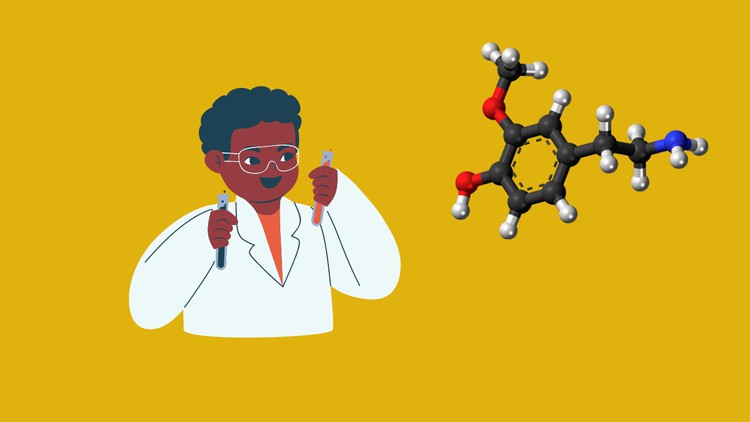
Chemistry with fun
What you will learn
basics of organic chemistry
Amines and its properties
Ammonia and its reactions
Nitrogeneous compounds and reactions
Logic of organic chemistry
Description
Welcome to the world of Organic Chemistry. In this course series we’re gonna explore the world of amines.
In this Organic Chemistry lessons centric to Amines we are going to focus upon the basics and trying to be as much interactive as possible.
I believe you love the subject when you be with the subject and if you give some time and patience it will surly take off your learning spark.
From the use in fertilizers to Pharmacuticals amines are an important part of our everyday life. Learning the fundamentals of amine gives a variety of experience and knowledge that makes you suddenly aware from whats visible but you might overlooked it., but you cant do so if it comes in your knowledge even unintentionally it gets to you.
If you wanna start Organic Chemistry and wanna explore., This might be your best point to start with. In this course we will learn Properties, reactions, people and much much more about how and why the reaction happen the way they happen.
Moreover the course is centric to amines but this knowledge of understanding WHY’s & HOW’s ?? Of your Organic will be answered and its logic can be related for other advanced concepts of Organic Chemistry!
I hope by this course you will feel a good sense of Chemistry & that too with pure scratch level to a significant understanding. You will feel a little up after finishing this short course..
Hope you enjoy it..
Happy learning!!
Content
Introduction
Name reactions
Interesting reactions of Amines
Overview
Let’s be honest: most organic chemistry courses feel like someone dropped a 1,000-page dictionary on your head and told you to memorize it by Tuesday. But “Introduction with Amines” takes a refreshingly different approach. Having spent years in the tech sector, I’ve learned to spot the difference between “rote memorization” and “algorithmic logic.” This course treats the logic of organic chemistry less like a history lesson and more like a coding syntax. Instead of just showing you a bunch of nitrogen-based molecules, the instructor focuses on the “why” behind electron movement. It’s about understanding the underlying architecture of nitrogeneous compounds and reactions so you can predict outcomes rather than just guessing them.
The “Chemistry with fun” tag isn’t just marketing fluff here. The course manages to bridge the gap between dry academic theory and the kind of job-ready skills needed in modern pharmaceutical and materials science labs. It treats the study of Ammonia and its reactions as a foundational “API call” for more complex synthesis. By the time you get into the Name reactions of Amines, you aren’t just memorizing names like Gabriel or Hoffmann; you’re understanding the modular design of these reactions. It’s an “under-the-hood” look at how we build everything from nylon to life-saving medications, making it a solid choice for anyone looking for serious certification prep or a career pivot into bio-tech.
Prerequisites
- Foundational General Chemistry: You should understand basic atomic structure, electronegativity, and how covalent bonds work. If you don’t know what a valence electron is, you’re going to have a hard time.
- Introductory Organic Concepts: Familiarity with hydrocarbons (alkanes, alkenes) and basic functional groups will help you hit the ground running.
- Analytical Mindset: A willingness to look at molecules as 3D puzzles rather than 2D drawings is essential for grasping beginner to advanced stereochemistry.
- Basic Math: Nothing crazy, but comfort with stoichiometry is always a plus for real-world projects in the lab.
Skills & Tools
- IUPAC Naming Mastery: You’ll move beyond the basics to master complex IUPAC Naming for branched amines and polyfunctional compounds, treat it like learning a standardized documentation protocol.
- Molecular Modeling: While the course is theoretical, it encourages the use of industry-standard tools like ChemDraw or molecular visualization software to map out reaction mechanisms.
- Structural Analysis: Learning to identify Amines and its properties—such as basicity and nucleophilicity—is a core skill that translates directly to analytical chemistry roles.
- Synthesis Planning: You’ll develop the ability to perform retrosynthetic analysis, a key component of hands-on labs where you start with a target molecule and work backward.
Career Benefits & Job Roles
Completing a course like this isn’t just about passing an exam; it’s about building a foundation for career growth in high-stakes industries. If you’re eyeing a role as a Medicinal Chemist or a Process Engineer, understanding nitrogen chemistry is non-negotiable. The pharmaceutical industry is built on amines—most of the top-selling drugs contain at least one nitrogen atom.
Beyond pharma, these skills are vital for Chemical Technicians and Forensic Scientists who need to identify substances based on their reactive properties. For those in the tech-adjacent space, such as Bioinformatics, knowing the “wet-ware” logic of how these compounds interact allows you to build better predictive models. It’s a versatile toolkit that makes you a much more attractive candidate for real-world projects in environmental science, where nitrogen runoff and ammonia treatment are massive global challenges.
Pros
- Logical Framework: The course avoids the “memorize this” trap by focusing on the Logic of organic chemistry, making it easier to retain information long-term.
- Engaging Delivery: The “Chemistry with fun” aspect actually works. The instructor uses analogies that stick, which is a lifesaver when you’re tackling the 10th name reaction of the day.
- Industry Relevance: The curriculum doesn’t live in a vacuum; it constantly references how these reactions are used in industry-standard tools and commercial manufacturing.
- Scalable Difficulty: It transitions smoothly from beginner to advanced topics, ensuring you don’t feel overwhelmed in the first module but still feel challenged by the end.
Cons
- Intensity of Reaction Mechanisms: The section on Nitrogeneous compounds and reactions can feel like a firehose of information. If you aren’t disciplined with your hands-on labs or practice problems, it’s easy to get lost in the mechanism diagrams. I would have liked more interactive virtual simulations to help visualize the electron flow in real-time.