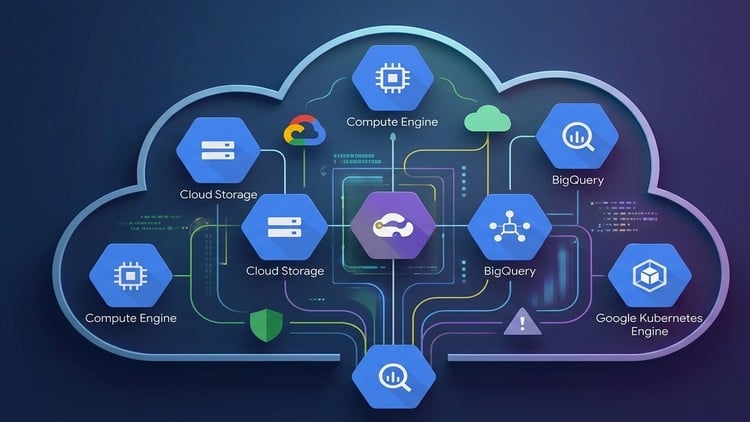
Realistic exam-level practice tests with detailed explanations for Google Cloud PCA 2026 prep.
What You Will Learn:
- Confidently answer PCA-style questions on GCP org design, IAM, networking, storage, and compute—aligned to the official exam domains.
- Choose the right GCP services for real-world scenarios, balancing cost, reliability, security, performance, and operations.
- Design secure, scalable architectures using VPCs, hybrid connectivity, IAM, KMS, and logging/monitoring best practices.
- Practice with timed mock tests and detailed explanations to identify weak areas and improve exam-taking strategy.
An Unfiltered Look at the Google Cloud Architect Practice Tests 2026
Let’s be honest for a second: the Google Professional Cloud Architect (PCA) exam is widely considered one of the toughest nuts to crack in the cloud ecosystem. Unlike other certifications that just ask you to identify a service icon, the PCA demands you think like a CTO on a budget. I’ve gone through my fair share of study materials, and most fall into the trap of being either too easy or outdated. The Google Cloud Architect Practice Tests 2026, however, feels like a breath of fresh air for anyone serious about certification prep.
What sets this specific set of tests apart isn’t just the questions—it’s the “why” behind the answers. In the world of industry-standard tools, knowing that Cloud Spanner is a relational database is “junior” knowledge. Knowing when to choose Spanner over Bigtable to maintain global consistency while managing career growth-defining budgets is where the real architecting happens. These tests push you into those uncomfortable gray areas where there are two “correct” answers, but only one “best” answer according to Google’s high-level design principles.
The 2026 edition reflects the shifting landscape of GCP, moving away from simple VM lift-and-shifts toward sophisticated real-world projects involving serverless architectures and high-level security integrations. If you are looking for a “shortcut,” this isn’t it. If you are looking to build job-ready skills that will actually serve you during a technical interview at a top-tier tech firm, this is the sandbox you want to play in.
Prerequisites for Success
While this course is a powerhouse for certification prep, it’s not a “zero-to-hero” tutorial. You shouldn’t jump into these mock exams on day one of your cloud journey. To get the most out of these tests, you should ideally have:
- A baseline understanding of cloud computing (the beginner to advanced transition happens fast here).
- Previous experience with hands-on labs via Qwiklabs or the GCP Free Tier.
- Familiarity with the official Google Cloud documentation—at least the high-level summaries of the core compute, storage, and networking products.
- A basic grasp of CLI tools and how the Google Cloud Console is organized.
Mastering the Skills & Tools
These practice tests act as a diagnostic tool for your technical repertoire. By the time you finish the final mock exam, you will have sharpened your skills in:
- VPC Design: Mastering Shared VPCs, VPC Peering, and hybrid connectivity options like Dedicated Interconnect.
- Identity & Access Management (IAM): Moving beyond basic roles to understand the principle of least privilege in a multi-org environment.
- Data Orchestration: Deciding between BigQuery, Cloud SQL, and Firestore based on performance and reliability metrics.
- Operations: Utilizing logging/monitoring (Cloud Trace, Cloud Debugger) to troubleshoot distributed systems.
- KMS & Security: Implementing industry-standard tools for encryption at rest and in transit.
Career Benefits & Job Roles
Earning the PCA badge isn’t just about putting a logo on your LinkedIn; it’s about a massive leap in career growth. This certification is consistently ranked as one of the highest-paying in the tech industry. By mastering the scenarios in these tests, you’re preparing for roles such as:
- Cloud Solutions Architect: Designing complex, secure, scalable architectures for enterprise clients.
- Site Reliability Engineer (SRE): Ensuring high availability and performance for mission-critical apps.
- Cloud Security Engineer: Implementing IAM and KMS best practices to protect sensitive data.
- DevOps Lead: Managing CI/CD pipelines and containerized workloads using GKE.
The Pros: Why This Works
- Ruthlessly Realistic: The question format mirrors the actual exam’s “long-form scenario” style, which tests your stamina as much as your knowledge.
- The Explanation Engine: Each answer comes with a deep-dive explanation that links back to official documentation. This is where the real learning happens.
- Up-to-Date for 2026: It covers the latest iterations of GCP services, including newer AI/ML integrations and evolved networking protocols that older courses miss.
- Cost-Efficiency Mindset: It trains you to think about the “bill” as much as the “build,” which is a vital job-ready skill.
The Cons: One Honest Critique
- The Difficulty Spike: Let’s be real—these tests are incredibly demanding. If you haven’t done the hands-on labs or read the whitepapers, your initial scores will be bruising. It can be discouraging for those expecting a more linear beginner to advanced learning curve without supplemental study.