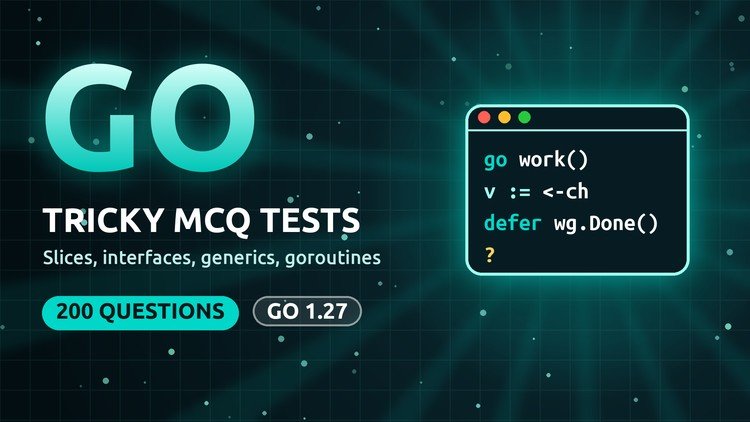
200 tricky Go (Golang) questions on slices, maps, interfaces, generics and goroutines, each verified with Go 1.27
What You Will Learn:
- Predict the output of tricky Go programs involving slices, maps, closures, defer and goroutines.
- Explain slice aliasing, append growth and full slice expressions, and avoid the bugs they cause.
- Use interfaces, method sets and type assertions correctly, including the nil interface trap.
- Wrap errors with %w and inspect them with the errors package (Is, As, AsType), and use panic and recover safely.
- Reason about channels, select, deadlocks, data races, sync primitives and context cancellation.
- Recognise what changed in modern Go: loop variables, range over functions, generics and new(expr).
Overview: Hard-Won Lessons in a Multiple-Choice Format
Let’s be real: Go is often marketed as the “simple” language. But any engineer who has spent six hours debugging a nil interface that wasn’t actually nil or a goroutine leak knows that “simple” is a double-edged sword. I recently sat through the ‘Go Programming Mastery: Tricky MCQ Practice Tests’, and it’s not your typical certification prep fluff. This course is essentially a concentrated dose of the mistakes I’ve seen (and made) in production over the last decade.
Instead of just asking you to identify a `for` loop, these tests force you to act as a human compiler. The questions focus heavily on the “implementation details” that the Go spec usually leaves for you to discover the hard way. It’s one thing to read about how slices work; it’s another thing entirely to predict the output of three nested `append()` calls when the underlying array is shared. The course is built for the modern Go era—specifically referencing Go 1.27 (which hints at a very forward-looking or cutting-edge curriculum)—and it doesn’t shy away from the complex stuff like generics and the recently fixed loop variable semantics.
This isn’t a course where you watch a video and nod along. It’s a series of mental hands-on labs that challenge your assumptions about memory management and concurrency. If you’re looking for a way to sharpen your technical edge before a big interview or a promotion cycle, this is a solid investment in your career growth.
Prerequisites
This is not a “What is a variable?” type of course. To get any value out of this, you need to be past the beginner to advanced transition phase. I’d recommend:
- A solid grasp of basic Go syntax and the standard library.
- Experience building real-world projects where you’ve actually used channels and interfaces.
- Familiarity with the command line and industry-standard tools like the Go CLI and `go vet`.
- A high tolerance for being wrong—these questions are designed to trick you!
Skills & Tools Covered
The course covers a surprisingly broad range of technical debt-preventing skills. You’ll spend a lot of time on slice aliasing and the nuances of full slice expressions (that `a[low:high:max]` syntax that everyone ignores until they have a bug). There’s a heavy emphasis on error handling using the modern `errors.Is` and `errors.As` patterns, which is vital for building job-ready skills in modern backend engineering.
On the concurrency side, it dives into sync primitives, context cancellation, and the terrifying world of data races. You’ll also get a look at modern Go features like range over functions and how generics change the way we design interfaces and method sets. It’s basically a guided tour through the trickiest parts of the Go documentation.
Career Benefits & Job Roles
In today’s market, “I know Go” isn’t enough. Hiring managers for Senior Software Engineer or Site Reliability Engineer (SRE) roles are looking for people who can prevent outages. This course helps you build the “spidey-sense” needed to spot a deadlock during a code review before it ever hits the main branch.
If you are going through certification prep or prepping for a “Live Coding” round at a Tier-1 tech company, these MCQs are gold. They mimic the pressure of a technical screening while reinforcing the industry-standard tools and practices that distinguish a junior from a senior dev. It’s a direct path to showing you have job-ready skills for high-scale distributed systems.
Pros
- Viciously Realistic: The “Tricky” in the title isn’t clickbait. These questions target the exact nil pointer and slice growth bugs that cause 3:00 AM PagerDuty alerts.
- Modern Relevance: It covers the latest iterations of the language, ensuring you aren’t learning outdated 1.10 patterns. Seeing generics and loop variable fixes included is a huge plus for staying current.
- Deep Explanations: Each MCQ isn’t just an answer key; it’s a mini-lesson. The explanations for interface method sets and panic/recover flows are better than most textbooks.
Cons
- High Barrier to Entry: If you don’t already have some experience with hands-on labs or building small apps, this course will feel like hitting a brick wall. It’s opinionated and assumes you’re here to master the language, not learn it from scratch.