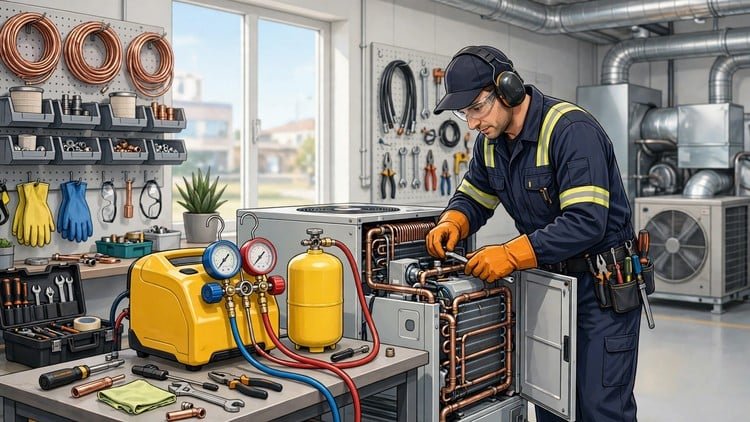
Prepare For EPA 608 Technician Certification exam with 566 Practice Questions for Core, Type I, Type II and Type III
What You Will Learn:
- Explain ozone depletion, the Clean Air Act and the Montreal Protocol rules for refrigerant handling.
- Compare refrigerant classes, blends, glide and lubricants, and apply cylinder safety and fill rules.
- Perform recovery, recycling and reclaiming to required levels and handle disposal correctly.
- Detect leaks safely, evacuate and dehydrate systems, and apply major repair rules.
- Service high-pressure and low-pressure appliances, including purge units and relief devices.
- Service small appliances safely, including recovery levels, valves and flammable refrigerants.
Overview: Cutting Through the Noise to Get Your Card
Listen, if you’ve spent five minutes on a job site, you know that the EPA 608 certification is the golden ticket. You can’t legally hook up a manifold gauge set to a system containing regulated refrigerant without that card in your wallet. I’ve seen plenty of “green” techs walk onto a site with all the fancy industry-standard tools but zero clue on the regulations, and they get sidelined immediately. That’s where the “EPA 608 Technician Certification Practice Tests 2026” comes into play. It isn’t some dry, dusty textbook reading; it’s a high-octane certification prep tool designed to get you past the finish line.
What sets this specific 2026 iteration apart is how it tackles the shifting landscape of our industry. We aren’t just talking about R-22 and R-410A anymore. The industry is moving toward A2L mildly flammable refrigerants, and the 566 questions in this bank reflect that reality. This course isn’t just about memorizing dates like the 1987 Montreal Protocol; it’s about understanding the “why” behind the “what.” It pushes you from beginner to advanced levels of comprehension by forcing you to differentiate between zeotropic blends and near-azeotropes, and how that affects your charging and recovery processes. It’s a deep dive into the technical weeds that actually matter when you’re standing in front of a chiller or a reach-in freezer.
Prerequisites
You don’t need to be a master mechanic to start this course, but you do need a bit of grit. While the course is open to anyone looking for career growth, it’s best suited for those who have at least a basic understanding of the refrigeration cycle. If you know the difference between a compressor and a condenser, you’re ready. Ideally, you should be enrolled in a trade school or currently working as a helper to get the most out of these hands-on labs and theoretical simulations. There are no formal legal requirements to take the practice tests, but your goal should be the actual proctored exam.
Skills & Tools of the Trade
To really crush this course and the subsequent exam, you need to think like a tech. While this is a digital practice suite, it prepares you to handle industry-standard tools with confidence. You’ll learn the mental framework for using:
- Manifold Gauge Sets: Understanding pressure-temperature (PT) charts and how to account for bubble and dew points.
- Recovery Units and Tanks: Mastering the 80% fill rule and how to perform a liquid vs. vapor recovery.
- Vacuum Pumps and Micron Gauges: Learning why 500 microns is the magic number for a dehydrated system.
- Electronic Leak Detectors: Knowing where and how to sniff for leaks without blowing through your sensors.
- Charging Scales: Precision is everything when dealing with small-appliance real-world projects where ounces matter.
Career Benefits & Job Roles
Let’s talk brass tacks: money and career growth. Without a 608 Universal certification, you’re stuck as a helper or an apprentice making entry-level wages. Once you pass that exam using these practice tests, the doors swing wide open. You become job-ready for roles such as:
- Residential HVAC Technician: Handling Type I and Type II systems in homes.
- Commercial Refrigeration Mechanic: Working on huge supermarket racks and walk-ins.
- Chiller Technician: Specializing in Type III low-pressure industrial systems.
- Facilities Maintenance Manager: Overseeing large complexes where EPA compliance is a massive legal hurdle.
- Independent Contractor: You can’t even buy refrigerant at the supply house without that 608 card, so this is your path to business ownership.
Pros: Why This Course Hits the Mark
- Massive Question Volume: With 566 questions, it’s nearly impossible to find a scenario on the actual exam that you haven’t already seen here. It covers Core, Type I, II, and III with brutal efficiency.
- Focus on New Tech: It actually addresses the 2026 standards, meaning you aren’t studying outdated info. It includes the latest on flammable refrigerants and the newest recovery vacuum requirements.
- Mental Conditioning: The way the questions are phrased mimics the “trick” questions the EPA loves to use. It trains your brain to look for the nuances in the Clean Air Act wording so you don’t get tripped up by “except” or “always” qualifiers.
- Practical Application: It doesn’t just give you the answer; it helps you build job-ready skills by explaining the logic, which helps when you’re actually out in the field doing real-world projects.
Cons: The Honest Truth
- Lack of Physical Interaction: The biggest downside is that it’s a digital practice suite. No matter how many questions you answer correctly about “triple evacuation,” it can’t replace the physical sensation of hauling a 50lb recovery tank up a ladder. You still need to supplement this with hands-on labs to truly master the craft.