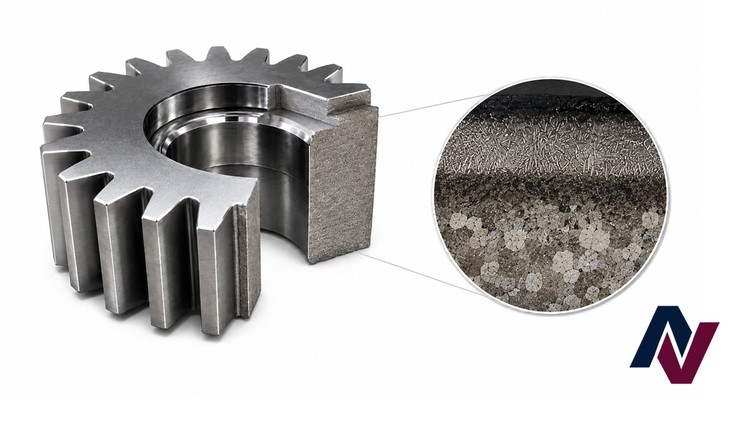
Understand metallic microstructures and apply metallography to material evaluation and engineering decisions
What You Will Learn:
- Identify grains, phases, constituents, inclusions, interfaces, defects, and other important metallographic features.
- Identify grains, phases, constituents, inclusions, interfaces, defects, and other important metallographic features.
- Select suitable sampling, sectioning, mounting, grinding, polishing, etching, and examination methods for a given objective.
- Recognize preparation artifacts and distinguish them from genuine microstructural features, defects, and service damage.
- Interpret macrographs, optical micrographs, SEM images, EDS results, EBSD data, and field metallographic evidence.
- Apply quantitative methods to measure grain size, phase fraction, inclusions, particles, porosity, layers, and microhardness.
- Show more
Overview: Beyond the Microscope Lens
I’ve spent the better part of a decade working in failure analysis and quality assurance, and if there’s one thing I’ve learned, it’s that a shiny piece of metal tells a lie until you look at its “bones.” Most people think metallography is just about taking pretty pictures of colorful grains, but it’s actually the forensic science of the engineering world. The Fundamentals of Metallography course isn’t just another dry academic exercise; it’s a deep dive into the “why” behind material behavior.
What I appreciated most about this curriculum was how it shifted my perspective from seeing a component as a solid block to seeing it as a living map of its thermal and mechanical history. This course isn’t about rote memorization. It’s about developing a “trained eye.” You learn that a specific etching contrast isn’t just a smudge—it’s the difference between a successful heat treatment and a catastrophic field failure. It bridges the gap between high-level materials science theory and the hands-on labs where the real engineering decisions are made. If you’ve ever looked at a fracture surface and felt like you were reading a foreign language, this course is your Rosetta Stone. It prepares you for real-world projects where millions of dollars—or human lives—depend on your ability to tell a genuine microstructural defect from a poorly polished artifact.
Prerequisites: What You Actually Need
While the course is marketed as a “fundamentals” track, don’t walk in expecting a total cake-walk. To really get your money’s worth, you should have a baseline understanding of:
- High School Physics and Chemistry: You need to understand basic phase changes and how chemical reactions (etchants) interact with surfaces.
- Basic Algebra: Quantitative metallography involves some math, especially when calculating grain sizes or phase volume fractions.
- Mechanical Aptitude: Since this is a hands-on labs intensive field, being comfortable with machinery (grinders, polishers, and mounting presses) is a huge plus.
- Patience: This is the unwritten prerequisite. Metallography is an art form as much as a science; if you rush the polishing stage, your results will be garbage.
Skills & Tools: The Professional Toolkit
This course moves you quickly from “beginner to advanced” by introducing industry-standard tools that you will encounter in any Tier-1 aerospace or automotive lab. You won’t just be looking through a standard optical microscope. You’ll be diving into:
- Sample Preparation Equipment: Mastering the delicate balance of sectioning, mounting (hot vs. cold), and the progressive grit-sequence of grinding.
- Etching Techniques: Learning which chemical reagents reveal specific phases like martensite, pearlite, or delta ferrite.
- Advanced Characterization: Getting comfortable with SEM (Scanning Electron Microscopy), EDS (Energy Dispersive Spectroscopy) for elemental mapping, and EBSD for crystallographic orientation.
- Quantitative Analysis Software: Using digital tools to ensure your measurements meet ASTM standards (like E112 for grain size).
- Hardness Testing: Integrating Vickers and Knoop microhardness testing to validate what you see under the lens.
Career Benefits & Job Roles: The ROI
Let’s talk about career growth. In today’s market, everyone can use CAD, but very few people can accurately interpret a microstructure. Completing this course serves as excellent certification prep for those looking to move into specialized roles. Whether you are aiming for a position in Quality Control (QC), R&D, or Forensic Engineering, these are job-ready skills that command a premium salary.
Common job roles that benefit directly from this training include:
- Metallurgist / Materials Engineer: The bread and butter of the profession.
- Failure Analysis Technician: Solving the “why” behind broken parts in the aerospace or oil and gas sectors.
- Quality Assurance Manager: Overseeing production lines and ensuring heat treats meet strict specifications.
- Welding Inspector: Analyzing Heat Affected Zones (HAZ) to ensure structural integrity.
Pros: Why It’s Worth the Investment
- Critical Thinking over Memorization: The course emphasizes distinguishing between genuine features and preparation artifacts (like scratches or “pull-outs”), which is the hallmark of a true professional.
- Comprehensive Modality: It covers everything from the “old school” manual polishing to high-tech SEM/EDS data interpretation, making you versatile in any lab environment.
- Immediate Application: You can take the knowledge learned on Friday and apply it to a real-world project on Monday morning. It’s that practical.
Cons: The Honest Truth
- The “Art” Learning Curve: The course can be frustrating for those who want instant results. No amount of video lecturing can replace the “feel” of a polishing wheel. You will likely mess up several samples before you get a “publication-quality” mount, and the course can’t fully automate that trial-and-error process.