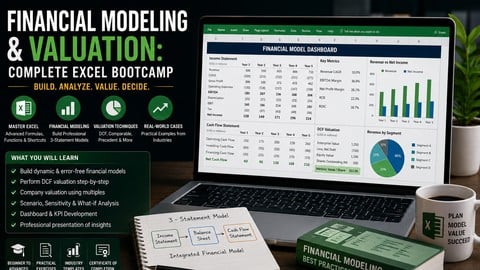
Master corporate finance, build dynamic 3-statement financial models, and value companies from scratch using Excel.
What You Will Learn:
- Build a fully integrated, dynamic 3-statement financial model from scratch using professional Excel techniques.
- Forecast future corporate revenues, operating expenses, and complex debt schedules based on historical data.
- Perform a complete Discounted Cash Flow (DCF) analysis to determine the true intrinsic value of a business.
- Calculate critical corporate finance metrics, including WACC, Free Cash Flow, and Terminal Value.
Learning Tracks: English
Note➛ Make sure your 𝐔𝐝𝐞𝐦𝐲 cart has only this course you're going to enroll it now, Remove all other courses from the 𝐔𝐝𝐞𝐦𝐲 cart before Enrolling!
Add-On Information:
- Course Overview
- This comprehensive bootcamp is meticulously designed to immerse you in the foundational and advanced practices of financial modeling and corporate valuation, transforming complex financial data into clear, actionable insights.
- Move beyond theoretical concepts to a highly practical, step-by-step methodology for constructing robust financial models that stand up to real-world scrutiny.
- Unravel the intricate relationship between a company’s past performance, its operational drivers, and its future financial trajectory, all within the dynamic environment of Microsoft Excel.
- Gain a holistic understanding of how businesses are financially structured, operate, and how their intrinsic value is derived, crucial for investment decisions, corporate strategy, and M&A activities.
- Position yourself at the forefront of financial analysis by mastering the art of converting raw financial statements into powerful predictive tools and strategic decision-making frameworks.
- Explore the essential role of sensitivity and scenario analysis in financial modeling, enabling you to stress-test assumptions and understand potential outcomes under varying market conditions.
- Learn to interpret and present complex financial findings effectively, providing clear justifications for valuation conclusions and strategic recommendations to stakeholders.
- Requirements / Prerequisites
- Basic Familiarity with Microsoft Excel: You should be comfortable navigating spreadsheets, entering data, and using basic formulas (e.g., SUM, AVERAGE). No advanced Excel knowledge is required, as professional techniques will be taught from the ground up.
- Fundamental Understanding of Accounting: A general awareness of core financial statements (Income Statement, Balance Sheet, Cash Flow Statement) and basic accounting principles is beneficial, though not strictly mandatory, as key concepts will be revisited.
- Keen Interest in Finance & Business Analysis: A genuine curiosity about how businesses operate, are financed, and how their value is assessed will significantly enhance your learning experience.
- Access to Microsoft Excel Software: The course is built around hands-on application in Excel, so having a working version of Excel (preferably 2013 or newer) is essential for practical exercises.
- Commitment to Hands-on Learning: This bootcamp emphasizes active participation and building models yourself. Be prepared to roll up your sleeves and engage deeply with the material.
- Skills Covered / Tools Used
- Advanced Excel Functionality: Master sophisticated Excel functions and features including data validation, conditional formatting for error checking, named ranges for clarity, OFFSET, INDEX-MATCH (or XLOOKUP equivalents), SUMIFS, and various logical functions to build dynamic and flexible models.
- Best Practice Model Structuring: Develop a disciplined approach to model layout, input-output organization, linking methodologies, and creating clear audit trails for transparency and usability.
- Scenario & Sensitivity Analysis: Utilize Excel’s powerful tools like Data Tables and Scenario Manager to perform comprehensive what-if analysis, assessing the impact of changing key assumptions on financial outcomes and company valuation.
- Financial Statement Inter-linking & Balancing: Understand the intricate dependencies between the Income Statement, Balance Sheet, and Cash Flow Statement, ensuring your models are always integrated and perpetually balance.
- Debt Schedule & Amortization Modeling: Construct detailed debt and interest schedules, incorporating various debt instruments, repayment terms, and interest calculations critical for accurate cash flow forecasting.
- Equity Valuation Methodologies: Dive into various equity valuation techniques beyond DCF, such as comparable company analysis (Comps) and precedent transactions (Precedents), to triangulate and cross-check valuation results.
- Robust Error-Checking & Auditing: Implement systematic error-checking mechanisms and auditing techniques within your models to identify discrepancies, ensure accuracy, and build trust in your financial projections.
- Data Visualization & Presentation: Learn to effectively present complex financial data through charts, graphs, and summary dashboards within Excel, making your model outputs clear and persuasive.
- Benefits / Outcomes
- Accelerated Career Progression: Equip yourself with in-demand skills highly valued in investment banking, private equity, equity research, corporate finance, venture capital, and other analytical roles.
- Enhanced Investment Decision-Making: Develop the analytical prowess to critically evaluate investment opportunities, assess company performance, and make more informed decisions as an investor or financial analyst.
- Strategic Business Acumen: Gain a deeper understanding of the drivers of business value, enabling you to contribute more effectively to strategic planning, M&A due diligence, and capital allocation decisions.
- Build a Professional Portfolio: Conclude the course with a fully functional, professional-grade financial model that serves as a tangible asset, showcasing your practical skills to potential employers.
- Confidence in Financial Analysis: Speak and act with greater authority and precision in financial discussions, backed by a thorough understanding of financial modeling principles and valuation techniques.
- Quantitative Problem-Solving Skills: Sharpen your ability to break down complex business problems into manageable, quantifiable components, leveraging Excel as a powerful analytical tool.
- Industry-Standard Proficiency: Adopt best practices and industry-standard methodologies in financial modeling and valuation, ensuring your work meets the expectations of top-tier finance firms.
- Pros
- Highly Practical and Hands-On Learning: Focuses on building models from scratch, providing immediate application of concepts.
- Directly Applicable to Finance Careers: Develops core skills essential for a wide range of analytical roles in the financial industry.
- Comprehensive Coverage: Goes beyond just DCF to include a holistic approach to financial modeling and valuation.
- Builds a Tangible Asset: Students leave with a professional-grade financial model for their portfolio.
- Empowers Independent Analysis: Teaches the methodology to critically evaluate any business or investment opportunity.
- Enhances Excel Proficiency: Elevates your Excel skills specifically for financial applications, making you a more efficient user.
- Cons
- Significant Time and Effort Commitment: As a “bootcamp,” it demands dedication and consistent practice to truly master the concepts and build proficiency.