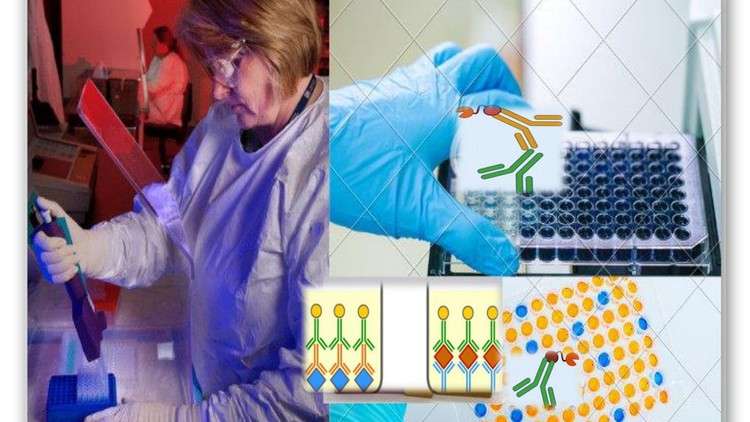
ELISA fundementals
What you will learn
Basic immunology
Monoclonal antibody
different types of antigens
different methods for antigen detection
common diagnostic techniques
enzyme immunoassay
mycotoxin and mycotoxicosis
food hormones residues
Description
Enzyme-linked immunosorbent Assay (ELISA)
ELISA from fundamentals of immune system and the history of the
analytical assay prior to the invention of ELISA to the materials of choice for
fabrication of the platforms, possible biomolecular interactions, different protocols,
and evaluation parameters among the rest. This book guides Readers through different steps of the analytical assay while familiarizing them with the possible
sources of error in the assay. The course offers detailed insights on the immobilization techniques used for protein attachment, different methods for evaluation
of the assay and calculation of the key important parameters in the analytical assay
such as sensitivity, specificity, accuracy, and limit of detection. Advantages and
shortages of the conventional ELISA as well as different attempts for improvement
of its performance are covered in this book. Merging and intergrading different
technologies with widely known ELISA have opened numerous windows of
opportunity to the advancement of this immunoassay. In that respect, the current
book provides the latest updates on integrated platforms such as ELISpot, plasmonic ELISA, sphere-/bead-based ELISAs, paper-/fiber-based ELISAs as well as
ELISA in micro-devices.
Fundamentals and History of ELISA
Evolution of the Immunoassays Until Invention of ELISA
Principles of the Immune System
Biomolecular Interactions Between Antibody and Antigen . . .
General Overviews on Applications of ELISA . . .
Step by Step with ELISA: Mechanism of Operation, Crucial
Elements, Different Protocols, and Insights on Immobilization
and Detection of Various Biomolecular Entities . . . . . . . . .
Evaluation of the Detection Results Obtained from ELISA . . .
.
Content
Introduction
immunoassay start up
Antibody production in human body
types of antibodies
ELISA Technique
ELISA applications
ELISA elements
conventional ELISA
Overview: Beyond the Pipette and the Plate
I’ve spent the better part of a decade navigating the intricacies of high-throughput labs, and if there is one thing I’ve learned, it’s that anyone can follow a protocol, but very few actually understand the enzyme immunoassay at a level where they can troubleshoot a failing assay in real-time. The ‘ELISA Mastery: From Lab Beginner to Diagnostic Expert’ course isn’t just another dry academic lecture; it’s a deep dive into the “why” behind the “how.” While most introductory courses treat ELISA as a simple “lock and key” mechanism, this curriculum pushes you to understand the kinetic interactions that define industry-standard tools.
What stood out to me immediately was the shift from pure immunology into the practical, somewhat gritty world of food safety and diagnostics. It’s one thing to detect a virus in a serum sample; it’s another thing entirely to navigate the matrix interference when testing for food hormones residues or identifying mycotoxin and mycotoxicosis in agricultural exports. This course bridges that gap. It takes you from a beginner to advanced mindset by treating the lab as a high-stakes environment where accuracy translates directly to public safety and bottom-line revenue. It’s about building job-ready skills that make you the go-to person when a plate comes back with high background noise or inconsistent replicates.
Prerequisites: Who Should Enroll?
You don’t need a PhD to get value out of this, but you shouldn’t go in completely blind. A basic understanding of general biology or chemistry—think high school senior or freshman undergrad level—is essential. If you know what a protein is and understand basic concentration units (ng/mL, pg/mL), you’re ready. This course is a perfect fit for certification prep for entry-level lab technicians or students looking to beef up their resumes with real-world projects that actually mirror what happens in a commercial diagnostic facility.
Skills & Tools: The Diagnostic Toolkit
The curriculum focuses heavily on the technical nuances that define a diagnostic expert. You aren’t just learning to pipette; you’re learning the logic behind different methods for antigen detection.
- Assay Design: Understanding how to select the right monoclonal antibody for high specificity versus polyclonal options for broader sensitivity.
- Data Analysis: Interpreting optical density (OD) values and building standard curves that actually hold up under regulatory scrutiny.
- Niche Diagnostics: Specialized focus on common diagnostic techniques for detecting different types of antigens, specifically in complex biological matrices.
- Environmental & Food Safety: Mastery over mycotoxin detection, which is a massive, high-growth sector in the current global supply chain.
Career Benefits & Job Roles: Why This Matters for Your Resume
In a competitive job market, “I know ELISA” is a commodity. “I can optimize an enzyme immunoassay for food-borne pathogens” is a career. This course is designed for career growth, specifically targeting roles that require a high degree of autonomy.
- Quality Control (QC) Analyst: Essential for pharmaceutical and food production lines where testing for food hormones residues is a legal requirement.
- Clinical Lab Technologist: Using hands-on labs experience to run diagnostic tests in hospital settings.
- Research Associate: Accelerating drug discovery by understanding the nuances of monoclonal antibody interactions.
- Food Safety Auditor: Specialized knowledge in mycotoxicosis makes you an invaluable asset to international regulatory bodies.
Pros: Why I Recommend This Course
- Contextual Learning: Unlike university courses that stay in the clouds, this course grounds basic immunology in actual diagnostic scenarios. You learn the theory so you can solve the practice.
- High-Demand Specialization: The inclusion of mycotoxin and mycotoxicosis and food hormones residues is a brilliant move. These are high-compliance areas where labs are constantly hiring.
- Job-Ready Focus: Everything is framed around job-ready skills. It feels less like a classroom and more like a high-end corporate training module designed to get you productive on Day 1.
- Comprehensive Scope: It covers the entire spectrum from the molecular behavior of a monoclonal antibody to the final interpretation of a diagnostic report.
Cons: The Honest Take
If I have one gripe, it’s the pace of the initial basic immunology section. For someone already working in a lab, it might feel a bit slow. I would have liked to see more “troubleshooting” simulation modules early on—specifically focusing on common errors like edge effects or pipetting drift—to really lean into that “expert” title. However, for a beginner, this thoroughness is probably a blessing rather than a curse.