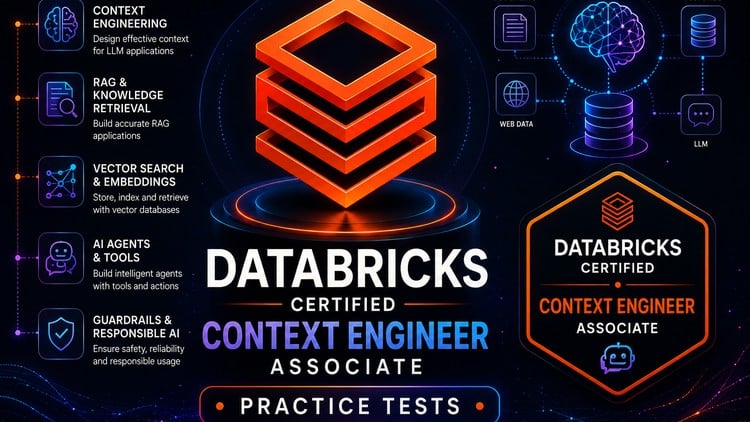
4 Full-Length Practice Tests | RAG, AI Search, MCP, Unity Catalog & AI Agent Systems
What You Will Learn:
- Assess readiness for the Databricks Certified Context Engineer Associate certification exam.
- Practice certification-style questions covering Context Engineering, AI Search, MCP, and AI Agent Systems.
- Identify knowledge gaps and strengthen weak areas through detailed answer explanations.
- Improve exam confidence, accuracy, and time management skills.
Mastering the Nuances of the Databricks Context Engineer Associate Exam
Let’s be real for a second: the AI landscape is shifting fast. A year ago, everyone was obsessed with just getting an LLM to respond. Today? It’s all about context. If your model doesn’t have the right data, at the right time, with the right permissions, it’s basically a high-tech magic 8-ball. That’s why the Databricks Context Engineer Associate certification has become such a hot ticket. I recently went through the ‘Databricks Context Engineer Associate Practice Tests’ to see if they actually deliver on the hype, and here’s my unfiltered take.
The first thing you notice about these 4 full-length practice tests is that they don’t just ask you to memorize definitions. In my experience, most certification prep materials fail because they are too academic. These tests, however, dive straight into the messy reality of AI Agent Systems and RAG (Retrieval-Augmented Generation). They force you to think like a practitioner who is actually sitting in the Databricks workspace trying to wire up a Vector Search index or manage Unity Catalog permissions. The questions feel “heavy”—in a good way—meaning they mirror the complexity of the actual exam scenarios where one wrong click in a configuration can break your entire pipeline.
Who Should Hit ‘Start’ on These Tests?
Before you jump in, let’s talk prerequisites. This isn’t a “Data Science 101” course. To get the most out of these practice exams, you should already have a baseline understanding of the Databricks ecosystem. If you haven’t touched hands-on labs involving Spark or basic Delta Lake operations, you’re going to struggle. You need a solid grasp of Python and a working knowledge of how LLMs consume data. It’s perfect for folks who have completed the initial documentation reading but need to bridge the gap between “I’ve read about it” and “I can build it.”
The Toolkit: Skills & Industry-Standard Tools
These tests lean heavily into the industry-standard tools that Databricks has been championing lately. We aren’t just talking about basic SQL here. You are being tested on your ability to implement AI Search, manage the Model Context Protocol (MCP), and leverage Unity Catalog for governance.
One of the highlights for me was how the tests cover the intersection of career growth and technical execution. For example, understanding how to optimize a RAG architecture isn’t just a test requirement; it’s one of those job-ready skills that makes you indispensable in a modern data team. You’ll find yourself answering questions on Vector Search optimization, tokenization strategies, and how to evaluate the performance of AI Agent Systems using Databricks’ native monitoring tools.
Career Benefits & Job Roles
Why bother with this cert? Because “Prompt Engineer” is a fading title, but “Context Engineer” is where the career growth is at. Passing this exam (with the help of these tests) signals to employers that you understand the “plumbing” of AI. It positions you perfectly for roles like AI Solutions Architect, Machine Learning Engineer, or Senior Data Engineer. Companies are desperate for people who can move a project from a notebook to a production-grade real-world project. Having this credential on your LinkedIn isn’t just about the badge; it’s about proving you can handle advanced context management in a secure, enterprise-grade environment.
The Pros: Why This Set Stands Out
- Realistic Difficulty Curve: The questions are designed to be slightly harder than the actual exam. This is a classic certification prep strategy that builds massive exam confidence. If you can pass these, the actual test feels like a breeze.
- Deep-Dive Explanations: This is where the real value lies. Each answer doesn’t just tell you “C is correct.” It explains *why* A, B, and D are wrong. This is crucial for strengthening weak areas and turning a practice test into a learning tool.
- Up-to-Date Content: It’s refreshing to see MCP and AI Agent Systems featured so prominently. A lot of materials out there are still stuck on basic LangChain wrappers, but these tests feel current with the 2024/2025 Databricks roadmap.
- Time Management Mastery: With four full-length tests, you can actually practice your pacing. Accuracy is great, but if you run out of time on the 60th question, you’re in trouble. These tests help you find your rhythm.
The Cons: An Honest Critique
If I have one gripe, it’s that there isn’t an integrated hands-on lab environment directly inside the testing platform. While the questions are excellent at simulating scenarios, you still need to have your own Databricks Community Edition or enterprise workspace open on the side to truly “feel” the configurations being discussed. It’s a minor hurdle, but for beginner-level students, it adds an extra layer of friction to the study process.
The bottom line? If you are serious about becoming a Databricks Certified Context Engineer Associate, don’t walk into that exam room having only read the docs. You need a stress test. These practice exams provide exactly that—a rigorous, technical, and honest assessment of whether you’re ready for the big leagues.