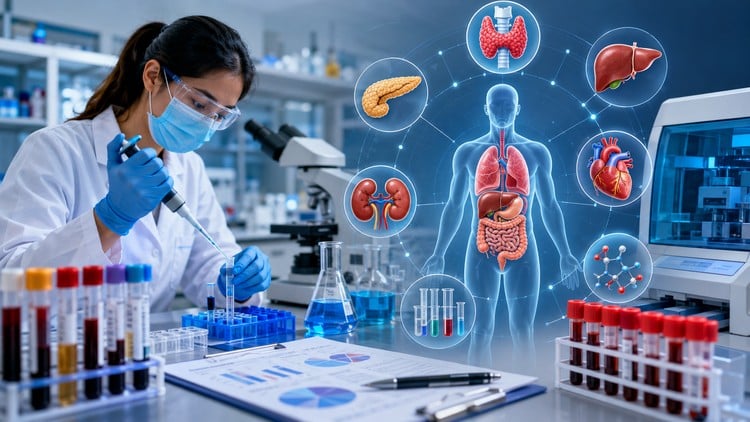
Master Laboratory Testing and Clinical Interpretation
What You Will Learn:
- Clinical Laboratory Statistics
- Preanalytical Variables & Specimen Integrity
- Myocardial Infarction & Heart Failure
- Renal Disease & Urinalysis
Alright, let’s talk about “Clinical Chemistry: From Bench to Bedside Part 1.” As someone who’s been navigating the clinical lab trenches for a good while now, I’m always on the lookout for courses that actually deliver on the promise of bridging that gap between theory and what we do day in and day out. This one caught my eye, and I’ve spent some time digging into it.
Overview
My initial impression? This course is a solid foundation builder, especially for anyone looking to get a firm grip on the core principles of clinical chemistry and how they directly impact patient care. It’s not just about memorizing analytes; it’s about understanding the *why* behind the numbers. The focus on clinical interpretation is where it really shines. They’ve managed to take what can be pretty dry statistical concepts and preanalytical nuances and weave them into a narrative that highlights their real-world significance. For instance, the section on clinical laboratory statistics isn’t just abstract math; it’s presented in a way that makes you think about assay validation and quality control in a much more practical sense. And that’s crucial, especially when you’re aiming for certification prep. The material feels curated, not just a data dump. It hits key areas that are absolutely critical for day-to-day lab operations and diagnostic decision-making. Think of it as getting your eyes opened to the domino effect: a seemingly small preanalytical issue can have massive downstream diagnostic consequences.
Prerequisites
Honestly, if you’re coming into this without some foundational science background, you might find yourself swimming a bit. A basic understanding of biology and chemistry is pretty much a given. If you’ve got a degree in a related science field, or even some solid coursework under your belt, you’ll be in a good spot. If you’re fresh out of high school and looking to dive headfirst, I’d recommend brushing up on some general science principles first. It’s not a course for the absolute novice to science, but it’s definitely accessible if you’ve got the basics covered.
Skills & Tools
This course is excellent for developing job-ready skills. You’ll get a much sharper understanding of how to approach and interpret results for critical areas like myocardial infarction and heart failure – topics that are high-volume and high-stakes in any clinical setting. The dive into renal disease and urinalysis is equally practical. While it might not be a course with extensive hands-on labs in the traditional sense (given its likely online format), the emphasis on interpretation and the ‘bench to bedside’ approach effectively simulates the decision-making process. You’re learning to think like a clinician interpreting lab data. The “tools” here are more conceptual – developing analytical thinking, understanding assay limitations, and grasping the significance of patient context. For those looking to advance, understanding these core principles is essential before you even touch more complex industry-standard tools.
Career Benefits & Job Roles
This is where “Bench to Bedside” really pays off. For those aiming for career growth, this course is a smart investment. It directly supports roles such as Medical Laboratory Technicians (MLTs), Medical Laboratory Scientists (MLSs), and even aspiring clinical chemists. The insights gained are directly applicable to tasks like validating new assays, troubleshooting instrument issues, and, of course, the critical role of reporting accurate and meaningful results to physicians. It builds a strong foundation that can take you from a beginner level to more advanced roles where you’re involved in method development or quality assurance.
Pros
- Clear Clinical Relevance: The course excels at connecting theoretical concepts to real-world patient scenarios, making the learning much more impactful and memorable.
- Strong Interpretive Focus: It goes beyond just listing tests; it teaches you *how* to interpret them within a clinical context, which is a crucial differentiator.
- Excellent for Certification Prep: The content covers key areas that are consistently tested in professional certification exams, providing a solid review or foundational knowledge.
- Logical Flow of Topics: The progression from statistical underpinnings and preanalytical considerations to specific organ system applications is well-structured.
Cons
My one honest critique? While the course emphasizes the ‘bench to bedside’ idea, it could benefit from more concrete examples of how data from specific real-world projects or case studies are integrated. For instance, seeing how a series of results led to a specific patient management decision would really cement the learning. Right now, it’s strong on principles, but a few more tangible, step-by-step diagnostic journeys would elevate it even further.