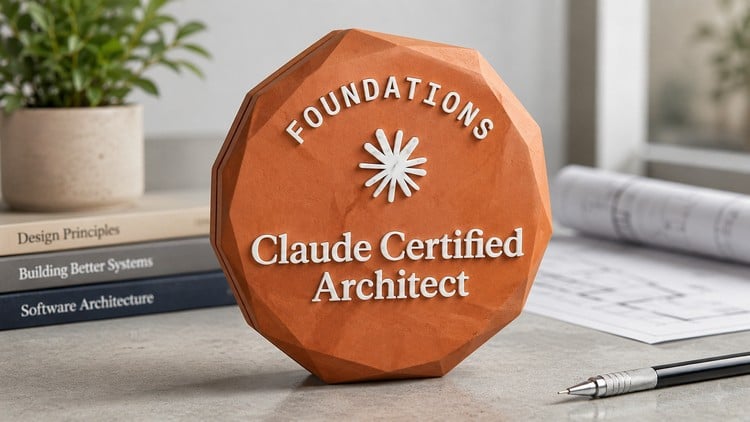
6 Practice Exams for CCA-F: Agent Orchestration, MCP, Claude Code and Prompt Engineering at Scale
What You Will Learn:
- Prepare for the Claude Certified Architect – Foundations exam through realistic, scenario-based practice questions weighted across all official exam domains
- Design agentic architecture and multi-agent orchestration patterns, including hub-and-spoke coordination and lifecycle hooks for production Claude systems
- Build and configure MCP (Model Context Protocol) servers, define tool boundaries and resources, and design interoperable agent-tool interfaces
- Configure Claude Code for enterprise workflows — CLAUDE .md setup, Agent Skills, plan mode, slash commands, and CI/CD integration
- Engineer context and structured output at scale, including JSON schemas, structured extraction patterns, and context window management
- Apply architectural decision-making to real-world scenarios: choosing the right pattern for reliability, scalability, and production readiness
- Show more
My Honest Take: Why Architecting for Claude is the New Gold Standard
Let’s be real for a second: the AI landscape is currently flooded with “prompt engineering” courses that are, frankly, about two years past their expiration date. If you’re still just learning how to write a better persona, you’re falling behind. The industry has shifted from simple chat interfaces to complex, agentic architecture. That’s why I jumped into the Claude Certified Architect – Foundations (CCA-F) 2026 practice exams. This isn’t your typical “AI for beginners” fluff; it’s a deep dive into the industry-standard tools that are actually being used in production environments right now.
What caught my eye immediately was the focus on the Model Context Protocol (MCP). While everyone else is still debating which LLM has the best creative writing, the pros are focused on how to connect these models to local data and third-party tools securely. This course doesn’t just ask you to memorize definitions; it throws you into the deep end of real-world projects, forcing you to think like a systems designer rather than just a user. It’s about moving from a hobbyist mindset to building job-ready skills that enterprise clients are screaming for.
What You Need Before Diving In
While this is billed as a “Foundations” course, don’t let the name fool you. You need a solid baseline to get the most out of this certification prep. I’d recommend the following before you hit “start” on those practice exams:
- Basic Programming Proficiency: You don’t need to be a Senior Dev, but you should be comfortable reading Python and understanding how JSON schemas work.
- API Fundamentals: An understanding of RESTful services and how LLMs interact with external data via function calling.
- LLM Literacy: You should already know the difference between Claude 3.5 Sonnet and Haiku, and have a grasp of basic context window limitations.
- Architectural Curiosity: A willingness to look at AI as a component of a larger system, not just a standalone “magic box.”
The Toolkit: Skills and Tech You’ll Master
This course tracks the beginner to advanced journey by focusing on the “how” of implementation. You’ll spend significant time on:
- Agent Orchestration: Moving beyond single-prompt bots to hub-and-spoke coordination and multi-agent systems.
- MCP (Model Context Protocol): Learning how to define tool boundaries and build interoperable interfaces so Claude can actually do things with your data.
- Claude Code: Deep-diving into the CLAUDE.md setup, agent skills, and how to integrate AI directly into CI/CD pipelines.
- Prompt Engineering at Scale: This isn’t about “please” and “thank you.” It’s about structured extraction, managing token limits, and ensuring reliability across thousands of calls.
Career Growth and Modern Job Roles
The career growth potential here is massive. We are seeing a massive surge in demand for roles that didn’t exist eighteen months ago. Completing this certification prep prepares you for high-paying positions such as:
- AI Solutions Architect: Designing the high-level flow of how AI integrates with legacy enterprise systems.
- Agentic Systems Engineer: Building and maintaining autonomous workflows that use MCP servers to execute tasks.
- Machine Learning Operations (MLOps) Specialist: Focusing on the production readiness and reliability of Claude-powered applications.
- Technical Product Manager: Overseeing AI transitions with a firm grasp of what is actually technically feasible (and what’s just hype).
The Pros: What Makes This Course Stand Out
- High-Fidelity Scenarios: The 6 practice exams aren’t just multiple-choice memory tests. They are scenario-based, meaning you have to apply architectural decision-making to solve problems. It feels like a hands-on lab in text form.
- Focus on Production, Not Hype: I love that it addresses lifecycle hooks and reliability. It acknowledges that AI fails sometimes and teaches you how to design systems that handle those failures gracefully.
- Deep Dive into MCP: Most courses barely mention the Model Context Protocol. This course treats it as a first-class citizen, which is essential for anyone wanting to build industry-standard tools.
- Scalability Training: Learning how to manage context windows and structured output (JSON) is the “meat and potatoes” of enterprise AI. This course nails the technical specifics.
The Honest Con: Where It Might Bite You
If I have one gripe, it’s the steep difficulty curve for those without a background in systems architecture. If you are coming from a strictly non-technical background, the sections on hub-and-spoke orchestration and CI/CD integration might feel like hitting a brick wall. It’s an intensive experience that assumes you’re ready to work, not just watch videos. It’s definitely not a “passive learning” course; you have to be ready to fail the practice exams a few times before the patterns really click.