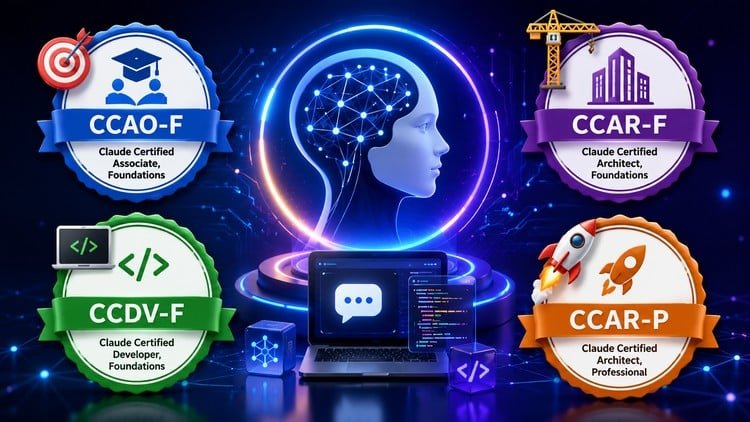
Claude Certified Associate (CCAO-F), Developer -(CCDV-F),Architect – Foundations (CCAR-F), Professional (CCAR-P) Exams
What You Will Learn:
- Prepare for Claude Certified Architect – Foundations (CCAR-F) certification.
- Prepare for Claude Certified Architect – Professional (CCAR-P) certification.
- Prepare for Claude Certified Associate – Foundations (CCAO-F) certification.
- Prepare for Claude Certified Developer – Foundations (CCDV-F) certification.
Overview
Alright, let’s talk Claude certifications. In a rapidly evolving field like `generative AI`, distinguishing yourself isn’t just about knowing the buzzwords; it’s about proving you can actually *build* and *deploy* intelligent solutions. These Claude certifications – CCAO-F, CCDV-F, CCAR-F, and CCAR-P – aren’t just another badge to collect. They represent a structured pathway to becoming proficient with one of the leading large language models on the market. Forget just reading documentation; this program is designed to transform theoretical understanding into tangible, `job-ready skills`. It dives deep into everything from fundamental interaction patterns to complex `enterprise solutions` architecture, emphasizing Claude’s unique strengths like its advanced context window and commitment to `Constitutional AI` for safer, more reliable applications. If you’re serious about mastering `LLM deployment` and `AI integration`, this is a strong play, offering a solid framework for `career growth` in a high-demand sector.
Prerequisites
Look, while the “Foundations” certifications (CCAO-F, CCDV-F, CCAR-F) might imply a complete beginner can jump in, I’d say you’ll get the most out of it with a baseline understanding. For the CCAO-F (Associate), basic computer literacy and a general curiosity about AI are sufficient. However, for CCDV-F (Developer), you’ll definitely want some `programming experience`, ideally with Python, and familiarity with consuming APIs. The CCAR-F (Architect – Foundations) will be smoother if you have some conceptual understanding of `cloud platforms` and system design principles. Now, for the CCAR-P (Architect – Professional), you absolutely need practical experience designing and deploying complex systems, ideally with a background in `machine learning engineering` or `solutions architecture`. Don’t expect to walk into the Professional exam without having genuinely built things before; it’s not a purely theoretical test.
Skills & Tools
Upon completing these certification tracks, you’re not just going to be able to talk a good game; you’ll have a practical toolkit. Expect to master advanced `prompt engineering` techniques, learning how to coax optimal responses from Claude for various tasks like content generation, summarization, and coding assistance. You’ll gain expertise in integrating Claude into existing applications using its `API`, developing robust `AI applications` that leverage its capabilities. The more advanced tracks delve into `model deployment strategies`, performance optimization, and understanding the nuances of `LLM architecture` for building scalable and efficient `enterprise solutions`. You’ll get hands-on with crucial concepts like managing context windows, handling long-form interactions, and even exploring potential `fine-tuning` or customization approaches. Expect to use Python SDKs, work within various `cloud environments`, and apply `industry-standard tools` for development and monitoring, all while adhering to `responsible AI` practices championed by Claude.
Career Benefits & Job Roles
The demand for `generative AI specialists` is skyrocketing, and frankly, having formal validation of your skills with a cutting-edge model like Claude gives you a significant edge. These certifications aren’t just about personal development; they directly translate to enhanced `career growth` and opens doors to exciting opportunities. You’ll be highly marketable for roles such as Prompt Engineer, specializing in crafting effective AI interactions; AI Developer, building applications powered by Claude; Machine Learning Engineer focused on `LLM integration` and deployment; and even `Solutions Architect (AI)`, designing end-to-end `AI systems` for businesses. For those aiming higher, the Professional Architect certification positions you as an expert capable of strategizing and implementing transformative `AI initiatives` across an organization, driving innovation with `real-world projects` and transforming business processes.
Pros
- Deep Specialization & Industry Relevance: Unlike generic AI courses, these certifications offer focused, in-depth knowledge of Claude, its unique `Constitutional AI` framework, and its advanced features. This specialization is highly valuable in a competitive landscape where `generative AI` differentiation matters.
- Practical, Hands-On Focus: While `certification prep` often gets a bad rap for being overly theoretical, these exams, particularly at the Developer and Architect levels, demand a true understanding of `API integration`, `prompt engineering`, and `model deployment`. You’re not just memorizing; you’re applying.
- Clear Path from Beginner to Advanced: The structured progression from Associate Foundations all the way to Architect Professional provides a clear learning roadmap. It’s excellent for individuals at various stages of their career, allowing for gradual skill acquisition and `career growth` from fundamental concepts to complex `enterprise solutions`.
- Validation of Job-Ready Skills: In an era of buzzwords, an official certification from a major player like Claude’s creators provides tangible proof of your expertise. It signals to employers that you possess verified `job-ready skills` in a crucial, emerging technology sector.
Cons
- Platform-Specific Focus: While deep specialization is a pro, it’s also worth noting the con: these certifications are intrinsically tied to Claude. While many `LLM concepts` are transferable, a heavy focus on one platform might mean less exposure to the broader `AI ecosystem` or alternative `industry-standard tools` and models. If your organization primarily uses another LLM or you pivot to a role demanding expertise across multiple platforms, additional learning will be necessary. It’s excellent for Claude, but it’s not a one-stop shop for *all* `generative AI` knowledge.