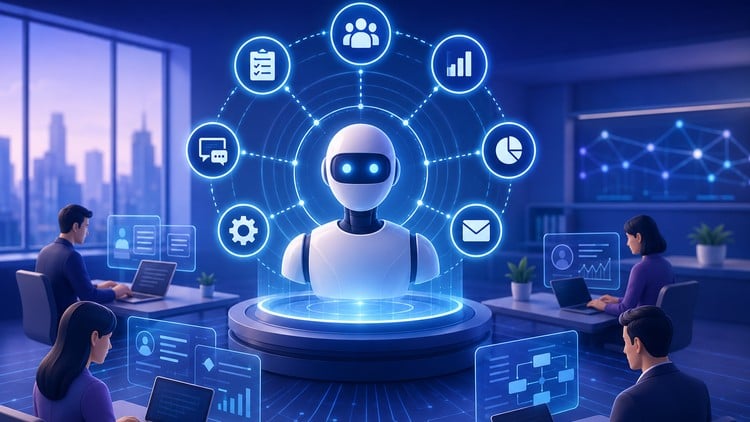
Design AI Employees, Multi-Agent Teams, SOP Workflows, and Business Automation Systems with Claude AI
What You Will Learn:
- Design AI Employees with defined roles, responsibilities, objectives, performance metrics, and operating procedures using Claude AI.
- Build Multi-Agent Systems that coordinate tasks, communicate effectively, and collaborate as AI-powered teams within business workflows.
- Create SOP-Driven AI Workflows by converting business processes, standard operating procedures, and decision frameworks into scalable automation systems.
- Develop Knowledge Management Systems that organize, structure, and deliver the right information to AI systems for improved performance and consistency.
- Design AI-Powered Business Departments for marketing, operations, research, analytics, content creation, and customer service functions.
- Build Decision Support Systems that generate recommendations, monitor KPIs, assess risks, and provide executive-level business insights.
- Show more
Overview
If you’ve moved past basic prompt engineering and are ready to architect real AI solutions, ‘Claude AI Systems Architect: Build AI Employees’ is precisely what you need. This course fundamentally shifts your perspective from conversational AI to designing, deploying, and managing full-fledged “AI employees” within an organization. We’re talking about AIs with defined roles, responsibilities, objectives, and performance metrics, all operating within meticulously crafted Standard Operating Procedures (SOPs). This isn’t just another tutorial; it’s a deep dive into AI systems architecture.
The course tackles the critical shift from treating AI as a mere assistant to leveraging it as a foundational component of business automation. It truly excels in pushing the idea of multi-agent systems, showing you how to orchestrate these AI employees into cohesive, collaborative teams. This isn’t theoretical fluff; it’s about converting conceptual business processes into scalable, AI-driven workflows. For anyone serious about moving from tactical AI usage to strategic deployment, and for those looking to build truly impactful automation with Claude AI, this course promises a significant leap in job-ready skills and understanding. It’s for the professionals ready to design the next generation of digital workforces.
Prerequisites
- A foundational understanding of logical thinking and system design principles will be incredibly beneficial.
- Familiarity with general business processes, workflow mapping, or operational design concepts will aid in grasping SOP-driven AI workflows.
- Basic exposure to Large Language Models (LLMs) and some prior prompt engineering experience will give you a head start, though Claude-specific techniques are covered.
- An eagerness to experiment and a strategic mindset regarding AI’s role in complex business environments are paramount.
Skills & Tools
Upon completing this course, you’ll be adept at architecting solutions *with* Claude AI, not just prompting it. You’ll develop advanced prompt engineering techniques tailored for complex multi-agent interactions and structured output. A key skill is translating intricate business logic into detailed operating procedures that Claude AI can understand and execute. This involves mastering the design of multi-agent teams for effective communication, coordination, and collaboration.
You’ll learn how to build robust knowledge management systems specifically designed to feed AI employees the right information at the right time, ensuring consistency. The course dives into practical application, showing you how to leverage Claude AI as an industry-standard tool to construct entire AI-powered business departments—from marketing to customer service. Furthermore, you’ll gain expertise in designing decision support systems, empowering AI to generate recommendations, monitor KPIs, and provide crucial executive-level insights, moving you beyond basic automation into genuine strategic AI integration.
Career Benefits & Job Roles
This course offers significant career growth, equipping you with highly sought-after expertise in a burgeoning field. You’ll be well-positioned for roles like AI Systems Architect, designing and overseeing AI solution deployment, or an AI Workflow Designer, focusing on business process automation. For those in Product Management or Operations, it provides strategic insights to become an AI Product Owner or AI Transformation Lead. The emphasis on real-world projects means you’ll build a portfolio demonstrating genuine competence, making these skills invaluable for showcasing expertise in a niche that’s growing exponentially, even if not direct certification prep.
Pros
- Strategic & Practical Application: This course brilliantly bridges the gap between theoretical AI concepts and practical, strategic implementation. It moves beyond simple prompting into true AI systems design, demonstrating how to build functional “AI employees” and multi-agent teams for real-world projects.
- Comprehensive Skill Set: From defining AI roles and SOPs to building knowledge bases and departmental AI functions, the curriculum offers a holistic view. It equips learners with a diverse set of job-ready skills that span design, automation, and decision support.
- Focus on Business Impact: Unlike many courses that stay purely technical, this one consistently ties AI capabilities back to tangible business outcomes: automation, efficiency, insights, and scaling. It’s tailored for professionals who need to demonstrate ROI from their AI initiatives.
- Forward-Thinking Design: The emphasis on creating SOP-driven workflows and multi-agent systems with Claude AI positions learners at the forefront of AI innovation. It teaches how to build scalable, maintainable AI solutions, moving participants from beginner to advanced thinking in AI architecture.
Cons
- Claude AI Specificity: While the deep dive into Claude AI as an industry-standard tool is a major strength, it also means the architectural principles and implementation details are heavily tied to Claude’s capabilities and API. Learners seeking a broader, LLM-agnostic approach to AI systems architecture might find themselves needing to adapt or supplement this knowledge for other models like GPT-4 or open-source alternatives.