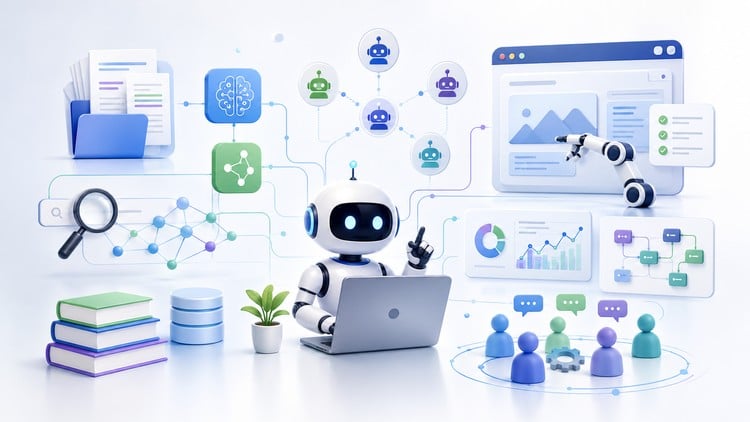
Build autonomous agents, advanced RAG systems, MCP servers, browser agents, and production-ready AI platforms.
What You Will Learn:
- Build autonomous AI agents capable of planning, reasoning, memory management, and tool execution.
- Design and implement advanced RAG systems using hybrid retrieval, knowledge graphs, and agentic workflows.
- Develop MCP servers that connect AI systems to databases, APIs, tools, and enterprise resources.
- Create browser agents that navigate websites, automate workflows, and perform real-world tasks.
- Architect and orchestrate multi-agent systems using LangGraph and modern agent communication patterns.
- Build multimodal AI applications that combine text, images, documents, and voice interactions.
- Implement AI evaluation, observability, monitoring, and governance practices for production systems.
- Develop portfolio-ready AI applications using Python, FastAPI, vector databases, and modern AI frameworks.
- Understand enterprise AI architecture patterns used in advanced AI products and platforms.
- Gain hands-on experience building seven complete AI systems from scratch.
Overview: Cutting Through the Hype of Autonomous Orchestration
If you’ve been hanging around the AI space for more than ten minutes, you know that simple wrapper apps are dead. The industry has shifted from “How do I prompt ChatGPT?” to “How do I build a system that thinks, plans, and actually executes tasks?” That is exactly where the AI Agents, RAG & MCP: 7-Day Builder Bootcamp positions itself. Unlike the generic tutorials cluttering YouTube, this course feels like a high-intensity certification prep for the reality of modern AI engineering.
What caught my eye wasn’t just the mention of agents, but the inclusion of the Model Context Protocol (MCP). If you aren’t familiar, MCP is Anthropic’s open standard that is currently revolutionizing how we connect LLMs to data sources. Most courses ignore the “plumbing” of AI, but this bootcamp leans into it. You aren’t just building a chatbot; you’re building the connective tissue between models and enterprise databases. The curriculum moves fast—from basic hands-on labs to complex multi-agent systems—and it assumes you’re here to work, not just watch. It’s an opinionated take on the “Agentic” era, focusing heavily on LangGraph for state management, which is quickly becoming the industry-standard tool for anyone serious about production-grade AI.
Prerequisites: Who Is This Actually For?
Let’s be real: this is advertised as beginner to advanced, but if you don’t know your way around a Python async function or an API call, you’re going to have a bad time. To get the most out of these real-world projects, you should have:
- A solid grasp of Python (intermediate level is preferred).
- Basic familiarity with FastAPI or similar web frameworks.
- An understanding of how Vector Databases work at a conceptual level.
- An active OpenAI or Anthropic API key (and the budget to run some tests).
Skills & Tools: The Modern AI Stack
This bootcamp doesn’t waste time on outdated tech. It forces you to get your hands dirty with the stack that actual AI Engineers are using in the field right now. You’ll spend most of your time in Python, working with LangGraph to handle agentic loops and state management—which is a massive step up from the linear chains we used to build.
On the data side, you’ll dive into hybrid retrieval and knowledge graphs, moving beyond basic semantic search into advanced RAG territory. The inclusion of MCP servers is the real “alpha” here, teaching you how to build secure, standardized bridges to local files and remote APIs. You’ll also touch on observability and evaluation frameworks, which are often the “forgotten” parts of the stack but are absolutely vital for career growth in enterprise environments.
Career Benefits & Job Roles
If you’re looking for job-ready skills, this is one of the few programs that actually delivers a portfolio-ready output. The shift from “software engineer” to “AI engineer” is less about learning a new language and more about mastering agent communication patterns. Completing this bootcamp prepares you for roles like:
- AI Solutions Architect: Designing the high-level flow of multi-agent systems.
- LLM Engineer: Specializing in advanced RAG and model fine-tuning or evaluation.
- Backend AI Developer: Building the MCP servers and FastAPI integrations that power the front end.
- Automation Consultant: Implementing browser agents to replace legacy RPA workflows.
Pros
- Cutting-Edge Curriculum: Most courses are six months behind; this one includes MCP and LangGraph, which are the current “hot” technologies in the valley.
- Focus on Production: It doesn’t just show you how to build a demo; it covers observability, monitoring, and governance—the stuff that actually keeps you from getting fired when your agent goes rogue.
- Hands-on Portfolio Building: You walk away with seven real-world projects. In a crowded job market, showing a recruiter a functional browser agent or a multi-modal RAG system is worth more than a hundred certificates.
Cons
- The “7-Day” Pace is Brutal: Unless you are doing this full-time with zero distractions, the 7-day timeline is more of a marketing suggestion than a reality. For a working professional, expect this to take 3-4 weeks to actually digest and implement the hands-on labs properly.