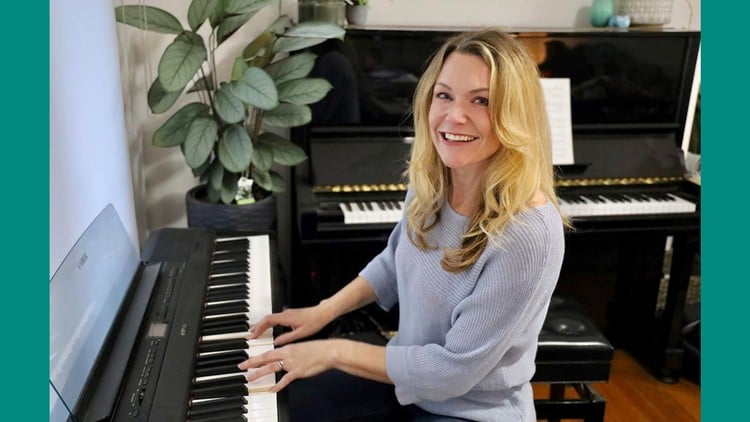
Master the chord and scale formulas used by professional songwriters – then play, improvise, and write your own music.
What You Will Learn:
- Discover the exact formula the Beatles used to write songs like Let It Be — and use it yourself
- Play the chords to any song in any key using simple formulas — no music reading required
- Write your own original songs from scratch in just 15 lessons, no piano experience needed
- Understand how chords, scales and chord families work together to create music
As someone who’s spent years navigating the often-intimidating landscape of tech and creative tools, I’ve seen countless courses promise the moon. But when I stumbled upon ‘Chord Jammer: Play & Write Piano Songs Without Reading Music,’ my skepticism was immediately piqued – in a good way. The idea of bypassing traditional music theory, scales, and sight-reading felt almost revolutionary, especially for someone who’s always wanted to dabble in music but felt stifled by the perceived complexity. This isn’t your grand-aunt’s piano lesson; it’s a direct, almost hacker-like approach to musical creation.
Overview
Forget everything you think you know about learning piano. Chord Jammer isn’t about deciphering sheet music or memorizing obscure scales. Instead, it dives deep into the underlying patterns and mathematical relationships that form the backbone of popular music. It’s less about “learning notes” and more about “understanding the matrix” of musical harmony. This course demystifies the structure of chords and scales, revealing simple, repeatable formulas that empower you to not just play, but truly *understand* why certain sounds work together. The genius here is in the abstraction – by focusing on relationships rather than notation, it unlocks a rapid path to musical fluency. You’re not just playing a song; you’re grasping the foundational logic that allows you to improvise, adapt, and ultimately, create original compositions with startling speed. It’s an accelerator for creative expression, stripping away the academic overhead to get straight to the essence of songwriting and improvisation. This method provides the kind of *job-ready skills* a modern content creator or indie artist needs, focusing on immediate, practical output.
Prerequisites
This is where Chord Jammer truly shines for the aspiring musician. You don’t need any prior piano experience, music theory knowledge, or even the ability to read a single note of sheet music. Seriously. The only real prerequisite is access to a keyboard or piano, even a modest digital one will do. Beyond that, it’s an open mind and a willingness to experiment. No fancy *certification prep* or prior musical education is required, making it incredibly accessible for literally anyone. It’s designed to take you from a complete musical novice to someone capable of crafting original pieces, proving its claim to cater from *beginner to advanced* within its specific framework.
Skills & Tools
By the end of this course, you won’t just be able to play a few chords; you’ll have a foundational understanding of harmonic structure that is surprisingly robust. You’ll master a handful of core chord and scale formulas, learn how to transpose songs into any key effortlessly, and gain the intuitive sense of ‘what sounds good’ that often takes years to develop. The primary “tool” is your keyboard and your ears. The course structure itself feels like a series of cleverly designed *hands-on labs*, where each lesson builds directly on the last, immediately putting new concepts into practice. While it doesn’t teach you how to use *industry-standard tools* like a Digital Audio Workstation (DAW) or notation software, it provides the fundamental compositional understanding that is a prerequisite for effectively using those tools down the line. You’ll gain the ability to tackle *real-world projects* like composing background music for videos, creating simple jingles, or writing your own complete songs from scratch.
Career Benefits & Job Roles
While this course isn’t going to make you a classical concert pianist or prepare you for advanced orchestral composition, its benefits for creative professionals are surprisingly potent. For instance, content creators, YouTubers, podcasters, and indie game developers often need original background music or jingles. This course provides the *job-ready skills* to produce those assets quickly and independently, saving money on licensing or hiring. Aspiring songwriters and producers, particularly in the indie scene, will find this a fantastic starting point for building a portfolio of original tracks. It fosters a DIY approach to music creation, contributing significantly to *career growth* for anyone whose work benefits from original audio. It’s about empowering you to be self-sufficient in a key creative domain, making you a more versatile and valuable asset in the digital creative landscape.
Pros
- Unparalleled Accessibility: It completely removes the traditional barriers to learning piano, making music creation attainable for absolute beginners who might otherwise be intimidated by formal music theory.
- Rapid Songwriting & Improvisation: The formula-based approach means you’re not just learning to play; you’re learning to compose and improvise almost immediately, turning musical ideas into *real-world projects* at an accelerated pace.
- Deep Intuitive Understanding: Instead of rote memorization, the course fosters an intuitive grasp of how harmony works, allowing for genuine creativity and adaptation. It’s truly a *beginner to advanced* journey in musical intuition.
- Empowering & Creative: This course isn’t just about playing notes; it’s about unlocking your personal musical voice. The consistent *hands-on labs* within the lessons ensure you’re always creating, fostering significant *career growth* for aspiring artists.
Cons
- Limited Traditional Music Theory: While its strength, the deliberate avoidance of traditional music notation and theory means you won’t be able to read sheet music or easily collaborate with classically trained musicians using standard notation. For those aiming for advanced *certification prep* in classical theory or aiming to use complex *industry-standard tools* like Sibelius for score writing, supplemental learning will be necessary.