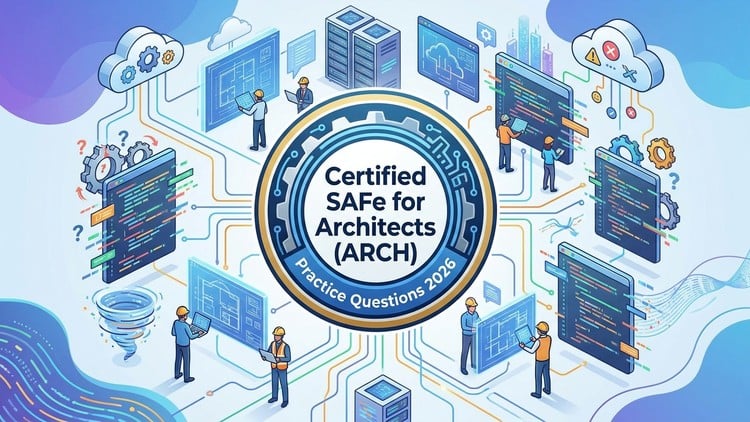
Prepare for the SAFe Architect Certification Exam with Realistic Practice Questions and Detailed Explanations.
What You Will Learn:
- Understand SAFe Architect roles, Lean-Agile principles, and architecture practices commonly tested in the ARCH certification exam.
- Apply knowledge of DevOps, CALMR, and Continuous Delivery Pipeline concepts through realistic certification practice questions.
- Learn how portfolios, value streams, Agile Release Trains, and solution architecture support business outcomes in SAFe environments.
- Strengthen exam readiness by practicing scenario-based questions with detailed explanations and real-world context.
- Improve confidence for the Certified SAFe for Architects exam by identifying weak areas and reinforcing key concepts.
- Show more
Course Overview: More Than Just a Flashcard Deck
Look, let’s be real for a second—anyone who’s spent more than a week in a large-scale enterprise knows that the Certified SAFe for Architects (ARCH) exam is a different beast entirely. Most certification prep courses focus on rote memorization, which is a recipe for disaster when you’re sitting in that proctored environment facing a question about a complex architectural runway. The ‘Certified SAFe for Architects (ARCH) Practice Tests 2026’ isn’t just another dump of questions; it’s a rigorous mental simulation designed for those of us who actually have to deliver real-world projects in a Lean-Agile environment.
What I appreciated most about this specific 2026 update is how it tackles the shift in the SAFe 6.0 framework. It doesn’t just ask you to identify a role; it forces you to think like a System, Solution, or Enterprise Architect who is stuck between a rock (the business’s demand for features) and a hard place (technical debt and architectural integrity). This course is a deep dive into the “why” behind the Continuous Delivery Pipeline and how to maintain a Value Stream without letting the whole thing crumble under its own weight. If you’re looking to gain job-ready skills that translate to a boardroom or a PI Planning session, this is where you start.
Prerequisites: Don’t Walk in Cold
While these practice tests are labeled as beginner to advanced in terms of their coverage, I’d argue you shouldn’t jump in without a baseline. This isn’t a “SAFe 101” course. To get the most out of this certification prep, you really should have:
- A foundational understanding of the SAFe framework (having your Leading SAFe or SAFe PO/PM is a huge plus).
- At least a few years of experience in a technical lead or software engineering role where you’ve seen how a DevOps culture (or lack thereof) affects delivery.
- The official SAFe for Architects course manual—these tests are meant to validate and sharpen that knowledge, not replace the primary curriculum.
Skills & Tools: Mastering the Architectural Runway
This course goes beyond simple multiple-choice. It tests your proficiency in industry-standard tools and frameworks that govern modern enterprise architecture. You’ll be grilled on:
- CALMR: Understanding how Culture, Automation, Lean, Measurement, and Recovery actually influence architectural runway health.
- Value Stream Mapping: Identifying bottlenecks in the flow of value—a critical skill for any architect looking at career growth.
- Agile Architecture: Moving away from “Big Design Up Front” and toward intentional design and emergent architecture.
- Solution Context: How to align your real-world projects with the broader ecosystem, including suppliers and customers.
Career Benefits & Job Roles
Nailing the ARCH certification isn’t just about the digital badge on your LinkedIn profile; it’s about positioning yourself for high-impact, high-salary roles. In the current market, companies are desperate for people who can bridge the gap between high-level strategy and technical execution. Completing these tests effectively prepares you for roles such as:
- System Architect: Managing the architectural integrity of a single Agile Release Train (ART).
- Solution Architect: Guiding the development of large, complex solutions across multiple ARTs.
- Enterprise Architect: Shaping the overall technology strategy and portfolio direction.
- Digital Transformation Consultant: Helping legacy organizations transition to modern, job-ready skills and frameworks.
Pros: Why This Bank Stands Out
- Scenario-Based Depth: The questions aren’t just definitions. They present a problem (e.g., “The ART is failing its Enabler features…”) and ask for the best architectural intervention. This is how you build actual confidence.
- No-Fluff Explanations: When you get a question wrong (and you will), the explanations don’t just point to a page in the manual. They explain the Lean-Agile logic behind the correct answer, which is vital for long-term retention.
- Current for 2026: Architecture evolves fast. These tests reflect the latest shifts in DevSecOps and cloud-native architecture that are often glossed over in older prep material.
- Realistic Timing: The practice exams are structured to mimic the pressure of the actual certification prep environment, helping you manage your time effectively.
Cons: The Honest Truth
- No Hands-on Labs: Because this is a practice test suite, you won’t find hands-on labs or interactive coding environments. It is strictly a knowledge-validation tool. If you learn best by “doing” rather than “testing,” you’ll need to supplement this with your own sandbox projects or architectural modeling tools.