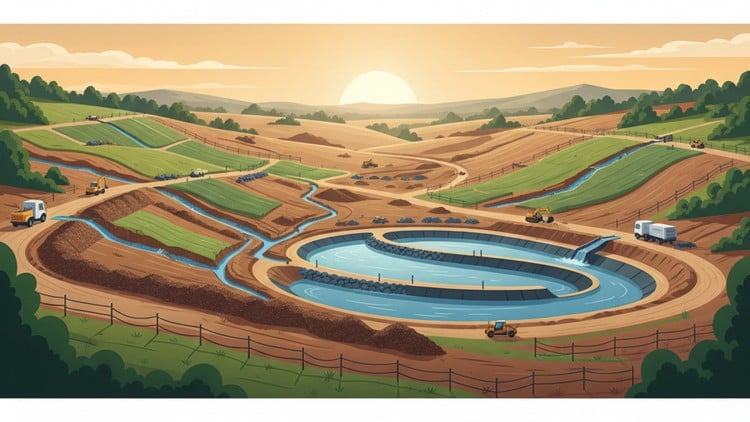
CPESC MCQ Mastery Practice Course
What You Will Learn:
- Apply erosion principles
- Evaluate sediment controls
- Analyze runoff behavior
- Improve exam readiness
CPESC MCQ Mastery Practice Course | Topics: Apply erosion principles, Evaluate sediment controls, Analyze runoff behavior, Improve exam readiness
Overview
Alright, let’s cut to the chase about the CPESC MCQ Mastery Practice Course. If you’re eyeing that Certified Professional in Erosion and Sediment Control (CPESC) designation, you know it’s not just a fancy acronym; it’s a testament to your expertise in a critically important field. This course isn’t your typical beginner’s guide to stormwater management. Think of it more as a finely tuned instrument designed to sharpen your existing knowledge and hone your test-taking prowess for the CPESC exam. What I found particularly valuable was its laser focus on the nuances of the multiple-choice questions (MCQ) format. It breaks down complex regulatory frameworks and scientific principles into digestible, examinable chunks, emphasizing not just what to know, but how the questions are likely to be framed. It moves beyond theoretical concepts, diving deep into practical application scenarios that challenge your critical thinking – a far cry from mere memorization. It’s an efficient, targeted approach to certification prep, aimed squarely at professionals who need to validate their skills and enhance their career growth.
Prerequisites
Let’s be real, this isn’t a “learn to spell erosion” kind of course. The CPESC certification itself demands a significant foundation. So, for this mastery practice course, you absolutely need to bring some prior knowledge to the table. I’d say you should have a solid background in environmental science, civil engineering, landscape architecture, or a related discipline. Experience with site planning, construction processes, and basic hydrology is non-negotiable. If you’re not familiar with terms like “hydrograph,” “shear stress,” or “turbidity,” you might find yourself playing catch-up rather than mastering the material. Ideally, you’ve already been working in the field for a few years, applying erosion and sediment control (ESC) principles in real-world settings. This course truly shines for those who have the practical experience but need to crystallize their understanding of the underlying science and regulatory requirements for the exam.
Skills & Tools
This course is less about learning how to use a specific software and more about mastering the intellectual tools necessary for effective erosion and sediment control. You’ll significantly enhance your ability to:
- Analyze runoff behavior across various terrains and climatic conditions.
- Evaluate sediment controls for their efficacy and appropriateness in diverse project contexts.
- Apply erosion principles in design and implementation phases.
- Interpret complex site data and develop comprehensive ESC plans.
- Navigate and apply relevant environmental regulations and permitting processes.
- Develop strong problem-solving skills for unexpected site challenges.
While it doesn’t teach specific software like HEC-RAS or SWMM, the analytical skills you develop are directly transferable to utilizing such industry-standard tools for modeling and design. The focus is on robust understanding of Best Management Practices (BMPs) and their practical limitations and strengths, pushing you from a beginner’s grasp to an advanced, nuanced perspective.
Career Benefits & Job Roles
Earning your CPESC isn’t just a feather in your cap; it’s a powerful statement to potential employers and clients. This course, by helping you achieve that certification, directly translates into tangible career growth. You become a recognized authority in a niche that is increasingly scrutinized by regulatory bodies and valued by developers.
- Enhanced Credibility: Position yourself as an expert, leading to greater trust and responsibility.
- Expanded Job Opportunities: Unlock roles requiring certified professionals, from project management to specialized consulting.
- Higher Earning Potential: Certified professionals often command better salaries due to their specialized knowledge.
This opens doors to roles such as:
- Environmental Consultant
- Stormwater Manager
- Civil Engineer (with a specialization in ESC)
- Regulatory Compliance Officer
- Site Superintendent (overseeing ESC implementation)
- Landscape Architect (designing sustainable sites)
It essentially makes you more job-ready for roles demanding high-level expertise in environmental protection and sustainable development, providing a clear path for professional advancement from intermediate to senior positions.
Pros
- Targeted Exam Readiness: This course excels at distilling vast amounts of information into an exam-focused format, making your certification prep highly efficient. The MCQ practice is invaluable.
- Deep Conceptual Understanding: It doesn’t just give you answers; it forces you to think through the underlying principles, which strengthens your ability to handle novel situations in the field.
- Practical Application Focus: While theoretical, the questions are often rooted in real-world projects and scenarios, bridging the gap between academic knowledge and on-site decision-making.
- Confidence Builder: Successfully navigating the practice questions instills a significant boost in confidence, which is crucial for tackling the actual CPESC exam.
Cons
- Limited Hands-On Labs: As a “Mastery Practice Course” primarily focused on MCQs, it naturally lacks direct hands-on labs or field work. While it primes you theoretically, it won’t replace the practical experience gained from designing and implementing ESC plans on an actual site. For truly comprehensive learning, you’ll need to supplement this with real-world application or dedicated field training.