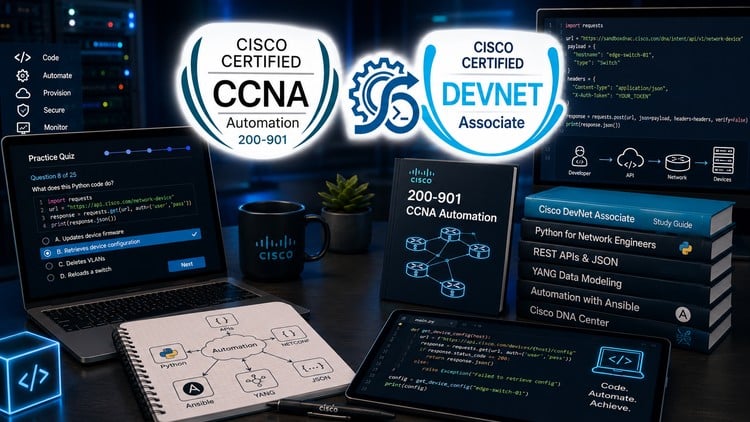
Exam-style questions with full explanations for CCNAAUTO: APIs, Python, Cisco platforms, automation & networking
What You Will Learn:
- Pass the 200-901 exam with confidence, using original exam-style questions written to the current published blueprint
- Consume and troubleshoot REST APIs fluently: authentication, headers, status codes, pagination, rate limits and response parsing
- Write and read the Python that this exam expects, including requests, data structures, error handling and unit testing basics
- Work with Cisco platform APIs across the enterprise, collaboration, security and datacenter portfolios
- Apply software development and design fundamentals — version control with Git, design patterns, agile practice and code review
- Deploy and secure applications using containers, CI/CD pipelines and common deployment models
- Automate infrastructure with Ansible, model-driven programmability, NETCONF, RESTCONF and YANG
- Hold your ground on network fundamentals: IP addressing, switching, routing, and diagnosing connectivity failures
Overview
Alright folks, let’s cut to the chase. If you’re eyeing the Cisco DevNet Associate (200-901) certification, you know it’s not your grandma’s CCNA. This exam marks a pivotal shift, bridging the historical chasm between traditional networking and modern software development practices. This “CCNA Automation 200-901 Practice Exams” package isn’t just another set of questions; it’s a critical tool in your certification prep arsenal, designed to validate if you’ve truly grasped the material needed to navigate this new converged landscape.
What I appreciate here is the laser focus on practical application within a testing environment. It’s one thing to read about REST APIs or Python scripting; it’s another to accurately troubleshoot a malformed JSON payload under exam conditions. This resource focuses on helping you solidify that understanding. It’s not just about memorizing facts, but applying concepts like authentication headers, understanding status codes, and knowing how to handle pagination and rate limits when consuming an API. In today’s highly automated network environments, these aren’t just exam topics – they are fundamental job-ready skills.
The exam-style questions are crucial for building confidence. They reflect the blueprint’s demands for understanding Cisco’s vast API ecosystem, from enterprise to datacenter, security, and collaboration portfolios. More than that, it delves into core software development and design fundamentals, which are often overlooked in traditional networking paths. Think Git for version control, applying design patterns, and understanding agile practices. This isn’t just about passing an exam; it’s about preparing you for the realities of modern infrastructure automation.
Prerequisites
Before you dive headfirst into these practice exams, a word to the wise: this isn’t an entry-level programming course, nor is it a primer on basic networking. You’re expected to have a foundational understanding of both. Ideally, you should possess at least a CCNA-level grasp of network fundamentals – IP addressing, routing, switching, and basic troubleshooting are assumed knowledge. On the development front, a basic proficiency in Python is non-negotiable. We’re talking about understanding data structures, flow control, and perhaps having written a few simple scripts. Familiarity with command-line interfaces (CLI), especially Linux, will also serve you well. While the practice exams will test your knowledge, they won’t teach you Python from scratch or explain what an IP address is. Think of this as a rigorous test of your integrated knowledge, not a starting point for absolute beginner to advanced learning in either domain.
Skills & Tools
This practice exam set essentially outlines the modern network engineer’s toolkit. You’ll be tested on your ability to fluently consume and troubleshoot REST APIs, including handling authentication, headers, and parsing responses. A significant chunk covers Python scripting, specifically its application for networking tasks, utilizing libraries like requests, working with data structures (JSON, YAML), and implementing basic error handling and unit testing. You’ll also encounter questions related to various Cisco platform APIs across their diverse portfolios (Enterprise, Collaboration, Security, Datacenter).
Beyond network-specific automation, the exams probe your understanding of general software development principles: version control with Git, design patterns, agile methodologies, and code review processes. Expect questions on modern application deployment using containers (like Docker), understanding CI/CD pipelines, and common deployment models. Furthermore, you’ll need to demonstrate proficiency in infrastructure automation with Ansible, model-driven programmability concepts like NETCONF, RESTCONF, and YANG, and naturally, solidify your core network fundamentals. These are all industry-standard tools and practices that are critical for anyone looking to make a mark in network automation.
Career Benefits & Job Roles
Passing the DevNet Associate exam, and by extension, mastering the content covered in these practice questions, is a significant leap for your career growth. In an era where “NetDevOps” is becoming less of a buzzword and more of a job requirement, these skills position you uniquely. You’re no longer just a network engineer; you’re a network automation specialist, a DevNet Engineer, or even a nascent Solution Architect who understands how to programmatically control infrastructure. These are highly sought-after job-ready skills that directly address the industry’s need for professionals who can automate, orchestrate, and integrate network services.
You’ll be equipped for roles focusing on network programmability, developing custom automation solutions, integrating network services with broader IT ecosystems, and contributing to CI/CD pipelines for infrastructure deployments. It opens doors to participating in real-world projects involving SD-WAN automation, cloud network integration, security policy automation, and much more. This certification signifies to employers that you can speak both ‘network’ and ‘code,’ a truly invaluable combination in today’s digital transformation landscape.
Pros
- Highly Realistic Exam Simulation: These questions are crafted directly to the current 200-901 blueprint, providing an authentic feel for the actual exam. This isn’t just random trivia; it’s designed to mirror the difficulty, scope, and style you’ll encounter, making it invaluable for targeted certification prep.
- Detailed Explanations for Deeper Learning: Each question comes with a comprehensive explanation, not just the correct answer. This is crucial for understanding *why* an option is right or wrong, turning a practice test into a powerful learning tool. It helps solidify complex concepts and addresses potential misunderstandings.
- Bridging the NetDevOps Gap: The content expertly blends traditional networking with modern software development principles (Python, APIs, Git, CI/CD). It effectively tests your ability to navigate this crucial convergence, preparing you for the multi-faceted demands of today’s network automation roles.
- Comprehensive Topic Coverage: From API consumption and Python scripting to platform-specific APIs, Git, containers, Ansible, and model-driven programmability, these exams cover the entire breadth of the DevNet Associate blueprint. This ensures you’re not missing any critical areas before exam day.
Cons
- Lack of Integrated Hands-on Labs: While excellent for testing theoretical knowledge and application, as a set of practice exams, this resource inherently lacks integrated hands-on labs. To truly cement the practical skills (e.g., writing actual Python scripts, configuring Ansible playbooks, deploying containers), you’ll need to supplement these practice exams with real-world experimentation and lab environments. This is a vital component for transitioning theoretical understanding into actual operational capability and is necessary for building truly robust job-ready skills.