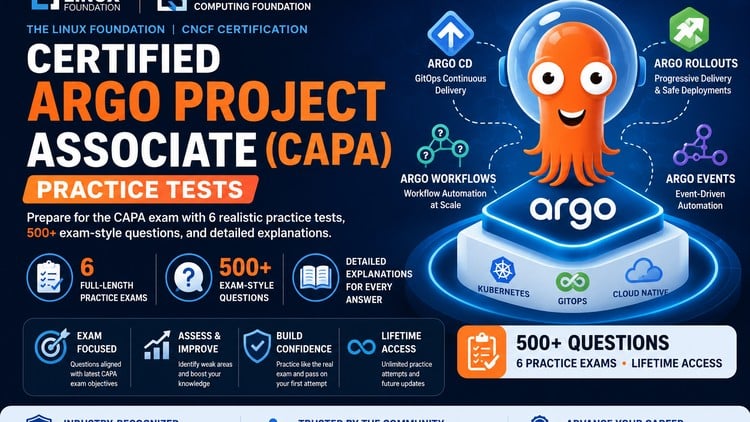
6 full-length practice tests | 300+ questions on Argo CD, Workflows, Rollouts & Events | For the Golden Kubestronaut
What You Will Learn:
- Master the official Certified Argo Project Associate (CAPA) exam objectives with 500+ realistic practice questions.
- Assess your knowledge of Argo CD, Argo Workflows, Argo Rollouts, Argo Events, GitOps, and Kubernetes before taking the certification exam.
- Build confidence by completing 6 full-length practice exams that closely simulate the real CAPA exam.
- Understand the reasoning behind every answer through detailed explanations that reinforce key concepts.
- Identify knowledge gaps and focus your study on areas that need improvement.
- Be fully prepared to pass the Certified Argo Project Associate (CAPA) certification exam on your first attempt.
- Show more
Overview: More Than Just a Test Bank
If you’ve been hanging around the CNCF ecosystem lately, you know that GitOps isn’t just a buzzword anymore—it’s the way we actually get things done without losing our minds. The Certified Argo Project Associate (CAPA) is the new gold standard for proving you aren’t just “faking it until you make it” with Kubernetes delivery. I’ve gone through my fair share of certification prep materials, and honestly, most are either too academic or just plain outdated. This practice exam suite for 2026 feels like it was written by people who actually stay up at 2 AM fixing broken sync policies.
What I appreciate here isn’t just the volume of questions, but the “vibe” of the scenarios. It doesn’t just ask you what a CRD is; it pushes you to understand how Argo CD interacts with a live cluster and how Argo Rollouts handles a canary release that’s gone sideways. For anyone aiming for that Golden Kubestronaut status, these 6 full-length exams are a reality check. They move you from a beginner to advanced mindset by forcing you to parse YAML structures and logic flows that mirror the official Linux Foundation environment. It’s about building the muscle memory needed to spot a misconfigured EventBus or a hanging Workflow before you click “submit” on the real exam.
Prerequisites: Don’t Walk in Cold
Look, I’ll be blunt: if you don’t know your way around a Kubernetes manifest, you’re going to have a bad time. While these exams are great for certification prep, they aren’t a “K8s 101” course. You should already have a solid grasp of namespaces, services, and how k8s controllers work in general. Ideally, you’ve spent a few hours in hands-on labs or messing around with a Minikube instance. You don’t need to be a principal engineer, but you should understand why we move away from kubectl apply and toward a declarative GitOps workflow. Having a baseline understanding of YAML is non-negotiable because the CAPA exam is notorious for throwing “spot the error” questions at you.
Skills & Tools: The Full Argo Stack
This course does a deep dive into the four pillars of the Argo ecosystem, which are now considered industry-standard tools for any serious DevOps pipeline:
- Argo CD: You’ll master ApplicationSets, sync policies, and multi-cluster management. It’s the meat and potatoes of the exam.
- Argo Workflows: This is where it gets technical. You’ll learn to navigate DAGs (Directed Acyclic Graphs) and step-based templates for container-native orchestration.
- Argo Rollouts: Forget “all-at-once” deployments. These tests grill you on Blue/Green and Canary strategies that provide job-ready skills for high-availability environments.
- Argo Events: Often the trickiest part of the stack. You’ll learn how to trigger workflows based on S3 buckets, Webhooks, or even calendar events.
Career Benefits & Job Roles
Adding “Certified Argo Project Associate” to your LinkedIn isn’t just about the digital badge; it’s about signaling to recruiters that you can handle real-world projects at scale. In the current market, companies are desperate for Platform Engineers and Site Reliability Engineers (SREs) who can automate away the manual toil of deployments. We are seeing a massive shift where career growth is tied directly to your ability to manage “infrastructure as code.” Mastering the Argo suite positions you for high-paying roles in cloud-native architecture. Whether you’re a DevOps Engineer or a Cloud Architect, these skills are the bridge to the next level of your professional journey.
Pros
- Granular Explanations: The “why” is more important than the “what.” Every answer comes with a breakdown that explains the logic, which is basically a hands-on lab in text form.
- Simulation Accuracy: The difficulty curve mimics the actual CAPA exam. It doesn’t give you “easy wins”; it makes you work for the passing score.
- Up-to-Date Content: Since it’s geared for 2026, it includes the latest features and deprecations within the Argo ecosystem, ensuring you aren’t studying obsolete syntax.
Cons
- Lack of an Integrated Terminal: While the questions are stellar, I’d love to see a built-in sandbox. You’ll still need to run your own local clusters to practice the commands mentioned in the explanations if you really want that knowledge to stick.