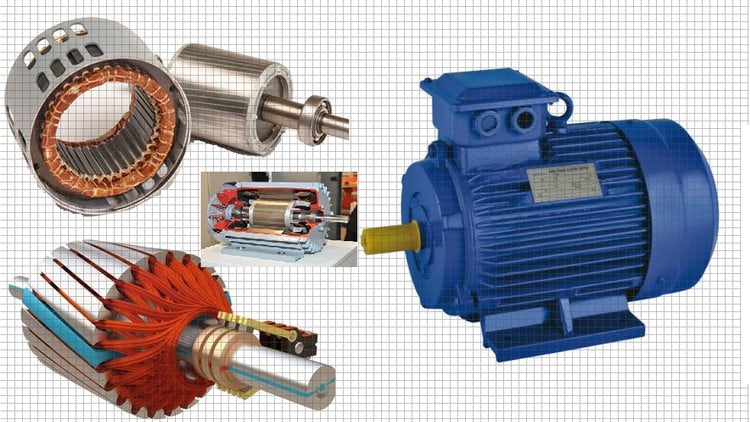
Induction Motor
What You Will Learn:
- Describe working principle of Alternating Current(AC) motors
- Explain the function of each parts of Alternating current motors
- Describe construction of Alternating motors.
- Identify application area of different types of Alternating motor(A)
- Describe speed and torque characteristics of Alternating motors.
- Describe types of Alternating motors; single phase, three phase AC motor
- Describe direction of rotation reversal of AC motors
Alright folks, let’s dive into the world of Alternating Current (AC) motors. I recently wrapped up a course on this topic, and as someone who’s been in the trenches with electrical systems for a while, I’ve got some thoughts to share. This isn’t just about rote memorization; it’s about building a foundational understanding of the workhorses that power so much of our modern world. The course, from what I saw, aims to take you from a basic grasp of how these beasts hum to a solid understanding of their inner workings and applications.
Overview
This course on AC motors, particularly the ubiquitous induction motor, is a solid dive into the fundamental principles that govern their operation. It goes beyond just stating the facts and actually dissects the working principle, which is crucial for any serious tech professional. You’ll get a clear picture of how AC voltage translates into rotational force, a concept that’s deceptively simple but incredibly powerful. The course also dedicates good time to the construction and the function of each part – from the stator to the rotor, and all the bits in between. Understanding these components isn’t just academic; it’s key to troubleshooting and even designing systems. What I appreciated was the emphasis on application areas for different types of AC motors, which really grounds the theoretical knowledge in practical, real-world projects. This isn’t just theory; it’s about knowing which motor to pick for that industrial pump versus that household appliance.
Prerequisites
Honestly, don’t jump into this without a decent grasp of basic electrical theory. Think Ohm’s Law, Kirchhoff’s Laws, and a foundational understanding of electromagnetism. If you’re fuzzy on AC fundamentals like voltage, current, phase, and frequency, you’ll be paddling upstream. Some familiarity with basic circuit analysis would also be a huge plus. This isn’t a “learn electricity from scratch” course, it’s more of a beginner to advanced progression once you have the groundwork laid.
Skills & Tools
By the end of this course, you should be proficient in:
- Describing the working principle of AC motors, with a strong focus on induction motors.
- Identifying and explaining the function of various AC motor components.
- Understanding the construction and variations in AC motor design.
- Categorizing and applying different types of AC motors to specific tasks.
- Analyzing speed and torque characteristics and how they impact performance.
- Differentiating between single-phase and three-phase AC motor types.
- Implementing direction of rotation reversal techniques.
While the course might not directly involve industry-standard tools in every module, the knowledge gained is directly applicable to working with oscilloscopes, multimeters, and motor control systems. You’ll also be well-prepared for any certification prep that requires a deep understanding of motor technology.
Career Benefits & Job Roles
This course is a no-brainer for anyone looking to boost their career in electrical engineering, mechatronics, or industrial automation. The skills you’ll acquire are directly transferable to roles like:
- Maintenance Technician (especially industrial)
- Electrical Engineer
- Automation Specialist
- Control Systems Engineer
- Field Service Engineer
Having this knowledge under your belt gives you a distinct advantage, demonstrating you’re not just a button-pusher but someone who understands the underlying tech. This translates directly into career growth and makes you a more valuable asset.
Pros
- Deep dive into fundamental principles: The course doesn’t shy away from the ‘why’ and ‘how,’ which is essential for true understanding.
- Practical application focus: Connecting theory to real-world uses through application areas and characteristics makes the learning stick.
- Solid foundation for advanced topics: This course sets you up perfectly for more complex motor control systems, VFDs, and advanced automation.
- Hands-on relevance: While the course itself might be theoretical, the knowledge gained is immediately applicable in any hands-on labs or on-the-job troubleshooting.
Cons
My one honest critique is that while the course covers the *types* of AC motors and their applications, I would have loved to see even more emphasis on the practicalities of selecting the *right* motor for a specific application, including efficiency considerations and power factor implications. It’s all there, but sometimes you have to connect the dots yourself. However, this might also be intentional to encourage critical thinking and problem-solving, which are vital job-ready skills anyway.