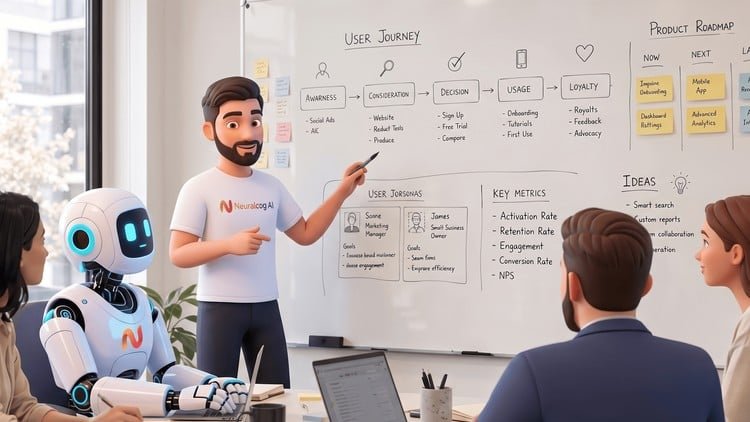
AI Product Management Practice Tests for Interviews, Certifications, and Exams – Beginner, Intermediate, and Expert.
What You Will Learn:
- Apply core AI product management frameworks such as RICE, Kano, MoSCoW, JTBD and OKRs to real product decisions
- Decide when a customer problem needs AI, and choose between rules, traditional ML, RAG, fine-tuning or LLM agents
- Calculate and interpret key metrics: precision, recall, F1, A/B test lift, CAC, LTV, ROI and gross margin
- Diagnose production issues and answer FDE interview questions by reasoning through real-world, scenario-based trade-offs
Alright, let’s talk about the ‘AI Product Management Practice Tests [2026]’. If you’re anything like me, you’ve seen the explosion of AI, and you know that simply understanding the concepts isn’t enough anymore. You need to be able to *apply* them, especially when the pressure’s on in an interview or during certification prep. This isn’t a course that teaches you from scratch; it’s a brutal, honest assessment of whether you can actually walk the walk in the rapidly evolving world of AI Product Management.
I’ve been around the tech block a few times, and I can tell you that the gap between theoretical knowledge and practical, scenario-based problem-solving is where most people stumble. These practice tests are designed to expose those weaknesses, forcing you to make decisions under simulated real-world conditions. It’s not about memorizing definitions; it’s about strategic thinking, critical evaluation, and making the tough calls that define a truly effective AI PM. What really sets this apart is its forward-looking nature, explicitly targeting 2026 – showing an understanding that this domain isn’t static. It challenges you across various difficulty levels, from beginner to advanced, making sure you don’t just grasp the basics but can navigate complex trade-offs like a seasoned pro. Forget regurgitating facts; this is about equipping you with genuinely job-ready skills.
Prerequisites
Let’s be clear: this isn’t your first rodeo in either Product Management or AI. You absolutely need a foundational understanding of both. If you’re new to PM concepts like agile methodologies, user stories, and market research, you’ll struggle. Similarly, a basic grasp of AI/ML concepts – what models are, general data science workflows, and the difference between supervised and unsupervised learning – is non-negotiable. You don’t need to be a data scientist, but you should understand the lexicon. Think of it this way: you should already have read the textbooks; now it’s time for the pop quizzes.
Skills & Tools
This practice test set drills down into the critical competencies required for modern AI PM roles. You’ll solidify your ability to:
- Apply fundamental AI product management frameworks such as RICE, Kano, MoSCoW, JTBD (Jobs-to-be-Done), and OKRs (Objectives and Key Results) to solve complex product challenges and drive strategic decisions.
- Sharpen your judgment on when an AI solution is truly warranted for a customer problem, and crucially, discern the optimal AI approach – be it traditional ML, a rules-based system, RAG (Retrieval Augmented Generation), fine-tuning, or leveraging advanced LLM agents. This decision-making simulates real-world challenges, similar to those found in hands-on labs.
- Master the calculation and interpretation of vital metrics: from technical ones like precision, recall, and F1 score, to business-critical indicators like A/B test lift, CAC (Customer Acquisition Cost), LTV (Lifetime Value), ROI (Return on Investment), and gross margin. This blending of technical and business acumen is crucial for driving career growth.
- Develop robust diagnostic skills for production issues and formulate articulate, well-reasoned answers to FDE (Forward Deployed Engineer, or similar technical PM) interview questions by analyzing real-world projects and scenario-based trade-offs. You’ll learn to reason like someone who uses industry-standard tools every day.
Career Benefits & Job Roles
For anyone serious about advancing their career in the AI space, these practice tests are invaluable. They are specifically tailored to help you ace those tough interviews for roles like:
- AI Product Manager
- Machine Learning Product Manager
- Product Lead (AI/ML focus)
- Technical Product Manager (with AI specialization)
- Product Strategist (AI-driven products)
Beyond specific job titles, passing these tests signifies a mastery of the practical skills demanded by today’s market, boosting your confidence for any high-stakes discussion. This isn’t just about passing a test; it’s about validating your ability to contribute meaningfully to real-world projects and accelerate your career growth.
Pros
- Comprehensive Coverage: The breadth of topics is impressive, spanning critical frameworks, technical decision-making, core metrics, and production diagnostics. It truly covers the full spectrum from beginner to advanced considerations for an AI PM.
- Interview & Certification Focused: This isn’t just random knowledge; it’s structured to mirror the types of questions and scenarios you’ll face in interviews and during official certification prep, emphasizing practical application over rote memorization.
- Scenario-Based Learning: The emphasis on real-world, scenario-based trade-offs is a game-changer. It forces you to think critically, not just recall facts, which is essential for developing true job-ready skills.
- Highlights Gaps: It’s fantastic for self-diagnosis. You quickly find out where your actual knowledge gaps are, allowing for targeted study and improving your overall understanding of how industry-standard tools and frameworks are applied.
Cons
- Not a Teaching Resource: As practice tests, they inherently assume prior learning. If you’re looking for a course to *teach* you these concepts from scratch, you’ll be disappointed. This is strictly for testing and reinforcing existing knowledge, which might feel like jumping into a marathon without any prior training if you’re not adequately prepared.