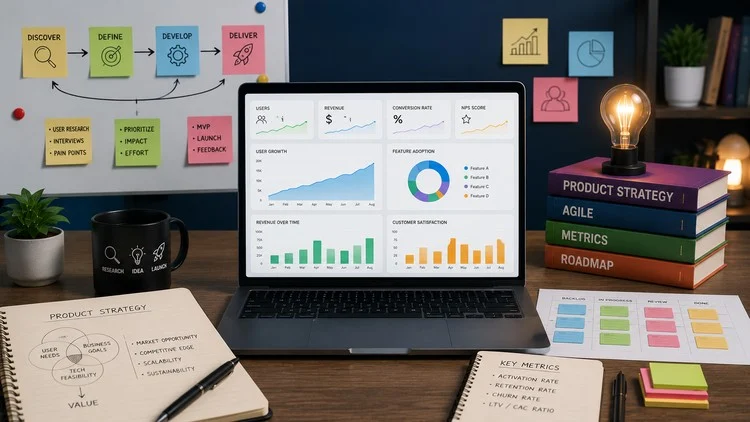
Master product discovery, KPIs, Go-to-Market (GTM) strategies, and Agile Product Ownership to ace your PM interviews.
👥 13 students
Add-On Information:
- Course Overview
- This program functions as a rigorous diagnostic tool designed to simulate the high-pressure environment of top-tier technology firm interviews, focusing on the intersection of business logic and technical execution.
- It bridges the gap between theoretical product knowledge and practical application by challenging students to defend their product decisions through a series of complex, scenario-based examinations.
- The curriculum emphasizes the “Product Mindset,” encouraging participants to look beyond simple feature requests to understand the underlying customer pain points and business objectives that drive long-term value.
- Participants will engage with a diverse range of case studies that mirror real-world dilemmas, such as managing technical debt while scaling or navigating the complexities of multi-sided marketplaces.
- The course structure focuses heavily on the “Why” behind product choices, teaching students how to articulate the reasoning for specific feature prioritizations in a way that aligns with organizational goals and vision.
- Special attention is given to the nuances of product leadership, including how to lead without formal authority and how to foster a culture of data-informed experimentation within a team.
- The exams are curated to test lateral thinking, requiring students to synthesize information from marketing, engineering, and finance to form cohesive product strategies.
- Requirements / Prerequisites
- Candidates should possess a fundamental understanding of the Software Development Life Cycle (SDLC) and how cross-functional teams collaborate to ship digital products.
- A baseline familiarity with business terminology, including profit margins, market share, and competitive landscapes, is essential for successfully navigating the strategic components of the exams.
- While no coding experience is required, a high level of technical literacy is necessary to understand how infrastructure constraints impact product roadmap decisions and feature feasibility.
- A proactive attitude toward self-directed learning is crucial, as these mock exams are designed to highlight knowledge gaps that may require further independent research or deep dives.
- Prior exposure to the role of a Product Manager or a Product Owner, either through professional experience or introductory coursework, will significantly enhance the learner’s ability to grasp advanced concepts.
- Access to a quiet environment and a commitment to completing the exams within set time limits is recommended to simulate actual interview conditions effectively.
- Skills Covered / Tools Used
- Prioritization Frameworks: Mastery of decision-making models such as RICE (Reach, Impact, Confidence, Effort), the Kano Model, and MoSCoW to objectively evaluate product backlogs.
- Analytical Software Logic: Understanding the implementation logic behind industry-standard analytics platforms like Amplitude, Mixpanel, and Google Analytics for deep-funnel exploration.
- Strategic Assessment: Utilization of SWOT analysis, Porter’s Five Forces, and PESTEL frameworks to evaluate market entry opportunities and defensive product positioning.
- Communication & Stakeholder Management: Techniques for translating complex technical requirements into business value for executive leadership and external stakeholders.
- Product-Led Growth (PLG): Strategies for building virality and self-service onboarding directly into the product core to reduce reliance on traditional sales motions.
- UX/UI Principles for PMs: Applying heuristics and cognitive psychology to improve user retention and minimize friction points within the digital customer journey.
- Financial Modeling: Developing basic spreadsheets to project the impact of new features on the company’s bottom line and unit economics.
- Benefits / Outcomes
- Develop a robust mental library of frameworks that can be deployed instantly during behavioral interviews to provide structured, logical, and impressive answers.
- Gain the ability to differentiate between vanity metrics and actionable data, ensuring that your future product reports focus on insights that actually move the needle for the business.
- Enhance your professional credibility by demonstrating a deep understanding of how Product Management integrates with Sales, Marketing, and Customer Success departments.
- Build the confidence necessary to lead Sprint ceremonies and backlog grooming sessions with authority, ensuring that the engineering team remains focused on high-impact tasks.
- Acquire a refined “Strategic Compass” that allows you to identify market trends before they become mainstream, positioning your products for first-mover advantage.
- Prepare yourself to handle “ambiguous” product prompts, such as “How would you improve a specific app?”, by applying a systematic approach to discovery and solutioning.
- Receive immediate feedback through the mock exam format, allowing for rapid iteration on your test-taking strategies and identifying specific areas for career development.
- PROS
- Realistic Simulations: The questions are modeled after actual interview banks from Fortune 500 tech companies, providing an authentic taste of the industry’s highest standards.
- Comprehensive Scope: Unlike focused bootcamps, this course covers the entire product lifecycle from initial ideation to post-launch optimization and eventual sunsetting.
- Time Efficiency: The condensed format allows busy professionals to sharpen their skills and identify weaknesses in a fraction of the time required by traditional textbooks.
- Scalable Logic: The strategies taught are applicable to various sectors, including B2B SaaS, B2C mobile apps, and even internal platform product management.
- CONS
- Self-Paced Nature: As a mock exam-based course, it lacks live 1-on-1 mentorship or real-time group discussions, requiring learners to be highly self-motivated to succeed.
Learning Tracks: English,Business,Management