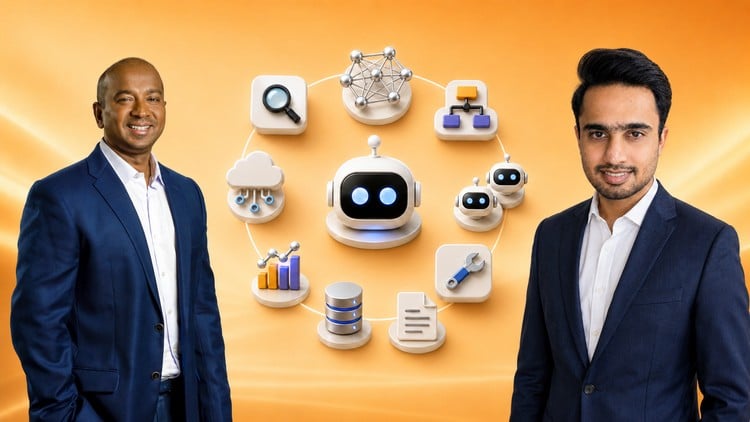
Learn to create AI assistants, research agents, tool-using agents, and multi-agent applications.
What You Will Learn:
- Build AI assistants from scratch using Python and Ollama.
- Understand the architecture of modern AI agents and autonomous workflows.
- Create planning agents that can break complex goals into actionable tasks.
- Build tool-using AI agents that interact with Python functions, APIs, and external services.
- Implement Retrieval-Augmented Generation (RAG) to build chatbots that answer questions from private documents.
- Add short-term and long-term memory to AI agents using SQLite and vector databases.
- Show more
Alright, let’s talk about the AI Agent Development with Python course. As someone who’s been in the trenches with AI for a while now, I was curious to see what this one offered, especially with the buzz around agent frameworks. My take? It’s a solid entry point for anyone looking to move beyond basic prompt engineering and into building genuinely intelligent systems.
Overview
This course dives headfirst into the nitty-gritty of building AI agents, not just theoretical concepts. They focus heavily on practical application, which is exactly what you need to be job-ready. We’re talking about going from zero to building functional agents that can do more than just spit out text. The emphasis on Ollama is a smart move, making it accessible to get local LLMs up and running without needing a supercharged GPU from day one. The curriculum smartly guides you through understanding the core components of an AI agent – the planning, the tool usage, the memory. It’s like learning to build with LEGOs, but the LEGOs are intelligent modules. They don’t just show you how to use pre-built libraries; they encourage you to understand the underlying architecture, which is crucial for career growth and tackling more complex, real-world projects.
Prerequisites
- A decent grasp of Python programming. You don’t need to be a senior developer, but being comfortable with functions, classes, and data structures is essential.
- Basic understanding of APIs and how to interact with them is helpful, though the course does touch on this.
- Familiarity with basic command-line operations will make things smoother.
Skills & Tools
You’ll walk away with hands-on experience in:
- Python (obviously)
- Ollama for local LLM deployment
- Designing agent architectures
- Implementing planning mechanisms
- Integrating with Python functions and external APIs
- Retrieval-Augmented Generation (RAG) techniques
- SQLite for short-term memory
- Vector databases for long-term memory
- Working with industry-standard tools for agent development
Career Benefits & Job Roles
This course is a direct pathway to roles like:
- AI Agent Developer
- Machine Learning Engineer (with an AI agent specialization)
- AI Automation Specialist
- Research Assistant (AI-powered)
- Developer Advocate (AI tooling)
The skills you gain are highly transferable and in demand, making it great for certification prep and upskilling for new opportunities. It equips you with job-ready skills that directly address current industry needs.
Pros
- Practical, Hands-On Approach: This isn’t a passive learning experience. You’ll be coding and building from early on, which is critical for cementing knowledge and preparing for real-world projects. The inclusion of hands-on labs is a major plus.
- Comprehensive Agent Architecture Coverage: The course doesn’t shy away from the core components. Understanding planning, tool use, and memory management is key to building sophisticated agents, and they cover these topics thoroughly.
- Accessibility with Local LLMs: Using Ollama to run models locally is a brilliant way to democratize agent development, making it less intimidating and more accessible for a wider audience without requiring hefty cloud costs upfront.
- Focus on Job-Readiness: The curriculum is clearly designed with the job market in mind, equipping you with practical, in-demand skills that directly translate to career opportunities.
Cons
If I had to pick one area for improvement, it would be that while the course covers the *building* of agents, a deeper dive into the evaluations and performance tuning of these agents could elevate it further. Understanding how to rigorously test and optimize agent behavior in complex scenarios is a crucial, often overlooked, aspect of production-ready AI systems.