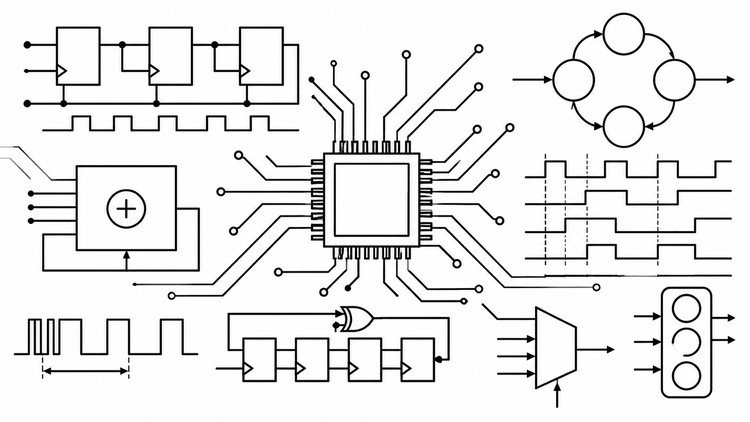
Master RTL Design, Registers, Counters, PWM, Finite State Machines, Timing Analysis and FPGA Clocking with Verilog HDL
What You Will Learn:
- Design sequential circuits using Verilog HDL, including registers, latches, flip-flops, and synchronous and asynchronous resets.
- Implement up-down counters, modulus counters, BCD counters, timers, PWM generators, and linear feedback shift registers (LFSRs).
- Analyze and implement Mealy and Moore finite state machines for control applications such as traffic light controllers.
- Understand setup time, hold time, clock skew, metastability, synchronizers, and FPGA timing reports using Vivado.
Overview: Moving Beyond “Hello World” in RTL
Look, anyone can write a basic bitwise AND gate in Verilog and call it a day. But if you’ve spent any time in the industry, you know that the real magic (and the real headaches) happens once you introduce a clock signal. I recently went through the Advanced Verilog HDL — Sequential Logic, Counters & FSMs course, and honestly, it’s the bridge most students need to cross the gap from “coding for fun” to “designing for silicon.”
What I appreciated most wasn’t just the syntax—it was the focus on hardware reality. In the professional world, we don’t just “write code”; we perform RTL design. This course forces you to think about how your Verilog translates into actual physical flip-flops and look-up tables (LUTs). It moves past simple combinational logic and dives deep into the temporal dimension of hardware. If you’ve ever struggled with why your simulation works but your hardware glitches, the sections here on synchronous and asynchronous resets and metastability will be your “lightbulb” moments. This isn’t just an academic exercise; it’s a deep dive into the industry-standard tools and methodologies used in modern VLSI design.
Prerequisites
Don’t jump into this if you don’t know what a logic gate is. To get the most out of these hands-on labs, you should have:
- A solid grasp of basic Verilog syntax (modules, ports, and wire vs. reg).
- Fundamental knowledge of digital logic (AND/OR/XOR gates and Truth Tables).
- A working installation of Xilinx Vivado (or a similar synthesis tool) if you want to follow along with the real-world projects.
- A “hardware mindset”—understanding that code executes in parallel, not line-by-line like C++ or Python.
Skills & Tools
This course is packed with job-ready skills that directly translate to the cubicle. You aren’t just learning theory; you’re building a portfolio of functional blocks. Key takeaways include:
- Architectural Design: Mastering Finite State Machines (FSMs) using both Mealy and Moore architectures—this is the bread and butter of control logic.
- Complex Counters: Implementing everything from simple up-down counters to Linear Feedback Shift Registers (LFSRs) and BCD timers.
- Timing Analysis: Getting a grip on setup time, hold time, and clock skew. This is where the beginner to advanced transition really happens.
- Xilinx Vivado: Navigating FPGA timing reports to ensure your design actually meets the physical constraints of the chip.
- Signal Processing Basics: Using PWM generators to bridge the gap between digital logic and analog output.
Career Benefits & Job Roles
If you’re looking for career growth in the semiconductor space, these skills are non-negotiable. We are currently seeing a massive resurgence in domestic chip manufacturing and ASIC design, and companies are desperate for engineers who actually understand sequential logic.
Completing a course like this serves as excellent certification prep for technical interviews at companies like Intel, NVIDIA, or AMD. You’ll be well-positioned for roles such as:
- FPGA Design Engineer: Implementing high-speed data paths and control logic.
- RTL Validation Engineer: Writing testbenches and verifying complex state transitions.
- Hardware Developer: Designing custom peripherals for embedded systems.
- Digital IC Design Engineer: Working on the core architecture of next-gen processors.
Pros
- The Focus on Timing: Most online tutorials ignore timing analysis. This course tackles it head-on, explaining metastability and synchronizers. This is exactly what separates a hobbyist from a professional.
- Project-Based Learning: You aren’t just staring at slides. Building a traffic light controller or a PWM generator gives you real-world projects you can actually discuss in a job interview.
- Tool Integration: Using Vivado for FPGA clocking and timing reports makes the experience feel authentic to the daily workflow of a hardware engineer.
- FSM Depth: The distinction between Mealy and Moore machines is handled with great clarity, which is crucial since FSMs are the “brain” of almost every digital system.
Cons
- Steep Learning Curve: While it claims to go from beginner to advanced, the jump into timing constraints and clock domain crossing basics can feel like drinking from a firehose if you haven’t mastered basic sequential elements first. It requires significant self-study and re-watching of the labs to truly internalize the concepts.