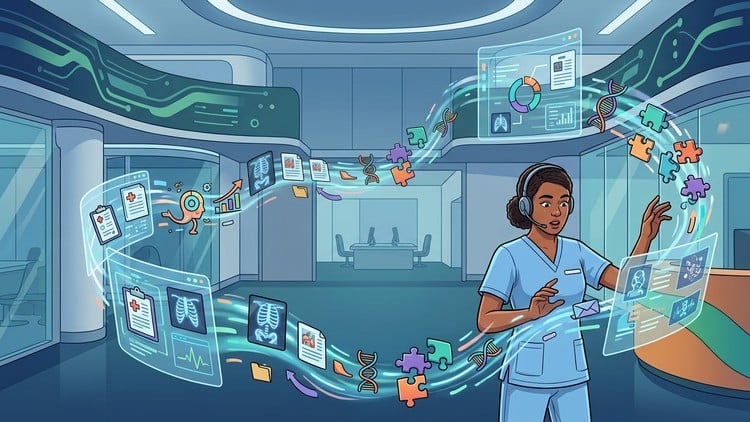
Practice Questions with Explanations to Help You Pass the Electronic Health Records Specialist Exam with Confidence
What You Will Learn:
- Learn how to verify patient identity and collect accurate health data in electronic records.
- Understand clinical documentation, charting formats, and secure data handling.
- Master the revenue cycle including coding, insurance checks, and payment posting.
- Apply HIPAA rules and compliance standards to protect patient privacy and data.
- Navigate EHR systems smoothly and support both clinical and non-clinical workflows.
Overview: My Take on the 2026 CEHRS Prep
Let’s be real for a second—studying for any NHA certification can feel like a total slog if you’re just staring at a dry textbook. I’ve seen plenty of certification prep materials that are either five years outdated or so theoretical they’ve lost touch with how a modern hospital actually functions. The “Practice Tests For CEHRS Exam 2026” is a different beast entirely. It’s designed specifically for the upcoming 2026 standards, which is a huge deal because the shift toward interoperability and patient-driven data is moving faster than most curriculum developers can keep up with.
What I appreciate here is that it doesn’t just ask you to memorize industry-standard tools or acronyms. Instead, it forces you to think like an Electronic Health Records Specialist sitting in a high-pressure clinic. It bridges the gap between beginner to advanced concepts by using situational questions. You aren’t just clicking “A” or “B”; you’re deciding how to handle a data discrepancy or a breach in protocol. For anyone looking to get job-ready skills, this isn’t just a test bank—it’s a stress test for your professional intuition. It’s about the “why” behind the click, focusing heavily on the accuracy of the data lifecycle rather than just the mechanics of the software.
Prerequisites
You don’t need a degree in Computer Science to dive into this, but you shouldn’t go in totally cold either. Ideally, you’ve already completed a basic Electronic Health Records course or have worked in a front-office medical setting. A solid grasp of basic medical terminology is a must. If you don’t know the difference between an acute and chronic condition, or if you’ve never seen a CMS-1500 form, you might find some of the revenue cycle questions a bit jarring. This is essentially the “final boss” of your certification prep journey, so treat it as the polishing phase of your studies.
Skills & Tools
While this is a practice test suite, it effectively trains you in several industry-standard tools and methodologies by proxy. You’ll be mentally navigating through:
- Clinical Documentation: Mastering various charting formats like SOAP notes and ensuring they meet audit-ready standards.
- Data Security: Deep-diving into HIPAA rules and the technical safeguards required for secure data handling.
- Revenue Cycle Management: Learning the flow from insurance verification to payment posting without losing revenue in the cracks.
- Interoperability: Understanding how data moves between different EHR systems and the importance of accurate patient identity verification.
- Compliance: Applying real-world projects logic to regulatory standards to ensure the facility remains compliant with federal laws.
Career Benefits & Job Roles
The career growth potential in Healthcare IT is massive right now. We’re seeing a massive push for data-driven healthcare, and that requires specialists who actually know what they’re doing. Passing the CEHRS exam isn’t just about getting a piece of paper; it’s about proving you have the job-ready skills to manage the backbone of a medical practice. Once you’ve used these practice tests to nail the exam, you’re looking at roles like EHR Implementation Specialist, Medical Records Coordinator, or even Health Data Analyst. These aren’t just entry-level “file clerk” jobs anymore; they are tech-adjacent roles that offer a clear path into Healthcare Information Management (HIM) and higher-tier administration. In an era where real-world projects increasingly rely on clean data, being the person who ensures that data is accurate is a very safe career bet.
Pros
- Highly Relevant Explanations: This isn’t just an answer key. The explanations are robust, explaining why the wrong answers are wrong, which is where the real learning happens.
- Modern Context: It includes 2026-specific standards, meaning you aren’t wasting time on legacy systems or outdated HIPAA interpretations that no longer apply.
- Confidence Builder: The difficulty level is slightly higher than the actual exam in some sections, which is exactly what you want. If you can pass these, the actual NHA exam will feel like a breeze.
- Strategic Focus: It places a heavy emphasis on the revenue cycle and compliance, which are the two areas where most candidates struggle during the actual certification prep phase.
Cons
- Requires Prior Knowledge: This is strictly a testing and certification prep tool. If you are looking for hands-on labs where you can actually click through a live EHR demo like Epic or Cerner, you won’t find that here—this is about the knowledge and logic required to pass the exam, not a software simulation.