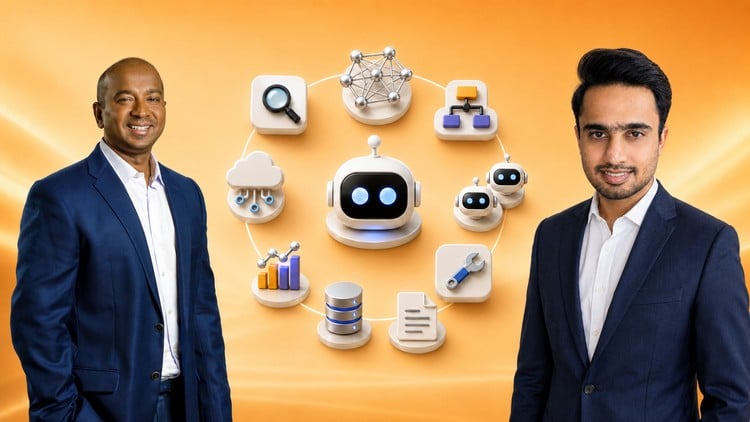
Learn to create AI assistants, research agents, tool-using agents, and multi-agent applications.
What You Will Learn:
- Build AI assistants from scratch using Python and Ollama.
- Understand the architecture of modern AI agents and autonomous workflows.
- Create planning agents that can break complex goals into actionable tasks.
- Build tool-using AI agents that interact with Python functions, APIs, and external services.
- Implement Retrieval-Augmented Generation (RAG) to build chatbots that answer questions from private documents.
- Add short-term and long-term memory to AI agents using SQLite and vector databases.
- Show more
Overview: Moving Beyond the Chatbot Hype
If you’ve been hanging around the tech scene lately, you know that everyone and their mother is claiming to be an “AI Expert” because they figured out how to write a decent prompt. But let’s be real: the real value in today’s market isn’t in knowing how to talk to an LLM—it’s in knowing how to build autonomous systems that can actually do work. I recently dove into the ‘AI Agent Development with Python’ course, and I have to say, it’s a refreshing departure from the usual surface-level fluff. While most tutorials just show you how to call an OpenAI API, this course focuses on the “brain” behind the operation.
The core insight here is that an agent isn’t just a chatbot; it’s a reasoning engine. We’re talking about moving from a linear input-output model to a circular, iterative workflow where the AI evaluates its own work, uses industry-standard tools, and searches for information it wasn’t trained on. What I appreciated most was the focus on local development. Using Ollama to run models locally means you aren’t bleeding API credits while you’re in the “trial and error” phase of your hands-on labs. This is where the industry is heading—privacy-first, local-heavy, and highly specialized agents that don’t need a constant tether to a massive cloud provider.
This course doesn’t just hand you a script; it forces you to think about the architecture of modern AI agents. You start to see LLMs as a component in a larger machine, much like a CPU, rather than the machine itself. For anyone looking for career growth in a saturated market, shifting your focus from “AI user” to “AI architect” is the single best move you can make.
Prerequisites
- Intermediate Python Proficiency: You don’t need to be a core dev, but you should be comfortable with asynchronous programming, decorators, and basic class structures.
- Basic Command Line Knowledge: Since you’ll be working with Ollama and local environments, you need to know your way around a terminal.
- Understanding of APIs: A fundamental grasp of how REST APIs work will help when you start building tool-using AI agents.
- Hardware Requirements: While not strictly software, having a machine with a decent GPU (or an Apple Silicon Mac) makes running local LLMs a much smoother experience.
Skills & Tools Covered
- Programming & Logic: Advanced Python scripting for agentic workflows and autonomous decision-making loops.
- Local LLM Orchestration: Setting up and managing Ollama for private, cost-effective model deployment.
- Data Management: Using SQLite for persistent memory and Vector Databases (like Chroma or Pinecone) for high-performance retrieval.
- RAG Architecture: Implementing Retrieval-Augmented Generation to allow agents to “read” and analyze your private documentation.
- State Management: Building short-term and long-term memory systems so your agents don’t “forget” the context of a conversation.
- Multi-Agent Frameworks: Learning how to make different agents talk to each other to solve real-world projects.
Career Benefits & Job Roles
The demand for developers who can build custom AI solutions is skyrocketing. This isn’t just about “learning to code” anymore; it’s about certification prep for a new era of software engineering. Completing a course like this provides job-ready skills that bridge the gap between traditional software development and machine learning engineering. Companies are desperate for “AI Integration Specialists” who can take their messy, private data and make it searchable and actionable via autonomous workflows.
Potential job roles include:
- AI Engineer: Designing and deploying agentic systems for enterprise use.
- Machine Learning Operations (MLOps): Managing the lifecycle of local and cloud-based models.
- Automation Architect: Replacing brittle, legacy scripts with dynamic, tool-using AI agents.
- Solution Architect: Designing multi-agent applications that can handle complex, multi-step business goals.
Regardless of the title, the goal is career growth by becoming the person who knows how the “magic” actually works under the hood.
Pros
- Cost-Effective Learning: By using Ollama, the course teaches you how to build without racking up a $500 monthly bill from OpenAI or Anthropic.
- From Beginner to Advanced: It scales beautifully. You start with a basic script and end with a multi-agent application that can plan and execute tasks autonomously.
- Focus on Memory: Most courses ignore long-term memory. This one spends significant time on SQLite and vector databases, which is crucial for building anything beyond a toy app.
- Practical Utility: The real-world projects are actually useful. You aren’t just building a “hello world” bot; you’re building research agents that can browse the web and interact with APIs.
Cons
- Debugging Complexity: Let’s be honest—debugging AI agents is a pain in the neck. Because LLMs are non-deterministic, the course can sometimes feel like you’re chasing ghosts when an agent decides to hallucinate a tool call, and more “troubleshooting” content would have been a welcome addition.