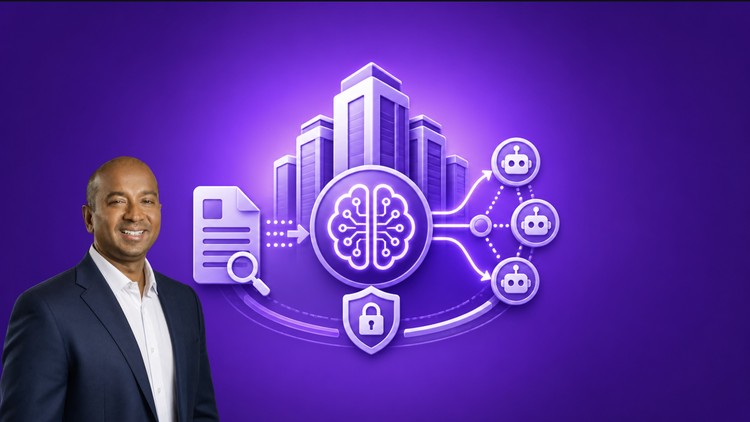
Design secure enterprise GenAI systems with RAG, AI agents, governance, monitoring, and production-scale architecture.
What You Will Learn:
- Explain the business drivers behind enterprise generative AI adoption and identify where GenAI can create measurable value.
- Understand common enterprise GenAI architecture patterns, deployment models, and integration approaches.
- Compare public cloud, private cloud, hybrid, and on-premises deployment considerations.
- Identify enterprise knowledge sources suitable for retrieval-augmented generation.
- Design RAG pipelines involving document ingestion, chunking, embeddings, indexing, retrieval, and grounded generation.
- Apply retrieval, ranking, filtering, and metadata strategies to improve response relevance.
- Show more
Overview: Moving Beyond the Chatbot Hype
Let’s be honest: everyone and their cousin knows how to prompt ChatGPT by now. But building a production-grade generative AI system that doesn’t leak sensitive company data or hallucinate nonsense at a board member? That’s where the real challenge lies. I recently dove into the Enterprise GenAI with RAG and Agents course, and it’s a refreshing departure from the “Hello World” tutorials flooding the internet. Instead of just showing you how to call an API, this course focuses on the “Production Gap”—the massive chasm between a cool demo and a secure, scalable, enterprise-ready architecture.
The core insight here is that enterprise AI isn’t just about the model; it’s about the infrastructure surrounding it. We’re talking about governance, monitoring, and security. This course moves fast from beginner to advanced concepts, forcing you to think like an architect rather than just a script kiddie. It tackles the hard questions: How do you handle hybrid cloud deployments? How do you ensure your retrieval-augmented generation (RAG) pipeline is actually pulling the right data? It’s a deep dive into turning LLMs into reliable business tools that solve actual problems rather than just being a fancy parlor trick.
Prerequisites: What You Need Before You Start
Don’t expect to walk in here without some technical skin in the game. While the course covers business drivers, you’ll get the most value if you have:
- A solid handle on Python programming (async calls and data manipulation are key).
- A foundational understanding of Cloud Computing (AWS, Azure, or GCP—the principles are similar).
- Basic knowledge of REST APIs and how data flows through a microservices architecture.
- Familiarity with Machine Learning basics—you don’t need a PhD, but you should know what an “embedding” is before you start the hands-on labs.
Skills & Tools: The Enterprise Tech Stack
This isn’t a theoretical lecture; it’s a toolkit for the modern AI engineer. You’ll spend time with industry-standard tools and frameworks that are actually being used in high-stakes environments. Key focus areas include:
- Orchestration Frameworks: Deep dives into LangChain and LlamaIndex for building complex agentic workflows.
- Vector Databases: Understanding the nuances of Pinecone, Weaviate, or Milvus for high-performance retrieval.
- Data Engineering for AI: Mastering chunking strategies and metadata filtering to keep your RAG pipeline accurate.
- Security & Governance: Implementing PII masking, rate limiting, and cost management to keep the finance team happy.
- Monitoring: Using tools for LLM observability to track drift and response quality in real-time.
Career Benefits & Job Roles
The market is currently starving for people who can actually deploy these systems. This course is excellent certification prep for anyone looking to validate their expertise. Completing real-world projects within this curriculum gives you a portfolio that says, “I can build secure systems,” which is a massive differentiator in the current job market. Potential roles include:
- AI Architect: Designing the high-level flow of Enterprise GenAI systems.
- Generative AI Engineer: Building and fine-tuning RAG pipelines and AI agents.
- Machine Learning Operations (MLOps) Engineer: Focusing on the deployment and scaling of LLM-based applications.
- Solution Architect: Helping legacy enterprises integrate AI into their existing hybrid cloud workflows.
This is career growth fuel. Being able to talk about grounded generation and agentic reasoning in a job interview puts you in the top 5% of candidates right now.
Pros: Why This Course Hits the Mark
- Architecture First: It treats AI as a software engineering discipline. You learn about deployment models (on-prem vs. cloud) that actually matter to CTOs.
- Practical RAG: The focus isn’t just on “retrieval,” but on ranking, filtering, and metadata strategies. This is what prevents your AI from giving “confident-but-wrong” answers.
- Focus on AI Agents: Beyond simple Q&A, you learn how to build AI agents that can actually take actions, which is the next frontier of job-ready skills.
Cons: The Honest Truth
The only real downside is the pacing for absolute beginners. If you aren’t comfortable with high-level architectural diagrams or managing API keys, you might feel a bit underwater by the second module. It’s a hands-on labs intensive experience, and if you don’t stay on top of the rapidly changing industry-standard tools, some of the specific library syntax might feel a bit dated by the time you finish—though the core Enterprise GenAI principles remain rock solid.