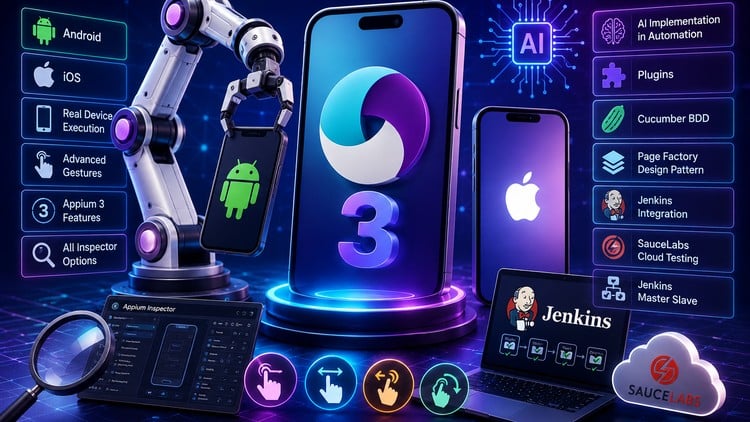
Learn Appium 3, AI, Android, iOS, Cucumber, Jenkins, SauceLabs & real device mobile automation
What You Will Learn:
- Master Appium 3 mobile automation from basics to advanced
- Automate Android and iOS mobile applications
- Execute tests on real Android and real iPhone devices
- Implement Cucumber BDD and Page Factory frameworks
- Work with advanced gestures and mobile interactions
- Integrate Appium automation with Jenkins and SauceLabs
- Understand Jenkins master-slave execution setup
- Learn Java concepts required for automation testing
- Explore AI concepts and AI implementation in Mobile automation testing
- Prepare for Appium automation interviews with real interview questions and answers
Overview: Beyond the Hype of Appium 3
If you’ve been in the QA space for more than a minute, you know that mobile automation is often the “final boss” of testing. Between flaky selectors, device fragmentation, and the nightmare of setting up environment variables, many testers retreat to the safety of web automation. However, the Appium 3 Mobile Automation with AI course feels like a genuine attempt to bridge that gap. Having sat through dozens of these tutorials, I can tell you that this one stands out because it doesn’t just treat Appium like a library—it treats it like an ecosystem.
The transition to Appium 3 is a significant shift in the industry, and this course captures that evolution well. What I found refreshing was the departure from the “tutorial-hell” loop. Instead of just showing you how to click a button on an emulator, it dives into the nuances of the new driver-based architecture. The inclusion of AI-driven testing isn’t just marketing fluff either. It explores how AI can be leveraged for element discovery and self-healing scripts—features that are becoming industry-standard tools for anyone looking to stay relevant. It’s a beginner to advanced roadmap that actually respects the learner’s time by focusing on what works in a production environment rather than just a sandbox.
Prerequisites: What You Actually Need
While the course advertises itself as accessible, don’t walk in totally cold. You’ll need a machine with enough RAM to run Android Studio and Xcode simultaneously (16GB is the sweet spot, though you can scrape by with 8GB). While the instructor covers the essential Java concepts, having a baseline understanding of loops, classes, and inheritance will save you from hitting the “pause” button every five minutes. Most importantly, you need a mindset for troubleshooting. Mobile automation is 20% writing code and 80% figuring out why the server won’t talk to the device. If you have the patience for that, the hands-on labs provided here will do the rest.
Skills & Tools: The Full Stack Experience
This course is essentially a toolkit for a modern SDET (Software Development Engineer in Test). You aren’t just learning a single tool; you are building a pipeline. The curriculum covers:
- Appium 3 Framework: Understanding the decoupled server-client architecture and driver management.
- Cucumber BDD: How to write tests that stakeholders can actually read using Gherkin syntax.
- Cloud Integration: Running tests on SauceLabs to solve the “I don’t have 50 physical phones” problem.
- CI/CD Mastery: Setting up Jenkins with a master-slave configuration, which is a critical job-ready skill.
- Advanced Gestures: Moving beyond simple clicks to handle swipes, pinches, and long-presses that real users actually use.
Career Benefits & Job Roles
Let’s talk money and career growth. The market for manual testers is shrinking, but the demand for mobile automation engineers is skyrocketing. Completing a course of this depth is excellent certification prep for internal company promotions or external job-ready skills validation. By mastering real-world projects involving both Android and iOS, you position yourself for roles like Mobile Automation Lead, QA Architect, or Release Engineer. Companies are desperate for people who can integrate automation into their DevOps pipeline, and the Jenkins/SauceLabs section of this course gives you exactly the talking points you need for high-level interviews.
Pros
- Real Device Focus: The course doesn’t cheat by only using emulators. Seeing tests run on a real iPhone and Android device is crucial for understanding real-world latency and hardware issues.
- End-to-End DevOps: It doesn’t stop at “Test Passed.” The focus on Jenkins master-slave execution is a pro-level topic that most courses ignore, yet it’s exactly what enterprise companies use.
- Interview Readiness: The dedicated section for Appium automation interview questions is gold. It covers the “why” behind the code, which is what senior-level recruiters actually look for.
Cons
If I have one gripe, it’s the initial setup phase. Mobile automation setup is notoriously tedious (especially for iOS/macOS), and while the course tries to be thorough, it can feel overwhelming for a true beginner. I would have liked to see a bit more “troubleshooting common errors” documentation for when the WebDriverAgent inevitably fails to build on a first attempt. It’s a hurdle every mobile tester faces, and a few more “what if this breaks” scenarios would have been the cherry on top.
Overall, if you’re looking to transition into high-paying automation roles, this is one of the most comprehensive deep dives available today. It takes you from the basics to the cutting edge of AI implementation without losing the plot.