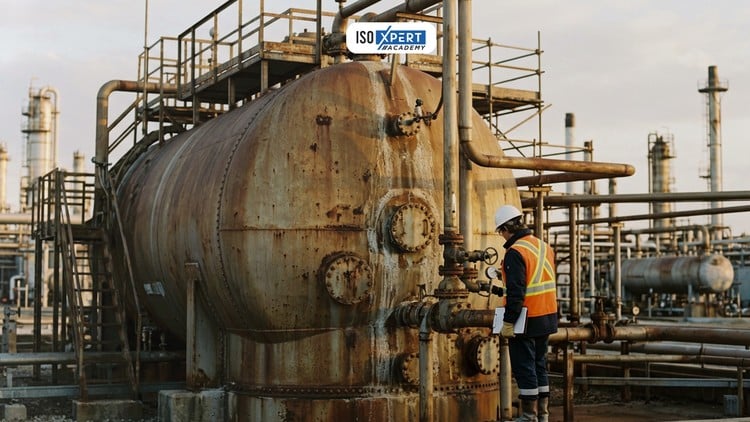
Identify, inspect & prevent refinery equipment failures. Master API RP 571 damage mechanisms with real-world case study.
What You Will Learn:
- Understand and identify over 70+ damage mechanisms affecting fixed equipment in refining operations
- Apply proper inspection techniques and strategies for each damage mechanism
- Integrate damage mechanism knowledge into Risk-Based Inspection (RBI) programs
- Analyze failure modes and determine root causes of equipment degradation
- Develop effective mitigation and prevention strategies for damage mechanisms
- Interpret inspection data and assess equipment fitness-for-service
- Understand material selection considerations for damage mechanism resistance
- Prepare for API ICP certifications (API 510, 570, 653, 571, 580)
- Apply API RP 571 principles to real-world inspection scenarios
- Implement best practices from international case studies and industry standards
Overview: More Than Just a Study Guide
Let’s be honest: most people approach the API RP 571: Damage Mechanisms course because they have a terrifying exam date looming on the calendar. But after spending a significant amount of time in the refining and petrochemical sector, I’ve realized that this material is the literal “Bible” of asset integrity. This course isn’t just a dry walkthrough of a 500-page document; it’s a deep dive into the “how” and “why” of mechanical failure.
What I appreciated most about this specific certification prep program was how it transitioned from beginner to advanced concepts without losing the student in academic jargon. It covers over 70 damage mechanisms—from the common headaches like Corrosion Under Insulation (CUI) to the high-stakes nightmares like High-Temperature Hydrogen Attack (HTHA). The course uses a real-world project approach, walking you through failure modes that actually happen on-site, rather than just reciting definitions. It’s an opinionated take on inspection, prioritizing what actually kills equipment versus what just looks ugly during a turnaround.
Prerequisites: What You Need Before You Dive In
While the course is marketed as accessible, don’t walk in totally green. To get the most out of this, you should have a baseline understanding of:
- Basic mechanical properties of metals (yield strength, ductility, etc.).
- A general familiarity with refinery or chemical plant layouts.
- Experience with basic industry-standard tools like ultrasonic testing (UT) or radiographic testing (RT) is a huge plus, though not strictly required.
- A mindset for detailed failure mode analysis; this isn’t a course you can skim and expect to master.
Skills & Tools: Building Your Technical Arsenal
This course isn’t about learning how to turn a wrench; it’s about building the job-ready skills needed to predict the future of a pressure vessel or piping system. By the end, you’re proficient in:
- Risk-Based Inspection (RBI): Learning how to prioritize equipment based on its likelihood of failure.
- Material Selection: Understanding why 300-series stainless steel might be great for one process but a disaster for another due to Stress Corrosion Cracking (SCC).
- Non-Destructive Testing (NDT) Strategy: Knowing exactly which tool to use for which “bad actor” mechanism.
- Fitness-for-Service (FFS): Assessing if a pitted tank can safely stay in operation or if it needs an immediate shutdown.
Career Benefits & Job Roles
If you’re looking for career growth, this is one of the highest-leverage certifications you can grab. In the Oil & Gas world, an API 571 certification is a badge of technical authority. It moves you from “the person who takes the measurements” to “the person who interprets the data.” Common job roles for graduates include:
- Fixed Equipment Inspector: Essential for API 510, 570, and 653 holders looking to specialize.
- Asset Integrity Engineer: Managing the long-term health of multi-billion dollar plants.
- Corrosion Technician: Designing mitigation and chemical injection strategies.
- Reliability Consultant: Working for third-party firms to audit plant safety and Risk-Based Inspection programs.
The Pros: Why This Course Stands Out
- Comprehensive Case Studies: The inclusion of hands-on labs (digital simulations) and international case studies is a game changer. Seeing a photo of a ruptured heat exchanger tube and then tracing it back to Sulfidation makes the theory stick.
- Certification Synergy: This course is the “missing link” for anyone pursuing API 510, 570, or 653. It provides the technical depth that those broader certifications often gloss over.
- Practical Mitigation Strategies: It doesn’t just tell you what’s breaking; it tells you how to stop it. The focus on effective mitigation and prevention is what makes this a practical tool for daily plant operations, not just a certificate for your LinkedIn profile.
The Cons: An Honest Critique
The sheer volume of information can be overwhelming. Because the course covers 70+ mechanisms, the pace can feel like drinking from a firehose. If you aren’t disciplined with your note-taking, the differences between various forms of environmental cracking can start to blur together by the third module. It requires a significant time commitment—don’t expect to “fast-track” this in a weekend.
In summary, if you want to be more than just a “code-checker” and actually understand the metallurgy and chemistry of plant failures, this course is worth every penny. It delivers job-ready skills that are in high demand across the globe.