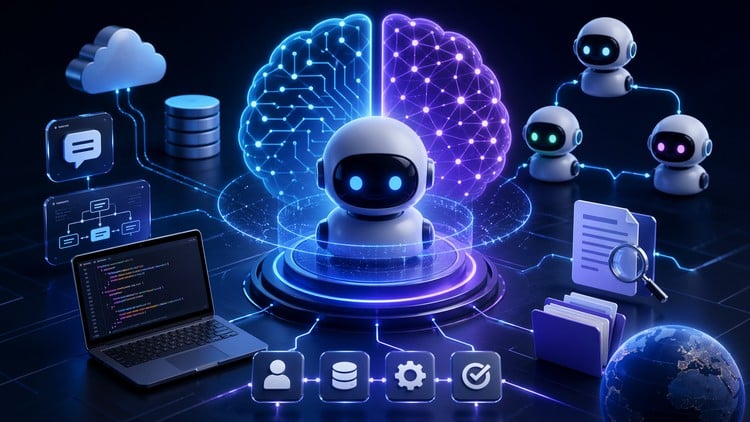
Master RAG, Prompt Engineering, Automation, Safety, Debugging & Production AI Systems with Hands-On Projects
What You Will Learn:
- Build and deploy real AI agents that can handle tasks, automate workflows, and operate like AI employees
- Master prompt engineering from basics to advanced techniques including structured outputs and optimization
- Design AI systems with memory, context, and decision-making logic for smarter and more reliable agents
- Create RAG (Retrieval-Augmented Generation) systems to connect AI with custom data and improve accuracy
- Develop autonomous workflows and multi-agent systems that run 24/7 with scheduling and triggers
- Build real-world projects like AI Customer Support, Business Analyst, Email Automation, and Task Automation agents
- Deploy AI applications using VPS, APIs, and production-ready setups
- Optimize systems with cost control, caching, prompt efficiency, and performance improvements
- Implement AI safety techniques including guardrails, validation, and hallucination handling
- Learn debugging, testing, and monitoring to build reliable and scalable AI systems
Alright, let’s talk about the ‘Agentic AI & Prompt Engineering Bootcamp: Build AI Employees.’ As someone who’s spent a fair bit of time wrestling with various AI frameworks and deployment challenges, I’ve seen my share of courses that promise the moon but deliver a pebble. This one, however, caught my eye with its ambitious claim of helping you “build AI employees.” That’s a bold statement, and frankly, I was skeptical but intrigued. After diving in, I can say it largely delivers on that promise, pushing past mere prompt design into the fascinating realm of autonomous agents.
The core idea here isn’t just about crafting a clever prompt for ChatGPT. It’s about designing and deploying AI systems that can independently understand tasks, access information, make decisions, and execute actions – essentially, functioning as intelligent, automated extensions of your workforce. This goes beyond simple conversational AI; we’re talking about true workflow automation, where AI agents can interact with external tools, manage state, and persist information. It’s a significant leap from what most developers are currently doing with LLMs, moving towards genuinely smart, proactive systems. The bootcamp tackles the engineering aspects head-on, focusing on building robust, production-grade agents rather than just theoretical constructs. This practical, implementation-first approach is refreshing and, frankly, essential for anyone serious about leveraging AI beyond experimental scripts.
Prerequisites
While the course description mentions “basics to advanced techniques,” let’s be realistic: you’ll get the most out of this if you have a solid foundation in Python programming. This isn’t a “learn to code” bootcamp. Familiarity with common data structures, API interactions, and object-oriented programming will serve you well. A basic understanding of what an LLM is and how it generally works is also highly beneficial, though not strictly required, as the prompt engineering section does cover foundational concepts. If you’re completely new to programming or AI, prepare for a steeper learning curve, but it’s certainly manageable with dedication. Think of it as an accelerator for those with a technical background, rather than an introduction for absolute beginners.
Skills & Tools
This bootcamp is packed with practical skills. You’ll move beyond basic prompt templates to mastering advanced prompt engineering techniques, including structured outputs, few-shot prompting, and tools like JSON mode. A major focus is on designing sophisticated AI systems with memory, context management, and complex decision-making logic, often leveraging external tools and APIs. You’ll gain hands-on experience building RAG (Retrieval-Augmented Generation) systems to ground AI models with custom, up-to-date data, making your agents highly accurate and domain-specific. The course also delves deep into creating autonomous workflows and multi-agent systems that can run 24/7, complete with scheduling and triggers. On the deployment front, you’ll learn how to get your AI applications live using VPS and various API setups, focusing on production-ready setups. Crucially, it covers optimization techniques like cost control, caching, and prompt efficiency, along with critical AI safety measures such as guardrails, validation, and hallucination handling. Expect to work with industry-standard tools and frameworks like LangChain, various vector databases, and potentially cloud-specific services (implicitly, for deployment).
Career Benefits & Job Roles
This bootcamp genuinely delivers job-ready skills that are in high demand right now. Mastering agentic AI and advanced prompt engineering positions you perfectly for roles such as AI Engineer, Prompt Engineer, Machine Learning Engineer (with a strong focus on deployment and MLOps), AI Automation Specialist, or even an AI Solutions Architect. For existing developers, it’s a phenomenal way to supercharge your existing skill set and unlock significant career growth in the rapidly evolving AI landscape. The ability to build, deploy, and manage autonomous AI systems that can automate complex business processes is a game-changer for companies, and you’ll be equipped to lead those initiatives. While not a direct certification prep course for a specific vendor, the comprehensive knowledge gained here will put you in an excellent position to tackle advanced AI certifications or demonstrate competence in high-stakes interviews.
Pros
- Deep Dive into Agentic AI: Unlike many courses that skim the surface, this bootcamp provides a comprehensive, beginner to advanced exploration of building truly autonomous AI agents. The promise of “AI employees” isn’t just marketing; it’s a practical outcome.
- Hands-On & Project-Centric: The emphasis on real-world projects like AI Customer Support, Business Analyst, and Email Automation agents means you’re not just learning theory. You’re building a robust portfolio through practical, hands-on labs that demonstrate tangible skills.
- Production-Ready Focus: It goes beyond mere development, covering critical aspects of deploying, optimizing, and maintaining production AI systems. Topics like cost control, debugging, monitoring, and AI safety are invaluable for anyone looking to implement AI in a business context.
- Highly Relevant & Future-Proof: The skills taught here – RAG, multi-agent systems, advanced prompt engineering – are at the forefront of AI development. This course equips you with expertise in cutting-edge techniques that will be crucial for the next wave of AI applications, significantly boosting your career growth prospects.
Cons
- Steep Initial Curve for True Novices: While it attempts to cover basics, the sheer volume and complexity of topics, especially concerning deployment and debugging of multi-agent systems, mean that individuals with absolutely no prior coding experience or AI exposure might find the pace challenging. It’s best suited for those with at least a foundational understanding of Python and basic programming concepts.