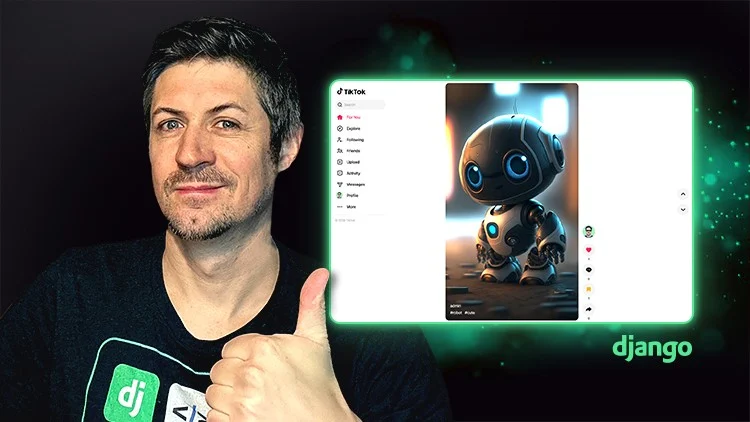
Build a full-stack social media app from scratch with Django: frontend, backend, and deployment.
⏱️ Length: 16.4 total hours
👥 79 students
🔄 March 2026 update
Add-On Information:
Note➛ Make sure your 𝐔𝐝𝐞𝐦𝐲 cart has only this course you're going to enroll it now, Remove all other courses from the 𝐔𝐝𝐞𝐦𝐲 cart before Enrolling!
- Course Overview
- Analyze the paradigm shift toward Hypermedia-Driven Applications, where the server retains control of the state while providing a highly reactive user experience.
- Explore the architectural philosophy of the Django-HTMX-Alpine (DHA) stack, which serves as a lightweight and powerful alternative to complex Single Page Application (SPA) frameworks.
- Understand the intricacies of building vertical scroll video feeds that demand high performance, efficient data fetching, and seamless media playback transitions.
- Deep dive into the request-response lifecycle of hypermedia fragments, learning how to update specific parts of the DOM without full page reloads.
- Master the implementation of infinite scrolling logic by utilizing server-side triggers that detect when a user has reached the bottom of the content container.
- Study the integration of reactive frontend components that handle localized state, such as toggling menus, modal windows, and interactive buttons, using minimal declarative code.
- Evaluate the trade-offs between client-side rendering and server-side rendering, focusing on why keeping logic in Python leads to faster development cycles.
- Learn to architect a content delivery strategy specifically designed for high-bandwidth media like short-form video content.
- Requirements / Prerequisites
- A fundamental grasp of Python 3.x programming, including an understanding of classes, decorators, and basic data structures like dictionaries and lists.
- Basic familiarity with Django’s Model-Template-View (MTV) pattern and how the framework handles URL routing and view logic.
- Experience using a Command Line Interface (CLI) to manage virtual environments, install packages, and execute administrative scripts.
- Conceptual knowledge of Relational Database Management Systems (RDBMS) and how primary keys and foreign keys define data relationships.
- A working installation of Python and a code editor like VS Code or PyCharm, along with the ability to manage local file directories.
- Standard understanding of HTTP protocols, specifically how headers and status codes function during browser-to-server communication.
- Skills Covered / Tools Used
- Implementing PostgreSQL as the primary data store to manage complex many-to-many relationships between users, followers, and video interactions.
- Configuring Redis as a message broker to facilitate the exchange of data between the application server and the background worker processes.
- Utilizing Django Signals to automate backend workflows, such as automatically generating user profiles or triggering notifications upon specific events.
- Leveraging FFmpeg or similar libraries for processing video uploads, ensuring that media is optimized for web playback across different devices.
- Applying WhiteNoise or AWS S3 for managing static and media files, ensuring that assets are served securely and efficiently in a production environment.
- Integrating python-decouple to manage environment variables, keeping sensitive credentials like API keys and database passwords out of the source code.
- Mastering Django QuerySet optimization techniques, such as select_related and prefetch_related, to prevent the N+1 query problem in large feeds.
- Setting up Nginx as a reverse proxy and Gunicorn as the WSGI server to handle concurrent requests and maintain high application availability.
- Building custom Django Template Tags to encapsulate complex logic and create reusable UI components that can be dropped into any page.
- Managing User Authentication and Authorization, including custom user models that support unique profile requirements and secure password handling.
- Using Docker and Docker Compose to create reproducible development environments that mirror the final production setup.
- Implementing Cross-Site Request Forgery (CSRF) protections within AJAX and HTMX requests to maintain high-level security standards.
- Benefits / Outcomes
- Acquire the ability to build dynamic, modern web applications without the steep learning curve and technical debt often associated with JavaScript-heavy stacks.
- Develop a comprehensive portfolio project that demonstrates full-stack proficiency, from database design to deployment and DevOps.
- Improve developer productivity by utilizing a unified language (Python) for both the backend logic and the majority of the frontend interactivity.
- Learn how to scale a social media architecture by understanding how to handle high-frequency interactions like likes, comments, and shares.
- Gain professional expertise in deploying Django applications to cloud platforms, ensuring they are robust enough to handle real-world traffic.
- Understand how to create a fluid user experience that rivals native mobile apps using only browser-standard technologies and light scripting.
- Enhance your problem-solving skills by tackling the challenges of real-time data synchronization and heavy media file management.
- PROS
- Enables rapid prototyping and faster time-to-market by significantly reducing the amount of JavaScript code required for interactivity.
- Provides enhanced SEO performance because the core content is rendered on the server, making it easily indexable by search engine crawlers.
- Lower maintenance overhead as the application remains a monolith, avoiding the complexity of managing separate frontend and backend repositories.
- Exceptional application security by utilizing Django’s battle-tested built-in protections for the majority of the application’s functionality.
- High performance on low-power devices because the browser does not have to execute massive JavaScript bundles to display the initial interface.
- CONS
- This course focuses on a hypermedia-centric workflow, which may not be suitable for developers specifically seeking deep React or Vue.js ecosystem training.
Learning Tracks: English,Development,Web Development
Found It Free? Share It Fast!