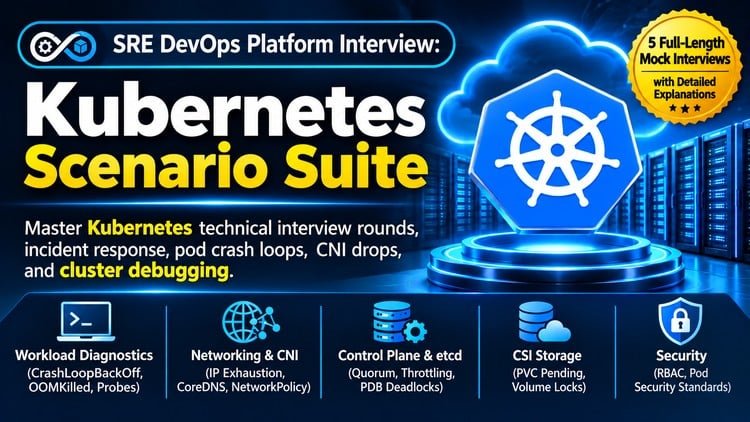
Master Kubernetes technical interview rounds, incident response, pod crash loops, CNI drops, and cluster debugging.
What You Will Learn:
- Troubleshoot production Pod failures (CrashLoopBackOff, OOMKilled, probe failures, init containers) under technical interview conditions.
- Diagnose Kubernetes networking outages including VPC-CNI IP exhaustion, CoreDNS latency, Ingress drops, and NetworkPolicy enforcement.
- Resolve control plane and storage crises covering etcd quorum loss, API server rate-limiting, PDB deadlocks, and CSI volume attachment locks.
- Master multi-tenant RBAC permissions, Pod Security Standards, expired tokens, and senior SRE/Platform engineering scenario interview rounds.
Alright, let’s talk about the SRE DevOps Platform Interview: Kubernetes Scenario Suite. I’ve been wrestling with Kubernetes in production for a good few years now, seen my fair share of PagerDuty alerts and late-night debugging sessions. So, when I saw this course advertised, promising to prep you for those brutal Kubernetes interview rounds, I was intrigued. I figured, “Why not? Let’s see if it can actually shave some time off my own incident response playbook and, more importantly, help aspiring SREs land those coveted roles.”
Overview
This isn’t your typical “hello world” Kubernetes course. The title really nails it: it’s all about scenario-based interview preparation. They throw you into the deep end with simulated production incidents, forcing you to think on your feet. The focus is heavily on troubleshooting, which, let’s be honest, is 90% of the job for anyone managing Kubernetes in the wild. They cover the gamut from your everyday Pod failures like CrashLoopBackOff and OOMKilled to the more insidious networking issues that can bring an entire cluster to its knees, like CNI IP exhaustion and frustrating CoreDNS latency. What really sets this apart is the emphasis on control plane and storage crises – things that can truly test your mettle and often require a deeper understanding than just deploying an app. Think etcd quorum loss and CSI volume attachment locks. They also dive into the nitty-gritty of RBAC and Pod Security Standards, which are non-negotiable for any serious platform engineer.
Prerequisites
To get the most out of this, you absolutely need a solid foundation in Kubernetes. This isn’t for complete beginners. I’d say you should be comfortable with:
- Basic Kubernetes concepts: Pods, Deployments, Services, Namespaces.
- Containerization fundamentals (Docker is a must).
- Familiarity with Linux command line.
- A general understanding of networking principles.
If you’re just starting your certification prep journey or are new to cloud-native, you might want to tackle a more introductory Kubernetes course first. This one assumes you’ve got some exposure already.
Skills & Tools
The course explicitly aims to build job-ready skills. You’ll be sharpening your teeth on:
- Kubernetes troubleshooting techniques.
- Incident response methodologies.
- Debugging tools like kubectl, lens (though not explicitly mentioned, it’s a common companion), and understanding logs.
- Networking diagnostic tools.
- Understanding control plane components.
- RBAC and security best practices.
The scenarios are designed to mimic real-world projects, forcing you to use industry-standard tools to diagnose and resolve complex issues.
Career Benefits & Job Roles
This course is a direct investment in career growth for anyone aiming for SRE, Platform Engineering, or DevOps roles. The skills you hone here are precisely what hiring managers look for in senior candidates. Successfully navigating these scenarios demonstrates a level of practical expertise that goes beyond theoretical knowledge. It’s particularly valuable for those looking to transition into more senior positions or for anyone wanting to solidify their understanding of production-grade Kubernetes management. The ability to confidently discuss and solve these complex problems in an interview can be a game-changer. This directly translates to higher earning potential and access to more challenging and rewarding opportunities.
Pros
- Deep Dive into Production Issues: This is where the course truly shines. It doesn’t shy away from the messy, real-world problems that plague Kubernetes deployments. You’ll learn to diagnose things that actually break in production, not just textbook examples.
- Interview-Centric Approach: The scenario-based format is brilliant for interview preparation. It forces you to articulate your thought process under pressure, a critical skill in technical interviews.
- Comprehensive Coverage: From networking and Pod failures to control plane and storage issues, the course covers a remarkably broad spectrum of critical Kubernetes operational challenges.
Cons
My one honest critique is that while the scenarios are excellent for *diagnosing* problems, the resolution steps could sometimes be a bit more fleshed out. It’s like being given a difficult puzzle – you figure out what’s wrong, but the exact “how-to” fix might require a bit of extra digging on your own. However, for an interview prep course, this might be intentional, pushing you to research and learn the solutions yourself, which is arguably a valuable learning experience in itself.