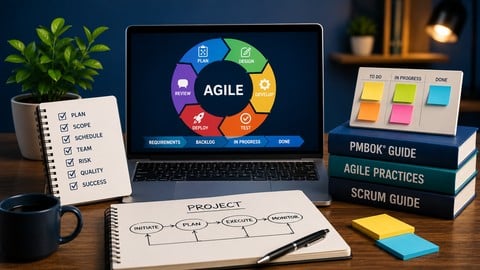
Test your readiness for PMP and Scrum certifications with 200 rigorous questions on Agile, Risk, and PM Fundamentals.
What You Will Learn:
- Evaluate your grasp of traditional Project Management concepts, including WBS, Critical Path, and EVM.
- Test your knowledge of Agile frameworks, Scrum ceremonies, and product backlog management.
- Assess your proficiency in identifying, analyzing, and mitigating complex project risks.
- Validate your ability to manage stakeholder expectations and craft effective communication plans.
Learning Tracks: English
Note➛ Make sure your 𝐔𝐝𝐞𝐦𝐲 cart has only this course you're going to enroll it now, Remove all other courses from the 𝐔𝐝𝐞𝐦𝐲 cart before Enrolling!
Add-On Information:
- Course Overview
- Comprehensive simulation of professional exam environments specifically engineered to bridge the intellectual gap between passive theoretical knowledge and the high-intensity practical test-taking proficiency required for today’s modern project leaders.
- Systematic evaluation of psychological and cognitive endurance, requiring students to maintain high levels of critical thinking focus across 200 diverse questions that accurately reflect current industry standards and rigorous certification benchmarks.
- Deep integration of situational logic and behavioral ethics, ensuring that certification candidates are thoroughly prepared for the non-technical, human-centric questions that often appear in top-tier professional credentialing exams.
- Sophisticated mapping of individual performance metrics against standard industry benchmarks to provide a crystal-clear roadmap for final-stage study priorities, allowing for a more surgical approach to content mastery and resource allocation.
- Utilization of a structured, iterative feedback loop where every incorrect selection serves as a powerful diagnostic tool for deeper conceptual refinement, helping the learner to mentally recalibrate their approach to professional problem-solving.
- Requirements / Prerequisites
- A proactive and disciplined commitment to professional development, accompanied by a genuine willingness to engage in a rigorous, self-paced evaluation of one’s current project management vocabulary and decision-making frameworks.
- Consistent access to a quiet, distraction-free testing environment that allows for full immersion into the practice sets, ensuring the results of the practice simulations accurately reflect the candidate’s true performance under time constraints.
- Preliminary exposure to various project documentation styles, such as charters and status reports, which helps the student to better contextualize the scenario-based questions provided in this expansive question set.
- An open mindset toward receiving critical feedback and analyzing mistakes, as this course is designed specifically to highlight hidden areas of deficiency to strengthen the learner’s overall competency and confidence before the actual exam day.
- Skills Covered / Tools Used
- Advanced Strategic Elimination Techniques: Mastering the sophisticated art of identifying subtle distractors and “partially correct” options to isolate the single most professional response in complex, multi-layered project scenarios.
- Critical Analytical Question Decomposition: Learning how to rapidly break down long-form, wordy situational descriptions to find the core problem or the “root cause” being tested by the examiners behind the narrative fluff.
- Internal Pacing and Chronological Management: Developing a personalized rhythmic approach to question sets to ensure that time-intensive calculations or complex reviews do not jeopardize the successful completion of the full exam within the allotted time.
- Standardized Professional Terminology Fluency: Successfully transitioning from internal, organization-specific jargon or “slang” to the universally recognized, standardized language utilized by global project management bodies and accrediting organizations.
- Quantifiable Data-Driven Weakness Mapping: Using granular, quantitative score breakdowns to isolate specific knowledge domains or process groups that require further intensive review before the candidate attempts the official test.
- Benefits / Outcomes
- Substantial and Measurable Reduction in Exam Anxiety: Building a high degree of familiarity with the specific phrasing, tone, and difficulty level of professional exams, which leads to a significantly calmer and more focused mindset during the actual high-stakes event.
- Objective Validation of Professional Decision-Making: Confirming through empirical data that your instinctive reactions to project crises and team dynamics align perfectly with the “best practices” expected by global certification boards.
- Significant Acceleration of the Learning Curve: Moving strategically beyond passive reading and into the realm of active recall, which has been scientifically shown to increase the long-term retention of complex project methodologies and frameworks.
- Enhanced Mental Readiness for Multi-Methodology Environments: Gaining the requisite mental flexibility to pivot seamlessly between different management philosophies and leadership styles as required by the specific contextual demands of an exam question.
- Total Resource Optimization and Risk Mitigation: Saving valuable time and financial resources by ensuring you are truly prepared to pass on your first attempt, thereby avoiding the psychological burden and financial cost of retake fees and rescheduling.
- PROS
- High-Fidelity Question Logic: The scenarios are crafted to mirror the exact linguistic complexity and professional ambiguity found in high-level certification assessments.
- Immediate Explanatory Feedback: Every question is accompanied by a detailed rationale that explains not only why the correct answer is right but why the alternatives are less optimal.
- Global Standard Alignment: The question bank is continuously reviewed to ensure it remains consistent with the latest updates in project leadership and organizational principles.
- CONS
- Simulation Limitations: While these practice exams provide a near-identical experience, they cannot fully replicate the physiological stress and environmental variables of a live, proctored testing center.