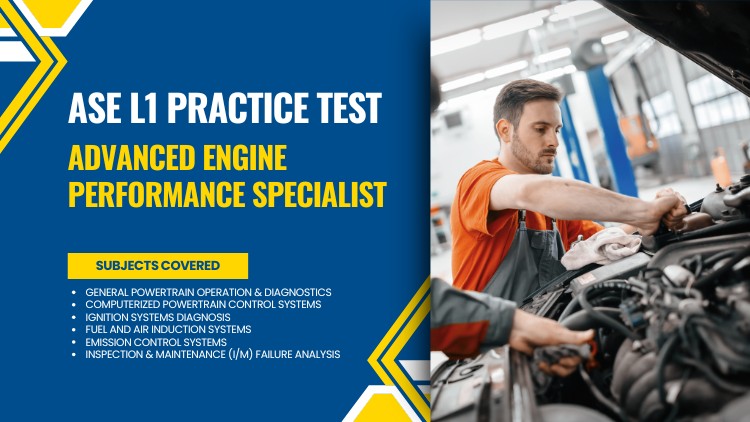
550+ Exam-Style Practice Questions for ASE L1 Advanced Engine Performance
⭐ 2.75/5 rating
👥 730 students
🔄 January 2026 update
Add-On Information:
- Course Overview
- This comprehensive practice test suite is meticulously designed to prepare automotive professionals for the rigorous ASE L1 Advanced Engine Performance Specialist certification exam. Far beyond a simple question bank, it immerses you in the challenging format and depth of knowledge required to master complex engine performance issues.
- Engage with over 550 expert-crafted, exam-style questions that simulate the actual L1 test environment, focusing on real-world diagnostic scenarios that demand critical thinking and a deep understanding of modern vehicle systems.
- Developed to reinforce test-taking strategies and identify specific knowledge gaps, this course ensures you approach the L1 exam with maximum confidence and a proven ability to interpret intricate automotive data.
- Systematically review advanced concepts spanning complex electrical faults, sensor anomalies, and sophisticated emissions diagnostics that often challenge even seasoned technicians.
- Gain familiarity with the specific question structures and answer formats unique to the ASE L1 exam, optimizing your performance under test conditions.
- Access detailed explanations for each answer, providing not just the correct choice but also the underlying diagnostic rationale and technical principles.
- Requirements / Prerequisites
- Possession of a current ASE A8 Engine Performance certification is strongly recommended, as the L1 builds upon the foundational knowledge covered in A8.
- A solid working understanding of basic automotive electrical theory, including Ohm’s Law and circuit analysis, is essential for tackling advanced diagnostic challenges.
- Demonstrable experience working on modern vehicles, involving the use of scan tools, digital multimeters, and other common shop equipment for troubleshooting engine performance issues.
- Familiarity with interpreting wiring diagrams and service information to diagnose complex drivability concerns.
- A foundational grasp of internal combustion engine principles and their operational parameters is presumed.
- Commitment to self-paced study and a disciplined approach to reviewing complex technical material.
- Skills Covered / Tools Used
- Strategic Test-Taking: Develop effective strategies for approaching multi-faceted diagnostic questions, managing time, and prioritizing information during the actual exam.
- Data Stream Interpretation: Hone your ability to analyze live data from advanced scan tools, identifying abnormal sensor readings, calculated values, and system PIDs indicative of underlying issues.
- Waveform Analysis: Practice interpreting complex oscilloscope patterns from ignition systems, fuel injectors, and various sensors to pinpoint intermittent faults and component degradation.
- Diagnostic Flowchart Execution: Learn to apply logical diagnostic processes to isolate root causes of performance problems, moving beyond mere code retrieval.
- Component Testing Proficiency: Understand the effective application of tools like DMMs, pressure gauges, and vacuum gauges to verify component integrity and system functionality.
- Advanced Electrical Troubleshooting: Deepen your skills in diagnosing intricate electrical malfunctions affecting powertrain control, including parasitic draws and communication network failures (CAN, LIN).
- Emissions System Analysis: Master the interpretation of exhaust gas analyzer readings and understand their correlation with catalytic converter efficiency, air/fuel ratio, and overall combustion health.
- Service Information Navigation: Efficiently locate and apply relevant OEM service procedures, technical service bulletins (TSBs), and diagnostic trouble code (DTC) charts.
- Critical Thinking in Scenario Analysis: Apply advanced problem-solving techniques to realistic vehicle symptoms, often presented without obvious DTCs, demanding a holistic diagnostic approach.
- Fuel System Integrity Verification: Utilize specialized tools and procedures to check fuel pressure, volume, and injector function, identifying critical fuel delivery issues.
- Benefits / Outcomes
- Significantly increase your probability of successfully passing the challenging ASE L1 exam on your first attempt, validating your expertise as an Advanced Engine Performance Specialist.
- Elevate your professional standing within the automotive industry, opening doors to more advanced roles, higher earning potential, and leadership opportunities.
- Gain profound confidence in your ability to diagnose and repair the most complex engine performance issues encountered in modern vehicles, becoming a sought-after expert.
- Solidify your understanding of advanced diagnostic methodologies, enabling you to tackle intricate drivability problems that baffle less experienced technicians.
- Achieve industry recognition for your specialized skills, distinguishing you as a top-tier automotive professional capable of handling cutting-edge vehicle technology.
- Improve diagnostic efficiency and accuracy in the shop, leading to reduced comeback rates and increased customer satisfaction.
- Build a strong foundation for continuous professional development in the rapidly evolving field of automotive technology.
- PROS
- Comprehensive coverage simulating the actual ASE L1 exam experience.
- Detailed explanations for every answer choice enhance learning.
- Flexible, self-paced learning accommodates busy professional schedules.
- Identifies specific areas of weakness for targeted study.
- Builds confidence through repeated exposure to exam-style questions.
- Accessible from anywhere with an internet connection.
- CONS
- Requires a significant level of self-discipline and prior knowledge to maximize learning outcomes.
Learning Tracks: English,Business,Operations