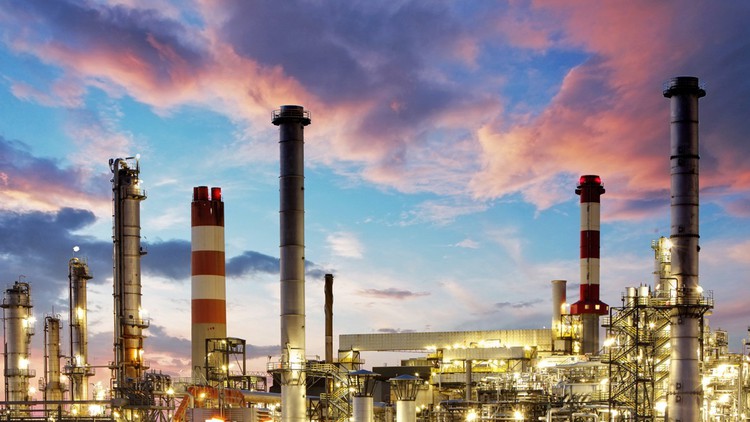
Core Course for many Chemical Courses that Allow Students to Solve Material & Energy Balance and Pressure Calculations.
What you will learn
Learn the common processes in Chemical Engineering industry and process variables and how to calculate them.
Will Understand about Pressure (Fluid Pressure and Hydrostatic head) and types of pressure and way to measure Fluid Pressure Measurement by Monometer.
Get the knowledge about Ideal Gas and the Laws of Gases.
Able to understand Law of Conservation of mass and know how to apply it on Different Systems.
Will Understand about Pressure and Pressure Scales and the Conversion Factor and the Measurement of Pressure.
Learn what system energy is and perform energy balance calculation.
Know how to Use Differential & Integral Balances for Material Balance.
Learn how to perform material balance and energy balance on Reactive Processes.
Know how to use Flow Chart Streams and Flow Chart Scaling for the Calculation of Material Balance.
Extent of Reaction and the Calculation of Extent of Reaction for Multiple Reactions.
Calculation of Balances on Molecular & Atomic Species
Understand about the Energy Balance on Open & Closed Systems
On completion of the course, students will be able to apply mass balance equation for different systems and can solve numericals based on mass transfer.
On completion of the course, students will be able to apply thermal energy balance equation for different systems and can solve numericals on Energy Transfer
On completion of the course, students will be able to calculate fluid pressure.
Description
Principle of Chemical Processes (PCP) is the fundamental course for Chemical Engineering students for other subjects such as Thermodynamics, Separation Processes, Heat Transfer, and Fluid Transport. Basically, the whole Chemical engineer career is based on the Principle of Chemical Processes. This course integrates chemistry(general chemistry, some organic chemistry, and physical chemistry), physics, maths (mostly simple algebra, some calculus).
Course Content
- Composition of Mixtures
· Molecular Weight & Mole and the Conversion between Mass & Moles
· Mass & Mole Fraction, Conversion from a Composition by Mass to Molar Composition
· Concentration
- Pressure
· Introduction of Pressure and Pressure Scales (Atmospheric, Gauge, Vacuum, Absolute)
· Conversion Factors of Pressure
· Fluid Pressure Measurement
- Ideal Gases & Gas Laws
· Ideal Gases & Equation of State, Standard Temperature & Pressure, Problems
· Ideal Gas Mixtures, Vapor-Liquid Equilibria for Multi-Component System
· Henry’Law, Raoult’s Law, Antoine Equation, Dalton’s Law
- Fundamentals of Material Balances
· Introduction, Chemical Processes Classification, Steady & Unsteady State, Balance Equation
· Differential and Integral Balances on Chemical Processes
· Differential Process to Perform Material Balance
· Flow Chart Streams and calculation of Flow Chart Stream Balance
· Flow Chart Scaling and their Calculation
- Balances on Reactive Systems
· Balances on Reactive Systems, Limiting & Excess Reactants
· Extent of Reaction and the Calculation of Extent of Reaction
· Multiple Reactions, Yield & Selectivity2
· Extent of Reaction for Multiple Reactions with Calculation
· Balances on Molecular & Atomic Species
· Degree of Freedom Analysis on Reactive Balances
- Energy Balance
· First Law of Thermodynamics, Forms of Energy (Kinetic, Molecular, Internal)
· Energy Balances on Closed Systems
· Specific Properties & Enthalpy
OZIS Academy is the best platform for struggling students as it provides a large no of quality and detailed courses. We offer courses from brilliant Ph.D. Professors from prestigious Universities who are experts in their relative fields. We have a team of well-experienced, full-time faculty and dedicated staff including talented retired and working University professors. Our mission is to impart most qualitative education by the way of systematic methodical and scientific approaches.
Visit our WEBSITE to get limited-time FREE & DISCOUNT COUPONS for our Udemy Courses
Content
Composition of Mixtures
Pressure ,Scales of Pressure and Measurement of Pressure
Ideal Gas and Laws of Gases
Fundamentals of Material Balances
Balances on Reactive Systems
Energy Balance
Alright, let’s talk about Principles of Chemical Processes – Mass & Energy Balance. As someone who’s been in the trenches of chemical engineering for a while, I can tell you this course is a foundational cornerstone. It’s not the flashy, cutting-edge stuff, but without mastering these basics, the advanced topics are like trying to build a skyscraper on quicksand. This is where you truly get your hands dirty with the fundamental calculations that underpin almost every chemical process out there.
Overview
This isn’t just a theoretical dive into equations; it’s about building an intuitive understanding of how mass and energy move through industrial chemical systems. You’ll move beyond textbook examples and start to see how these principles play out in everything from refining crude oil to manufacturing pharmaceuticals. The course does a solid job of introducing common unit operations and the variables that define them. What I particularly appreciated was the focus on practical application, moving from simple stoichiometric calculations to more complex energy balance scenarios. It’s about building that crucial problem-solving muscle for real-world process design and troubleshooting.
Prerequisites
Honestly, if you’re coming in cold with absolutely no science background, you might struggle. A solid understanding of basic algebra is non-negotiable. Think high school level math, where you’re comfortable with variables and solving equations. A foundational grasp of general chemistry principles would be a huge advantage, particularly stoichiometry. If you’ve taken an introductory chemistry course, you’re in a good spot. For those looking to use this as a stepping stone, having a strong math and chemistry foundation will make the learning curve much smoother and allow you to focus on the chemical engineering specifics rather than struggling with the underlying sciences.
Skills & Tools
By the end of this course, you’ll be proficient in:
- Material Balance Calculations: From simple batch processes to complex continuous flow systems.
- Energy Balance Calculations: Understanding enthalpy, heat transfer, and work.
- Pressure Concepts: Including fluid pressure, hydrostatic head, and various measurement techniques.
- Gas Laws: Working with ideal gases and understanding deviations.
- Process Variable Analysis: Identifying and calculating key parameters like flow rates, compositions, and temperatures.
While the course itself might not mandate specific industry-standard tools, the skills you develop are directly transferable to using software like Aspen Plus, HYSYS, or even advanced Excel spreadsheets for more complex simulations and calculations down the line. Think of this as your entry into using those powerful simulation packages.
Career Benefits & Job Roles
This course is often a gateway to more specialized chemical engineering topics and certifications, acting as a vital part of certification prep. For aspiring chemical engineers, process technicians, or even those in related fields like environmental engineering or materials science, this is pure gold. It equips you with job-ready skills that are in demand across a broad spectrum of industries. You’ll be a strong candidate for roles such as:
- Process Engineer
- Junior Chemical Engineer
- Process Design Engineer
- Operations Engineer
- R&D Technician
The ability to perform accurate mass and energy balances is a fundamental requirement in almost every entry-level and mid-level engineering position. It directly impacts process efficiency, safety, and profitability, making it a highly valued skill set for career growth.
Pros
- Unwavering Foundation: This course provides the bedrock for virtually all subsequent chemical engineering studies and practices. You cannot skip this.
- Practical Problem-Solving: It moves beyond theory to equip you with tangible skills for tackling real-world process challenges, essential for any real-world projects you might encounter.
- Broad Applicability: The principles learned are universal and apply across numerous sectors of the chemical industry, making your skillset highly versatile.
- Boosts Understanding of Complex Systems: By mastering these basics, you gain a much clearer perspective on how more intricate chemical processes function.
Cons
My one honest critique is that, depending on the instructor, the course can sometimes feel a bit *too* introductory. If you’ve already had some exposure to these concepts through extracurricular projects or previous coursework, you might find some sections repetitive. However, the depth of understanding that can be achieved with a good instructor makes even the familiar material valuable for solidifying those crucial concepts from beginner to advanced stages.