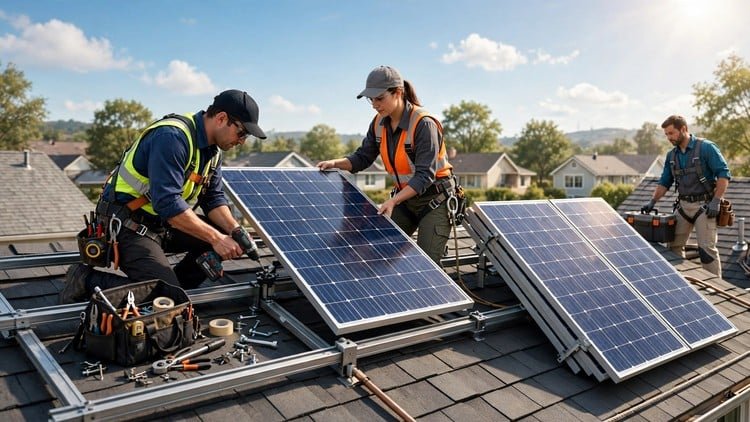
Prepare for the NABCEP PV Installer Specialist certification with 560 mock multiple-choice questions and explanation.
What You Will Learn:
- Develop and apply a site-specific safety plan for PV installations, including fall and electrical safety.
- Select and install raceways and electrical equipment correctly for PV systems and job-site conditions.
- Install and terminate DC and AC PV conductors safely, with correct identification and circuit rules.
- Apply grounding, bonding, and utility interconnection requirements to complete PV systems compliantly.
- Prepare confidently for NABCEP PVIS certification with 560 practice questions and detailed explanations.
The Real Deal on Prepping for the PVIS Certification
Let’s be honest for a second: the solar industry is currently flooded with “green” workers who know how to lug a panel up a ladder but couldn’t tell a grounded conductor from a grounding electrode to save their lives. If you want to stop being the guy who just follows orders and start being the one who signs off on the commission, you need a serious credential. That’s where the NABCEP PV Installer Specialist (PVIS) comes in. It’s a beast of an exam, and honestly, reading the NEC (National Electrical Code) cover-to-cover is a great way to fall asleep, not a great way to pass. This practice test course, however, is the high-octane certification prep that actually bridges the gap between field experience and passing the proctored exam.
I’ve looked at a lot of industry-standard tools for exam prep, and the sheer volume here—560 questions—is what caught my eye. It isn’t just about memorizing answers; it’s about building the mental muscle memory to navigate complex electrical scenarios under pressure. This course doesn’t baby you. It throws you into the deep end of technical specifications, forcing you to think like a specialist rather than a general laborer. It’s less about “how do I screw this in?” and more about “is this system going to burn down in five years because I chose the wrong raceway?”
Who Should Step Up? (Prerequisites)
Don’t jump into this if you’ve never touched a multimeter. While the course covers material from beginner to advanced levels, it’s really designed for folks who already have some skin in the game. Ideally, you should have at least a basic understanding of DC circuits and have spent a few months on a roof or at a ground-mount site. If you’ve already knocked out your PV Associate (PVA) credential, this is the logical next step. You’ll need a working knowledge of the NEC—specifically Article 690 and 705—because the questions assume you aren’t a complete novice. If you’re looking for job-ready skills that translate from the screen to the job site, you need that baseline level of electrical literacy first.
Skills & Industry-Standard Tools You’ll Master
This isn’t just a “test-taking” course; it’s a technical deep dive. By the time you grind through these 560 questions, you’ll have a much sharper grasp on the following:
- Code Compliance & Safety: You’ll learn to navigate the nuances of OCPD (Overcurrent Protection Device) sizing and how to develop a site-specific safety plan that actually keeps people alive.
- Electrical Architecture: Understanding the difference between various inverter topologies and how to correctly identify industry-standard tools for torque requirements and wire stripping.
- System Testing: You’ll get familiar with the logic behind commissioning tests, including Voc and Isc measurements, which are critical for real-world projects.
- Component Integration: Deciding between EMT, PVC, or liquid-tight based on the environment isn’t just a suggestion—it’s a requirement you’ll master here.
Career Benefits & Job Roles
In the solar world, career growth is tied directly to your certifications. Having “PVIS” next to your name on LinkedIn or a resume changes the conversation during a performance review. You move from being a “helper” to a “Specialist,” which usually comes with a healthy bump in your hourly rate or salary. This course is a direct investment in your career growth. Potential roles include:
- Lead PV Installer: Taking charge of the crew and ensuring the build matches the engineering prints.
- Solar Quality Assurance (QA) Inspector: Checking other people’s work to ensure it meets code before the utility arrives.
- PV Maintenance Technician: Troubleshooting failing systems using the diagnostic logic you learned during certification prep.
- Project Foreman: Managing the site-specific safety plans and logistics for real-world projects on a commercial scale.
The Upside: Why This Course Works
- Volume and Variety: With 560 questions, you aren’t just seeing the same five scenarios. You get a broad spectrum of edge cases that actually appear on the NABCEP exam.
- Detailed Explanations: This is the “secret sauce.” If you get a question wrong, the course explains *why*. It points back to the logic or the code section, which is vital for building job-ready skills.
- Mental Stamina: The real exam is a marathon. Taking these practice tests helps you build the focus needed to sit for hours and analyze technical diagrams without burning out.
- Focus on the Specialist Niche: It doesn’t waste time on sales or high-level design; it stays focused on the “how-to” of installation and safety, making it perfect for the technical professional.
The Downside: A Reality Check
If you’re looking for hands-on labs or flashy video production, you won’t find them here. This is a text-heavy, question-and-answer focused drill. It’s a “study gauntlet.” If you struggle with self-motivation or need a teacher to explain things via video, you might find the format a bit dry. It’s an incredibly effective tool for passing the test, but it requires you to put in the “grunt work” of reading and analyzing each explanation yourself.