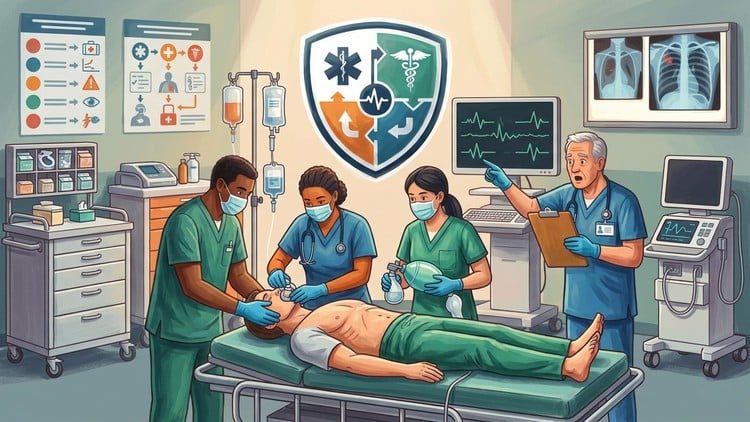
Practice with multiple choice questions and clear explanations to pass your ATLS exam with confidence_Updated for 2026
What You Will Learn:
- Spot and prioritize life-threatening trauma injuries fast using the ABCDE method taught in ATLS certification training.
- Answer realistic multiple choice ATLS exam questions covering airway, breathing, circulation, and shock management.
- Explain the reasoning behind correct and incorrect trauma exam answers, not just memorize facts for the test.
- Apply trauma assessment steps to head, chest, spine, and abdominal injuries with more clinical confidence.
- Understand trauma triage, mass casualty response, and trauma system basics tested on the ATLS exam.
My No-Nonsense Take on the 2026 ATLS Practice Sets
Look, I’ve sat through my fair share of certification prep cycles over the last decade, and if there is one thing I’ve learned, it’s that reading the manual is never enough. Whether you are prepping for a cloud architecture exam or, in this case, the Advanced Trauma Life Support (ATLS) certification, the gap between “knowing” the material and “applying” it under pressure is a mile wide. This course, “Practice Tests For ATLS,” is essentially a stress-test for your clinical intuition.
What I appreciate here isn’t just the sheer volume of questions, but the way they’ve anticipated the 2026 updates. In the high-stakes world of trauma, the industry-standard tools and protocols change as new data emerges. This isn’t a brain dump; it’s a strategic hands-on labs equivalent for your brain. It forces you to move past the “beginner” phase of memorizing the ABCDE acronym and pushes you toward job-ready skills where you can look at a complex multi-system injury and instinctively know which fire to put out first. If you’re looking for a way to turn theoretical knowledge into career growth, this is the grind you need to embrace.
Prerequisites
Before you jump into these practice exams, don’t expect a ground-up tutorial. This is certification prep for people who already have their feet wet. You’ll need a solid foundation in human anatomy and physiology—ideally at the level of a medical resident, senior nurse, or advanced paramedic. While the course scales from beginner to advanced logic, you should already be familiar with the basic terminology of trauma care. You don’t need to be a trauma surgeon yet, but if you don’t know the difference between a tension pneumothorax and a simple one, go back to the textbooks before burning through these practice sets.
Skills & Tools
This course effectively sharpens your use of industry-standard tools within the trauma bay. You’ll be working through real-world projects in the form of complex patient scenarios that test your mastery of:
- The ABCDE Hierarchy: Perfecting the sequence of Airway, Breathing, Circulation, Disability, and Exposure until it becomes second nature.
- Diagnostic Interpretation: Identifying when to pull the trigger on a FAST exam or a CT scan based on evolving hemodynamics.
- Shock Management: Moving beyond simple fluid resuscitation into nuanced, advanced hemodynamic stabilization.
- Triage Logic: Developing the job-ready skills needed to manage mass casualty incidents where resources are thin and every second counts.
Career Benefits & Job Roles
In the medical field, career growth is often gated by these four-letter certifications. Having ATLS on your resume is a non-negotiable for anyone looking to work in Level I or II Trauma Centers. This course prepares you for roles such as Emergency Medicine Physician, Trauma Nurse Specialist, or Surgical Resident.
By mastering these practice tests, you aren’t just passing a test; you are building the clinical confidence that prevents burnout. When you know the protocols inside and out, you reduce cognitive load during a crisis. That kind of reliability makes you an asset in any high-acuity environment, leading to faster promotions and more specialized job roles within the trauma system.
Pros
- Reasoning Over Rote Memorization: My favorite part of this course is the “why.” It breaks down exactly why the distractor answers are wrong. This is crucial for certification prep because the actual exam loves to give you two “correct” actions and ask which one you do *first*.
- Future-Proofed Content: With the “Updated for 2026” tag, you aren’t wasting time on deprecated protocols. It’s rare to find industry-standard prep that stays ahead of the revision cycle this effectively.
- Realistic Pressure Simulation: The questions mimic the phrasing and the “tricks” of the actual ATLS board. It builds the hands-on labs feel of a simulation center without the $2,000 price tag of a physical weekend retreat.
Cons
The only real downside is the lack of an integrated video component. While the written explanations are top-tier, some of the advanced trauma assessments (like needle decompression or surgical airways) would benefit from a visual walkthrough. It’s a pure-play practice test platform, so you’ll still need your primary source material or real-world projects experience to visualize the physical procedures.