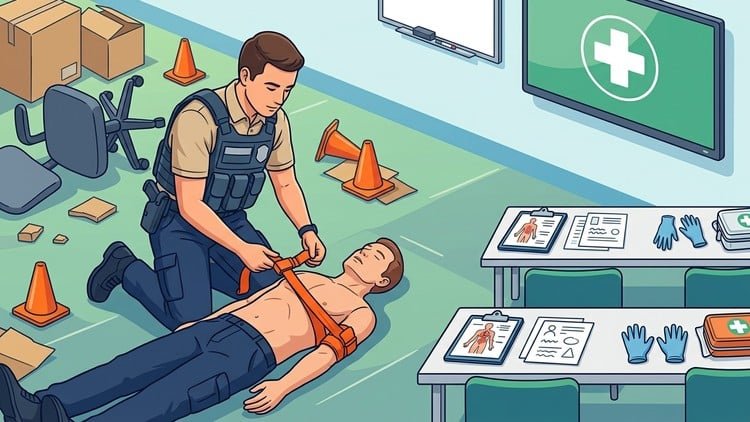
Pass your TECC certification with practice tests, mock exams, and test questions updated for 2026.
What You Will Learn:
- You will learn how to stop massive bleeding fast using tourniquets and pressure dressings while staying safe under fire.
- We will show you how to open blocked airways and use vented chest seals to keep your patient breathing during emergencies.
- You will practice how to find hidden wounds, keep patients warm, and treat hemorrhagic shock in the warm zone.
- I will teach you how to sort multiple patients quickly so you know exactly who needs life-saving help first.
- You will confidently pass your 2026 TECC exam by practicing with realistic mock questions and detailed explanations.
Overview
Alright, let’s cut to the chase for anyone eyeing the TECC certification: this isn’t your average “read a book and take a quiz” situation. The Tactical Emergency Casualty Care exam is a beast, demanding not just theoretical knowledge but the rapid, accurate application of life-saving protocols under immense pressure. That’s precisely where the ‘Practice Test For Tactical Emergency Casualty Care TECC Exam’ steps in as a non-negotiable component of your certification prep. From my vantage point, seeing countless professionals navigate high-stakes certifications, this isn’t just another set of questions; it’s a meticulously crafted simulation designed to harden your decision-making and solidify your understanding before you face the actual test. It speaks volumes that it’s updated for 2026, meaning you’re engaging with the absolute latest guidelines and best practices, crucial in a field where every update can literally mean the difference between life and death. This course doesn’t just rehash the material; it puts you through the wringer, mimicking the mental gymnastics required on the ground, making it an indispensable final polish for any serious candidate.
Prerequisites
Before you even think about diving into these practice tests, understand one thing: this isn’t a foundational TECC course. You wouldn’t try to debug production code without understanding the underlying architecture, right? Similarly, this assumes you’ve already completed a comprehensive TECC training program, or at minimum, possess a robust understanding of prehospital trauma care. Think of it as the ultimate stress test after you’ve built your core competencies. You should already be familiar with the principles of MARCH (Massive Hemorrhage, Airway, Respirations, Circulation, Hypothermia), basic patient assessment, and the common interventions taught in tactical medical courses. If you’re a seasoned EMT, Paramedic, military medic, or have undergone civilian tactical medical training, you’re likely in a good spot. If you’re coming in cold, expecting this practice test to teach you everything, you’re setting yourself up for frustration. Go get your primary TECC training first, then come back here to truly lock in those job-ready skills.
Skills & Tools
While this is a practice test, the skills it hones are profoundly practical. You’re not just memorizing facts; you’re developing the critical thinking necessary to correctly interpret scenarios and apply the right intervention at the right time. You’ll refine your ability to conduct rapid patient assessments, identify life threats under duress, and prioritize care – essentially, mastering the art of triage. The “tools” you’ll be working with aren’t physical in this digital environment, but rather the mental models for deploying industry-standard tools like various types of tourniquets, hemostatic dressings, vented chest seals, airway adjuncts, and hypothermia prevention techniques. It’s about building muscle memory for decision-making. You’ll practice recognizing the subtle cues of hemorrhagic shock, understanding the nuances of airway obstruction, and efficiently sorting multiple casualties. The ultimate skill you develop here is confidence in your own ability to perform when it counts, turning theoretical knowledge into actionable, life-saving reflexes.
Career Benefits & Job Roles
Earning your TECC certification is more than just a line on a resume; it’s a statement of specialized competency that significantly enhances your professional profile and opens doors to crucial roles. For anyone in emergency services, law enforcement, or security, this is a major boost to your career growth. We’re talking about roles like:
- Tactical Medic / SWAT Medic: Embedded with specialized law enforcement units, providing immediate medical support in high-threat environments.
- Law Enforcement Officer with Advanced Medical Training: Equipping patrol officers and specialized units with critical skills for active shooter events or major incidents.
- Private Security Contractor: Operating in austere or high-risk zones, where self-sufficiency and advanced medical capabilities are paramount.
- Paramedic / EMT in High-Threat Environments: Enhancing capabilities for conventional EMS in unconventional, dangerous scenarios.
- Military Personnel: Reinforcing and formalizing tactical combat casualty care (TCCC) principles for civilian applications.
This certification is a differentiator, demonstrating your commitment to continuous learning and your ability to operate effectively in dynamic, high-stakes situations. It signals to employers that you possess job-ready skills that are increasingly vital in today’s unpredictable world, making you a highly valuable asset to any team.
Pros
- Hyper-Realistic Scenario-Based Questions: This isn’t just multiple choice. The questions are designed to mimic the complex, ambiguous scenarios you’d face in the real world or on the actual exam, forcing you to apply your knowledge rather than just recall facts. It’s effective certification prep at its finest.
- Always Up-to-Date for 2026: In tactical medicine, guidelines evolve. The commitment to updating the content for 2026 ensures you’re practicing with the most current protocols and standards, giving you a distinct advantage and preventing you from learning outdated material.
- Detailed Explanations for Every Answer: This is huge. It’s not enough to know you got it wrong; you need to know *why* and *what* the correct rationale is. These explanations function as mini-lessons, bridging gaps in your understanding and pushing your knowledge from beginner to advanced.
- Confidence Builder and Knowledge Gap Identifier: By simulating the exam environment, this practice test helps you identify areas where your understanding is weak *before* the actual test. It builds crucial confidence by showing you what you *do* know and where to focus your last-minute efforts, ensuring you confidently pass.
Cons
- No Replacement for Practical Application & Hands-On Labs: This is a digital practice test, which by its nature, cannot replicate the tactile experience of applying a tourniquet, opening an airway, or managing a real patient. While it hones cognitive skills, it’s absolutely critical to pair this with actual hands-on labs and practical training. Relying solely on virtual practice for a field that demands physical skill is a significant oversight, and frankly, dangerous.