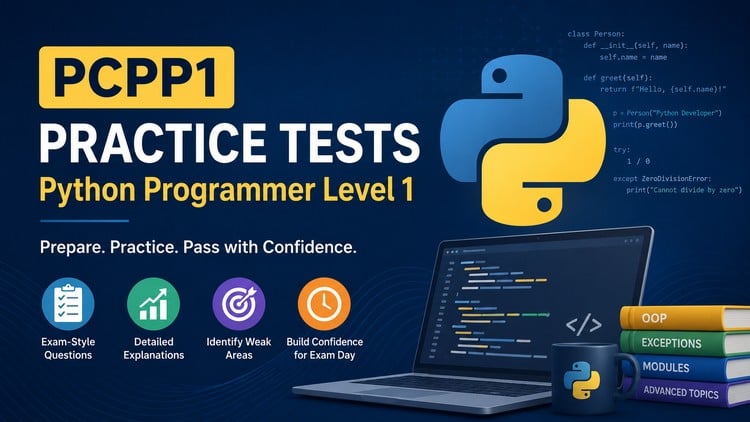
Prepare for the PCPP1 certification with realistic practice questions covering OOP, modules, packages,… and more
What You Will Learn:
- Assess your readiness for the PCPP1 certification exam with realistic practice questions.
- Strengthen your understanding of Python object-oriented programming, including classes, inheritance, polymorphism, and special methods.
- Practice working with exceptions, exception handling, custom exceptions, and exception propagation. Improve your knowledge of Python modules, packages, imports,
- Improve your knowledge of Python modules, packages, imports, and the standard library.
- Test your understanding of advanced Python concepts such as iterators, generators, closures, decorators, and comprehensions.
- Practice analyzing Python code, predicting output, identifying errors, and selecting the correct implementation.
- Show more
Alright, let’s talk about the PCPP1 Practice Tests: Professional Python Programmer Level 1. As someone who’s navigated the certification jungle a few times, I’m always on the lookout for resources that actually *prepare* you, not just pad your resume. This one, from what I’ve seen, aims to do just that. It’s not about memorizing trivia; it’s about building confidence for that PCPP1 exam.
Overview
This isn’t your typical fluffy “test yourself” quiz. The folks behind these practice tests have clearly put some thought into simulating the actual PCPP1 exam experience. You’re not just answering multiple-choice questions; you’re diving deep into scenarios that mimic real-world Python challenges. The emphasis is on applying your knowledge, not just recalling it. We’re talking about dissecting code snippets, predicting outcomes with a keen eye for detail, and identifying subtle bugs that could trip you up under pressure. It’s a pragmatic approach to certification prep, focusing on those areas that distinguish a good Python programmer from a truly proficient one – the stuff that makes you job-ready.
Prerequisites
This course is built for those who’ve already got a solid foundation in Python. I’d say you should be comfortable with the core language constructs, data types, and basic control flow. If you’re just starting out with Python, this is likely too advanced. Think of it as the next step after you’ve mastered the basics and are ready to tackle more complex topics and solidify your understanding for a more formal validation of your skills.
Skills & Tools
The primary “tool” here is your Python interpreter, of course! But more importantly, this course hones your ability to analyze and debug Python code. You’ll be strengthening your grasp on:
- Object-Oriented Programming (OOP): Deep dives into classes, inheritance, polymorphism, and the nitty-gritty of special methods (the dunder methods, as we affectionately call them).
- Exception Handling: Not just catching errors, but understanding the lifecycle of exceptions, crafting custom ones, and managing propagation effectively.
- Modules and Packages: Navigating the Python ecosystem, mastering imports, and leveraging the power of the standard library.
- Advanced Concepts: Get your hands dirty with iterators, generators, closures, decorators, and comprehensions – the building blocks for efficient and elegant Python code.
- Code Analysis: Sharpening your analytical skills to predict output, pinpoint errors, and choose the optimal implementation for given problem statements.
Career Benefits & Job Roles
Let’s be honest, certifications like PCPP1 aren’t a golden ticket, but they are a valuable signal to employers. In a competitive tech landscape, having a recognized certification can set you apart. It demonstrates a commitment to professional development and a validated level of expertise. This can open doors to roles like Python Developer, Software Engineer, Backend Developer, and positions that require strong programming fundamentals. It’s a stepping stone towards greater career growth and potentially higher earning potential.
Pros
- Realistic Exam Simulation: The questions are designed to mirror the actual PCPP1 exam’s difficulty and style, providing invaluable certification prep. You’re not just learning concepts; you’re learning how to apply them under exam conditions.
- Comprehensive Topic Coverage: It hits all the key areas required for the PCPP1, from fundamental OOP principles to more intricate advanced Python features. It’s a thorough review that covers both breadth and depth.
- Focus on Application: This isn’t theoretical. The emphasis on code analysis and error identification builds practical, hands-on lab-like experience, crucial for real-world problem-solving.
Cons
- Requires Prior Knowledge: As mentioned, this course is definitely geared towards those who already have a working knowledge of Python. If you’re looking for an introductory Python course, this is not it. You’ll need to have a good handle on the basics before diving in.
Overall, if you’re serious about passing the PCPP1 and want to ensure you’re truly ready, these practice tests seem like a solid investment. They bridge the gap between knowing Python and being able to prove it with confidence.