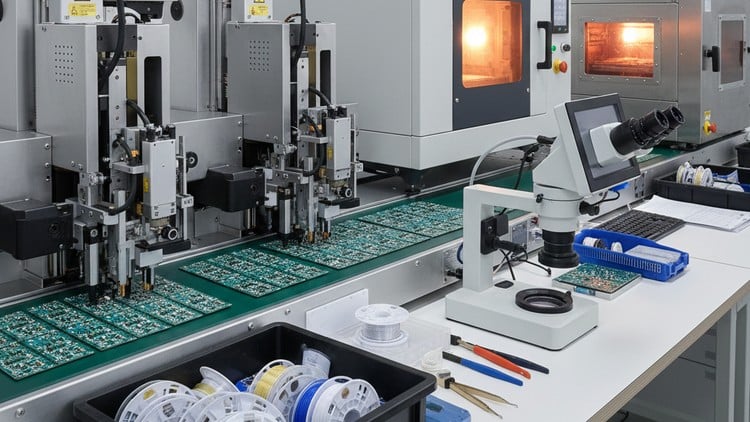
Practice MCQ to Master IPC Standards for PCB Assembly Certification Exams
What You Will Learn:
- Understand IPC terminology
- Apply assembly standards
- Identify workmanship defects
- Improve exam readiness
Overview
Alright folks, let’s talk about something critical for anyone serious about a career in electronics manufacturing: IPC certification. This ‘PCB Assembly Mock Exam for Certified IPC Technician Candidat’ isn’t just another practice quiz; it’s a strategic tool. From my vantage point, having navigated the trenches of production lines and quality control for years, the real value here lies beyond simply memorizing answers. This mock exam provides a crucial diagnostic step in your certification prep journey. It helps you accurately gauge your current understanding of rigorous IPC standards, pinpointing blind spots before they become costly errors in the actual exam, or worse, on the production floor. It’s about building confidence, sharpening your recall under pressure, and ultimately, striving for genuine manufacturing excellence. This isn’t just about passing; it’s about validating your foundational knowledge that underpins effective quality control and robust assembly processes.
Prerequisites
Now, before you jump in expecting a tutorial on how to hold a soldering iron, let’s set some expectations. This isn’t a “beginner to advanced” course; it’s firmly in the “intermediate to advanced prep” category. You absolutely need to come to this mock exam with a decent grasp of fundamental PCB assembly concepts. We’re talking basic component identification (resistors, capacitors, ICs, etc.), an understanding of different package types like surface mount technology (SMT) and through-hole technology (THT), and a foundational awareness of what IPC standards even are. If you’re completely new to PCB assembly, I’d suggest reviewing a basic IPC-A-610 handbook or taking an introductory course first. This mock exam is designed to test and refine existing knowledge, not build it from the ground up.
Skills & Tools
Even though it’s a multiple-choice question format, this mock exam implicitly hones a crucial set of skills vital in the real world. Firstly, your ability to interpret and apply the stringent IPC criteria for everything from component placement to soldering joint integrity is rigorously tested. You’ll be practicing identifying acceptable, preferred, and reject conditions, which directly translates to proficient inspection capabilities using industry-standard tools like microscopes and calipers. Furthermore, understanding the nuances of ESD procedures, the importance of traceability in component handling, and various aspects of rework principles are all woven into the questions. It’s not just about theoretical knowledge; it’s about developing the sharp eye and critical thinking skills required to ensure product reliability and mitigate costly manufacturing defects. This kind of practice is invaluable for developing true job-ready skills.
Career Benefits & Job Roles
Think this is just about a piece of paper? Think again. A certified IPC Technician is highly valued in the industry. Passing this mock exam, and subsequently the full certification, is a clear signal to employers that you understand and can apply the universal language of quality in electronics assembly. This directly contributes to your career growth. You’re not just a technician; you’re a guardian of quality. This opens doors to roles such as a dedicated Quality Assurance Inspector, Manufacturing Technician specializing in assembly and rework, or even moving into a Process Improvement Specialist position where your understanding of IPC standards directly informs lean manufacturing initiatives. For those looking to manage teams or train others, this certification is a stepping stone towards becoming an IPC Trainer or a Manufacturing Engineer. It significantly enhances your credibility and demonstrates a commitment to achieving excellence in every real-world project you tackle.
Pros
- Pinpoints Knowledge Gaps Effectively: The format of this mock exam is excellent for identifying exactly where your understanding of IPC standards is weak. It’s a targeted diagnostic tool, allowing you to focus your study efforts on specific sections of the IPC-A-610, which is far more efficient than aimless reviewing.
- Builds Confidence for the Real Exam: Simulating the actual certification exam environment is crucial. This mock exam helps you get comfortable with the question style, pace yourself, and reduce test anxiety, significantly boosting your exam readiness.
- Reinforces Critical Standards Application: The questions are designed to make you think about how IPC standards are applied in various assembly scenarios, not just recall definitions. This deepens your understanding of acceptable workmanship and defect identification, contributing to overall manufacturing excellence.
- A Cost-Effective Preparation Tool: Compared to full-blown training courses, this mock exam offers a highly affordable way to assess your readiness and solidify your knowledge before investing in the official certification exam itself.
Cons
- Lacks Hands-On Practical Application: Now, no review is complete without a dose of reality. While this mock exam is fantastic for theoretical knowledge, it is, by its nature, solely a theoretical assessment. It absolutely cannot replace actual hands-on labs or real-world experience. You won’t be using industry-standard tools, making physical solder joints, or performing rework under guidance. For true mastery and practical job-ready skills, you’ll need to combine this theoretical prep with practical training and real-world assembly tasks. This is a crucial distinction: it prepares you for the *exam*, not directly for the *physical work*.