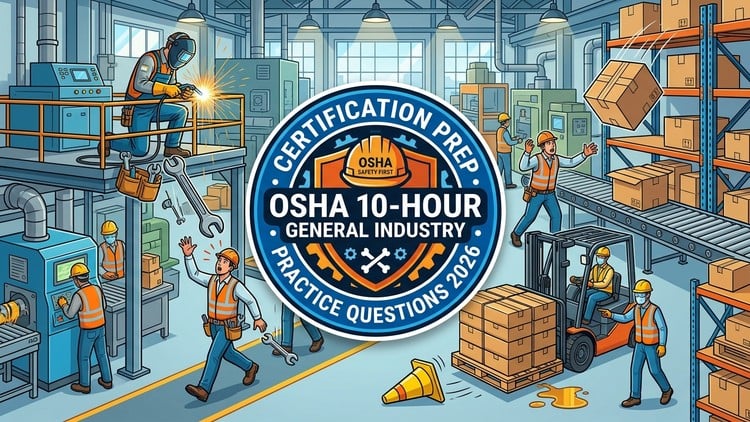
OSHA 10-Hour Exam Prep with Realistic Practice Questions, Detailed Explanations and Safety Knowledge Review.
What You Will Learn:
- Understand OSHA worker rights, employer responsibilities, inspections, and key workplace safety requirements covered in General Industry training.
- Identify common workplace hazards involving falls, walking-working surfaces, fire prevention, and emergency procedures.
- Recognize electrical hazards, machine guarding risks, lockout/tagout practices, and methods used to prevent injuries.
- Apply knowledge of PPE, hazard communication, chemical safety, confined spaces, and materials handling principles.
- Improve exam readiness through realistic practice questions and detailed explanations that reinforce safety concepts.
- Show more
Alright, let’s talk about the ‘OSHA 10-Hour General Industry Practice Test 2026’. If you’re anything like me, you appreciate a solid practice run before the big show. And when that “big show” involves something as critical as workplace safety and a coveted certification, you want to ensure your prep is top-notch. I’ve taken my share of certification exams in the tech world, and one thing I’ve learned is that great preparation isn’t just about memorizing facts; it’s about understanding the ‘why’ behind them. This isn’t just a random set of questions; it’s designed to genuinely get you ready.
Overview
Let’s face it, the world of workplace safety, especially under OSHA regulations, can feel like a dense forest of rules and responsibilities. This practice test, updated for 2026, isn’t just a regurgitation of facts you could find in a textbook. It’s a well-structured simulator for the actual OSHA 10-Hour General Industry exam. What impressed me most was its ability to bridge theoretical knowledge with practical application. It pushes you to think beyond simple recall, forcing you to apply your understanding to realistic scenarios. For anyone serious about not just passing but truly internalizing the principles of workplace safety, this is an invaluable asset. It’s part of building those foundational job-ready skills that extend beyond a single exam, contributing significantly to long-term career growth in any industrial or general workplace setting.
Prerequisites
While this is a practice test, it assumes you’ve got some exposure to the core concepts of OSHA 10-Hour General Industry training. Think of it as a final exam prep, not your initial learning material. You should ideally have either completed an OSHA 10-Hour course or be actively engaged in one. A basic understanding of general workplace operations and a commitment to safety are really the only non-negotiable requirements. If you’re coming in completely cold, you might find yourself struggling a bit, as the focus is on testing and reinforcing, not teaching from scratch. However, the detailed explanations go a long way in filling knowledge gaps you might discover.
Skills & Tools
This practice test is an excellent vehicle for honing several critical skills and mastering essential “tools” in the safety domain. You’ll significantly improve your ability to:
- Identify and assess hazards: From subtle electrical risks to common fall hazards, you’ll get better at spotting potential dangers.
- Interpret OSHA regulations: Understanding not just what the rule is, but its practical implications in diverse scenarios.
- Apply safety protocols: Reinforcing knowledge on PPE, lockout/tagout, emergency procedures, and more.
- Critical decision-making: Choosing the safest course of action based on a given scenario, a crucial aspect of real-world safety management.
The “tools” you’ll become more proficient with are the very industry-standard tools of workplace safety: the OSHA General Industry standards themselves, hazard communication protocols, confined space entry procedures, and machine guarding principles. These aren’t physical tools, but rather frameworks and knowledge systems that are absolutely vital in any operational environment.
Career Benefits & Job Roles
Let’s be real, an OSHA 10-Hour card is often a gatekeeper for many jobs in general industry. This practice test helps ensure you pass that gate. Beyond the certification itself, mastering these safety concepts offers significant career growth potential. Demonstrating a solid understanding of safety protocols not only makes you a more valuable employee but also opens doors to roles with greater responsibility. Think about it: a safe workplace reduces incidents, lowers costs, and boosts morale – all things leadership loves.
Specific job roles that benefit immensely include:
- Project Managers & Site Supervisors: Essential for maintaining a compliant and safe work environment for their teams.
- Facilities Managers: Overseeing maintenance, contractors, and general building safety.
- Maintenance Technicians & Engineers: Directly involved with machinery, electrical systems, and hazardous materials.
- Safety Coordinators (entry-level): A fundamental building block for a career purely focused on EHS.
- Anyone working on or managing real-world projects in manufacturing, warehousing, healthcare, or any general industry setting.
Pros
- Realistic & Up-to-Date Questions: The questions are not just filler; they genuinely mirror the complexity and phrasing of what you’ll encounter on the actual OSHA 10-Hour General Industry exam. And being updated for 2026 gives you peace of mind that you’re studying the most current regulations.
- Detailed Explanations are a Game-Changer: This is where the real learning happens. It’s not just “A is correct.” It tells you *why* A is correct, *why* B, C, and D are wrong, and often provides additional context or references. This transforms it from a mere test into a powerful learning tool, helping you move from beginner to advanced understanding.
- Comprehensive Topic Coverage: It hits all the critical areas mandated by OSHA 10-Hour training, ensuring no stone is left unturned. From walking-working surfaces to hazard communication and electrical safety, it provides thorough certification prep.
- Reinforces Foundational Knowledge: For those who’ve already taken the course, it serves as an excellent refresher and helps solidify concepts, turning theoretical knowledge into practical, recallable information.
Cons
- It’s Still a Practice Test: While incredibly effective for knowledge reinforcement and exam readiness, this isn’t a replacement for the actual OSHA 10-Hour training course itself. It doesn’t offer the kind of interactive, scenario-based learning or simulated hands-on labs that a full course might provide. It’s a fantastic supplement, but ensure you’ve got that core training under your belt first.