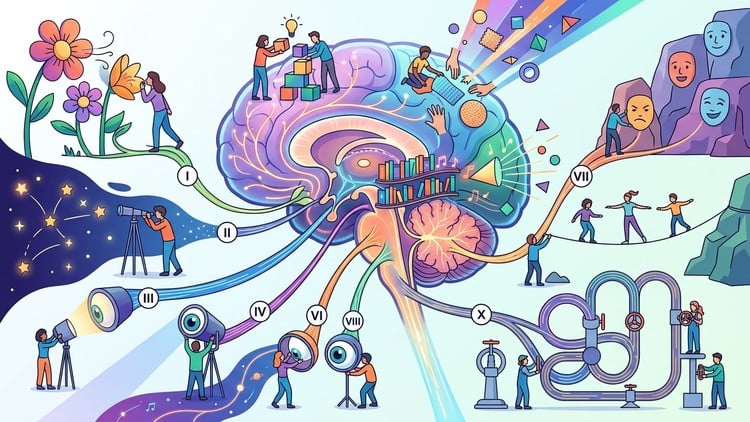
Learn the brain and cranial nerves quickly with realistic practice tests and simple explanations.
What You Will Learn:
- You will learn the main parts of the brain and what they do.
- You will understand how the cranial nerves work in the body.
- You will practice with real questions to prepare for your exam.
- You will easily remember tough medical facts about the brain.
- You will feel very confident before you take your final test.
Alright, let’s talk about ‘Neuroanatomy Practice Exam: Master the Brain & Cranial Nerve’. When I first saw this, my immediate thought was, “A practice exam? Is that a course or just a quiz bank?” But diving in, especially from the perspective of someone who constantly needs to learn complex systems and prepare for various certifications, there’s a definite value proposition here that’s worth unpacking. It’s not just a collection of questions; it’s a strategic weapon for anyone tackling the notoriously challenging world of neuroanatomy.
Overview
Forget the dry textbooks for a minute. What this “course” truly offers is a laser-focused approach to drilling down on the most critical, often trickiest, aspects of neuroanatomy. It’s less about foundational lectures and more about tactical rehearsal – think of it as a specialized training simulator for your brain. For those of us who appreciate efficiency and direct application, this isn’t just about learning *what* the parts of the brain are; it’s about understanding *how* they function in context and, crucially, how that understanding is tested. It’s a fantastic accelerant for solidifying knowledge, pinpointing weaknesses, and building that muscle memory for exam-day recall. This isn’t just memorization; it’s about pattern recognition and high-stakes information retrieval, which are truly valuable job-ready skills in any complex field.
Prerequisites
Here’s the deal: this isn’t your ‘Neuroanatomy for Dummies’ starting point. While the caption mentions “simple explanations,” this course is firmly situated as a certification prep tool. You absolutely need a foundational understanding of basic human anatomy and physiology. Ideally, you’ve already sat through some lectures or read through a comprehensive textbook on neuroanatomy. If you’re coming in completely cold, expecting this to teach you from zero, you might feel a bit overwhelmed. Think of it as refining an existing skillset, taking you from an intermediate grasp to an advanced state of exam readiness, rather than a true beginner course. It’s designed to help you organize and apply the knowledge you’ve already started to acquire.
Skills & Tools
The primary “tool” here is, unequivocally, the practice exam itself. This isn’t theoretical; it’s a practical application of learning theory. You’re not just passively consuming information; you’re actively engaging with it. The skills you’ll sharpen are less about using external industry-standard tools (like, say, a particular CAD program) and more about mastering your internal processing system:
- Critical Thinking & Diagnostic Skills: You’ll learn to interpret complex scenarios and apply your anatomical knowledge to deduce answers, mimicking real-world diagnostic challenges.
- Memory Retention Strategies: The repetitive, targeted practice helps engrain tough medical facts, making recall under pressure much more effective.
- Exam Strategy & Time Management: By simulating actual test conditions, you’ll get better at managing your time and approaching questions systematically.
- Self-Assessment & Gap Identification: The course helps you quickly identify areas where your knowledge is weak, allowing for targeted review rather than blind re-reading.
While there are no traditional hands-on labs, the practice tests function as a simulation of clinical scenarios, forcing you to “handle” complex information and make quick decisions.
Career Benefits & Job Roles
Mastering neuroanatomy isn’t just an academic exercise; it’s a critical component for numerous demanding professions. For aspiring doctors, neurologists, neurosurgeons, and psychiatrists, this is non-negotiable. But it extends beyond that: physical therapists, occupational therapists, nurses specializing in neurology, medical researchers, and even biotech professionals working on neural interfaces or diagnostic tools will find a robust understanding here invaluable. It directly contributes to career growth by equipping you with the specialized knowledge required for success in these fields. By developing a strong grasp of these complex systems, you are cultivating job-ready skills that directly impact patient care, research outcomes, and technological innovation. It’s about being able to confidently discuss, analyze, and troubleshoot issues related to the nervous system, whether you’re in a clinical setting or developing the next generation of neural prosthetics.
Pros
- Hyper-Focused Certification Prep: This course cuts through the fluff, providing realistic, challenging questions that mirror what you’ll encounter on high-stakes exams. It’s an incredibly efficient way to consolidate learning and build confidence.
- Practical Application Over Rote Memorization: Instead of just listing facts, the questions push you to apply your understanding of how different brain parts and cranial nerves interact, which is crucial for developing true mastery. It’s like engaging in real-world projects but in a test format.
- Confidence Builder: Successfully navigating these practice tests significantly boosts your self-assurance. Knowing you can tackle tough questions before the actual exam reduces anxiety and improves performance.
- Efficient Knowledge Consolidation: For those short on time, this course provides a streamlined method to review vast amounts of information, highlight critical areas, and reinforce learning without having to re-read entire textbooks.
Cons
- Not a Foundational Course: As stated, this is a practice exam, not a comprehensive curriculum designed to teach neuroanatomy from scratch. If you’re a true beginner, you’ll need to pair this with a more traditional learning resource. It offers excellent practice, but it won’t build your initial knowledge base from the ground up, nor does it include interactive hands-on labs beyond the simulated testing environment.