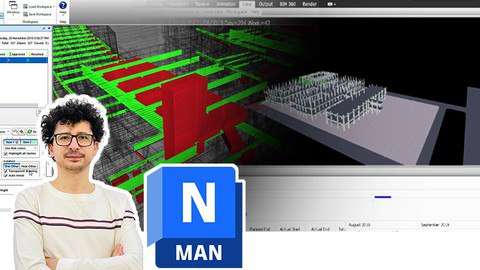
Master Navisworks Manage: Clash Detection, 4D Simulation, Quantification, and Animation for Enhanced Project Management
What you will learn
Navisworks Overview and Interface Navigation
Clash Detection and Coordination Review
4D Simulation to Visualize and Simulate Construction Sequencing
Creating Custom Timelines in Navisworks
Quantification and Takeoff in Navisworks
Animation and Rendering Techniques in Navisworks
Creating interactive Walkthroughs and Flyovers
Managing Large Projects in Navisworks
Managing 3D Models and Project Data
Collaborative Design Review with Navisworks
Description
Note: The main difference in this course compared to others is that we have not confined ourselves to explaining simple techniques. Instead, we have conveyed the subject through challenging projects and specific tricks, which are the result of numerous experiences.
- Do you know what features Navisworks software provides to the user?
- Want to effectively streamline your construction and design collaboration processes?
- Are you looking to become a master of project review and coordination in construction and design?
Welcome to ‘Navisworks Manage – from Beginners to Advanced‘! This comprehensive course is designed to take you on a journey from the basics to mastery of Navisworks Manage, a powerful project review software. Whether you’re new to 3D visualization or seeking to enhance your skills, this course will equip you with the tools to navigate complex construction and design projects seamlessly.
Through hands-on course and real-world examples, you’ll learn to combine models from various disciplines, perform clash detection, simulate construction timelines, and more. Join us to unlock the full potential of Navisworks Manage and elevate your project management capabilities
Headlines:
- Navisworks Overview and Interface Navigation
- Clash Detection and Coordination Review
- 4D Simulation to Visualize and Simulate Construction Sequencing
- Creating Custom Timelines in Navisworks
- Quantification and Takeoff in Navisworks
- Animation and Rendering Techniques in Navisworks
- Creating interactive Walkthroughs and Flyovers
- Managing Large Projects in Navisworks
- Managing 3D Models and Project Data
- Collaborative Design Review with Navisworks
If you are currently a BIM modeler or planning to become one, it is essential not to limit yourself to any form. You should be able to manage any architectural design in the BIM process And in the end, you will be the hero of this training. Please watch this course and feel free to ask me any questions you have while watching it. Additionally, during the learning Navisworks, ask me questions so that I can guide you.
Content
Introduction
Navisworks Environment
Navisworks Formats
Navigate Panel & Camera
Render Style
Select & Search
Visibility
Item Tools Panel
Unit, Position and Scale of the Model
Save & Search Set
Appearance Profile
BIM Model Review Tools
Section Tool
Grids & Levels Panel
Link
Compare Tool in BIM Models
Data Tools
Batch Utility Tool
Switchback
Animation and Script
Learns MS Project for TimeLiner in 4D BIM
TimeLiner
Clash Detection
Quantification
Render-Light-Material
Overview
Alright, let’s cut to the chase. If you’re looking to genuinely elevate your game in the AEC space, specifically concerning project coordination and visualization, this “Navisworks Manage – from Beginner to Advanced” course is a serious contender. It’s not just another basic tutorial; it’s a deep dive that takes you from merely opening a model to orchestrating complex project reviews. What struck me most was how it contextualizes each feature within the broader project lifecycle. You’re not just learning *how* to run a clash report, but *why* it’s critical for cost savings and risk mitigation. The course does an excellent job of integrating the disparate functions of Navisworks Manage – bringing together 3D models for holistic understanding, identifying potential issues before they hit the field, and then communicating those findings effectively. It aims to transform you into an active project coordinator, managing data, visualizing timelines, and driving informed decisions by leveraging this powerful platform as a central hub for truly collaborative design review.
Prerequisites
Honestly, while the title promises “Beginner to Advanced,” I’d suggest having at least a foundational understanding of BIM concepts. You don’t need to be an expert in Revit or AutoCAD, but knowing what a 3D model is, or the basics of a construction schedule, will give you a significant head start. Think of it less as “how to use a computer” and more “how to think like a project coordinator using digital tools.” Basic familiarity with Windows environments and file management is a given.
Skills & Tools
Upon completion, you’ll be wielding Navisworks Manage like a seasoned pro. Key *job-ready skills* you’ll acquire include:
- Proficiently navigating the Navisworks interface and understanding its toolsets.
- Mastering advanced Clash Detection and Coordination Review workflows: setting up robust tests, grouping results, and generating comprehensive reports.
- Developing powerful 4D Simulations to visualize construction sequencing, linking model elements to project schedules for better planning.
- Executing accurate Quantification and Takeoff from 3D models, providing critical data for cost estimation and material procurement.
- Creating compelling Animation and Rendering Techniques, along with interactive Walkthroughs and Flyovers for stakeholder presentations.
- Strategic approaches to Managing Large Projects and complex 3D model aggregation from diverse sources.
- Facilitating Collaborative Design Review sessions, marking up models, and communicating design intent and issues effectively.
The primary *industry-standard tool* you’ll master is Autodesk Navisworks Manage.
Career Benefits & Job Roles
This course isn’t just about learning software; it’s a direct investment in your *career growth*. By mastering Navisworks Manage, you position yourself for crucial roles that drive project efficiency and mitigate risks, significantly enhancing your value in the AEC industry.
Typical job roles this course directly supports and enhances include:
- BIM Coordinator / Manager: Leading BIM model integration and coordination.
- VDC Engineer (Virtual Design & Construction): Utilizing digital tools for project planning and execution.
- Project Engineer / Manager: Gaining advanced visualization and coordination capabilities.
- Estimator / Quantity Surveyor: Leveraging automated quantification for accurate cost analysis.
- Construction Scheduler: Using 4D simulations to optimize project timelines and logistics.
- Design Coordinator: Facilitating interdisciplinary reviews and issue resolution.
The ability to perform effective clash detection, 4D scheduling, and quantification translates directly into saving time and money on *real-world projects*, making you an indispensable asset.
Pros
- Comprehensive & Practical Curriculum: This course lives up to its “beginner to advanced” promise, covering every major Navisworks Manage function with a strong emphasis on practical application, including plenty of *hands-on labs*.
- Focus on Workflow Integration: It excels at showing how different Navisworks features integrate into a cohesive *project management* workflow, mirroring *real-world projects*, rather than just teaching individual tools.
- Enhanced Communication & Visualization: Modules on animation, walkthroughs, and rendering equip learners with powerful communication tools essential for stakeholder engagement and understanding complex project phases.
- Strategic Project Management Insights: Beyond software operations, the course provides valuable insights into *managing large projects* and optimizing project data, crucial skills for leadership or coordination roles.
Cons
The only significant drawback I found is that while the course is incredibly thorough, it could benefit from more explicit guidance on *certification prep* for specific Autodesk certifications. A dedicated module or resource list mapping content to certification objectives would be a valuable addition for those aiming for formal accreditation.