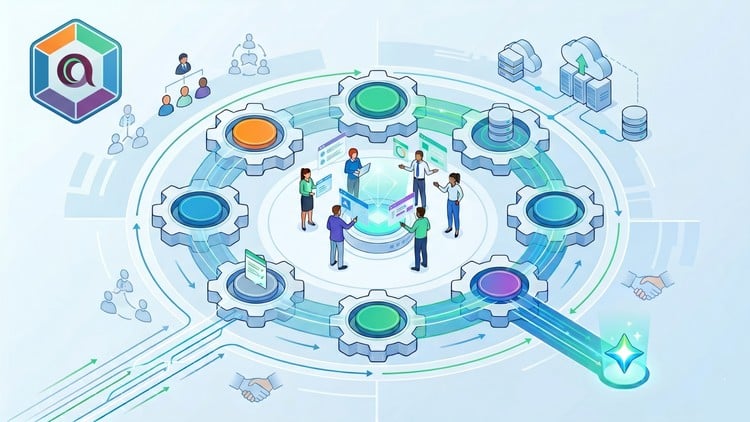
Build High-Performance IT Services, Creating Value Through Service Management, Service Value Chain and Value Creation.
What You Will Learn:
- Understand the purpose, structure, and key components.
- Explain the concepts of value, value co-creation, outcomes, outputs, and service relationships.
- Differentiate between products, services, and service offerings within modern service management environments.
- Identify and apply the Four Dimensions of Service Management.
- Describe the architecture and purpose of the Service Value System (SVS).
- Explain the role of governance and continual improvement within the Service Value System.
- Show more
Overview
Let’s be real for a second: most IT professionals hear the words “Service Management” and immediately think of dusty manuals and rigid processes that slow down innovation. I’ve spent over a decade in the trenches of IT operations, and I’ve seen my fair share of “best practices” that actually do nothing but create bottlenecks. However, the Modern IT Service Management 4 Foundation course is a refreshing departure from that old-school mindset. Instead of teaching you how to build a bureaucratic empire, this course focuses on how to actually deliver high-performance IT services that matter in a cloud-native, DevOps-driven world.
What I appreciated most about this updated version is the heavy emphasis on value co-creation. In the past, IT was seen as a vending machine—you put in a request, and a service came out. This course flips that script. It forced me to look at the relationship between the service provider and the consumer as a partnership. If you’re tired of the “us vs. them” mentality between IT and the business units, this curriculum provides the tactical framework to bridge that gap. It’s not just about certification prep; it’s about shifting your mindset from managing “servers and tickets” to managing “outcomes and value.”
The course does a deep dive into the Service Value System (SVS), which honestly, is the MVP of this framework. It provides a holistic view of how everything from governance to continual improvement fits together. For someone who has worked in siloed environments, seeing a visual representation of how demand transforms into value through the Service Value Chain was a “lightbulb” moment. It’s practical, it’s modern, and it’s clearly designed for the way we work today, not the way we worked in 2005.
Prerequisites
One of the best things about this course is its accessibility. You don’t need a fancy degree or fifteen years of sysadmin experience to get started. It’s designed for beginner to advanced learners. However, I’d suggest having at least a basic understanding of what an IT department does on a day-to-day basis. If you know what a “service desk” is or have ever been frustrated by a “change management” process, you have enough context to succeed. There are no hard technical requirements—no coding or server configuration needed—making it a perfect entry point for those looking to pivot into management roles.
Skills & Tools
- Framework Literacy: Mastering the language of modern ITSM, which is essential for communicating with stakeholders and senior leadership.
- Analytical Thinking: Learning to dissect service offerings and identify which components are actually driving value and which are just technical debt.
- Strategic Planning: Utilizing the Four Dimensions of Service Management (Organizations & People, Information & Technology, Partners & Suppliers, Value Streams & Processes) to ensure no part of the ecosystem is neglected.
- Incident & Problem Management: Developing job-ready skills to handle service disruptions with a focus on long-term resolution rather than just “putting out fires.”
- Industry-Standard Tools: While the course is platform-agnostic, the principles taught are what power industry-standard tools like ServiceNow, Jira Service Management, and BMC Helix.
Career Benefits & Job Roles
In today’s competitive market, simply having technical skills isn’t enough to secure career growth. Companies are looking for “T-shaped” professionals—people who have deep technical knowledge but also understand the business of IT. Completing this foundation course is a major signal to recruiters that you understand the big picture. It’s a vital step in certification prep for those aiming for the ITIL 4 Managing Professional designation.
Regarding specific job roles, this course is a goldmine for anyone looking to step into roles like Service Desk Manager, IT Project Manager, Release Manager, or Business Relationship Manager. Even if you’re a Lead Developer or a DevOps Engineer, understanding the Service Value System will help you justify your real-world projects to stakeholders in a language they actually understand: ROI and value. I’ve seen colleagues get a 15-20% salary bump just by pivoting into ITSM-focused leadership roles.
Pros
- Practical Application: This isn’t just theory. The course uses real-world projects and scenarios that mirror the actual challenges I face every Monday morning. It’s about building job-ready skills you can use immediately.
- Modern Context: It successfully integrates Lean, Agile, and DevOps principles. It doesn’t feel like a relic; it feels like a manual for 2024 and beyond.
- Efficiency: The structure is tight. It covers the Service Value Chain and value co-creation without unnecessary fluff, making it a great choice for busy professionals who need to upskill quickly.
Cons
The only real gripe I have is that the initial section on terminology can feel a bit like a vocabulary test. There is a lot of specific jargon (like the distinction between “outputs” and “outcomes”) that can feel pedantic at first. Stick with it, though—once you get past the definitions and start applying them to the Service Value System, the pieces start to fall into place and the “why” becomes much clearer.