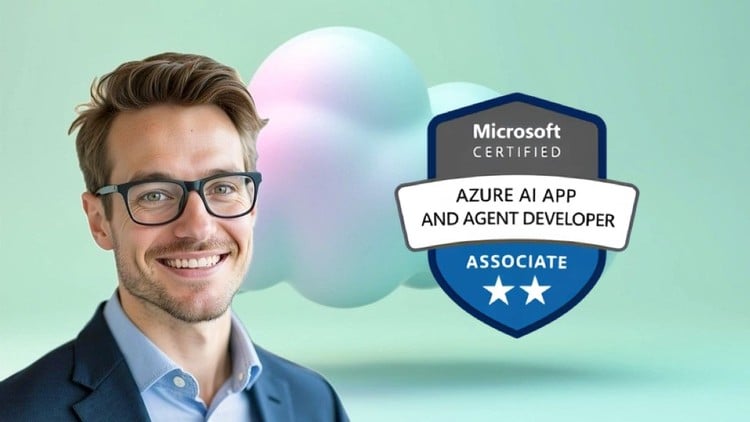
Pass the Azure AI-103 exam! 6 practice tests, 1,500 questions with detailed explanations, all 5 domains, updated 2026
What You Will Learn:
- Pass the Microsoft Azure AI-103 exam on your first attempt with realistic, exam-style practice questions
- Experience timed, exam-realistic simulation that matches the style and difficulty of the real AI-103 test
- Understand every answer through detailed explanations and official Azure documentation references
- Find and fix your weak areas across all 5 official AI-103 exam domains before test day
Overview
Let’s be real for a second: the AI landscape is moving so fast it feels like we’re all trying to drink from a firehose while riding a unicycle. One day you’re mastering prompt engineering, and the next, Microsoft drops a new certification like the AI-103 Azure AI Apps & Agents. If you’ve been in the game for a while, you know that certification prep isn’t just about passing a test; it’s about staying relevant before your skillset becomes legacy code. I recently dove into this practice exam suite for 2026, and it’s a massive undertaking. We’re talking 1,500 questions. That is a staggering amount of data to process, but in a world where industry-standard tools change every six months, that level of granularity is exactly what’s needed.
What I appreciate most about this specific set of exams is that it doesn’t just treat “AI Agents” as a buzzword. It digs into the plumbing—the orchestration, the memory management, and the specific Azure services that make agentic workflows actually function in an enterprise environment. It moves the needle from “I can talk to a chatbot” to “I can architect a multi-agent system.” This isn’t your typical beginner to advanced fluff; it’s a rigorous stress test designed to see if you can handle the architectural nuances of real-world projects without breaking the production environment.
Prerequisites
Don’t expect to walk into these practice exams cold. While the course covers the full spectrum, you’ll have a much better time if you already have the following under your belt:
- Foundational Cloud Knowledge: You should be comfortable with Azure fundamentals (AZ-900 level) and have a basic grasp of how resource groups and identity management work.
- Python or C# Basics: You don’t need to be a senior dev, but understanding how hands-on labs translate into code is crucial.
- AI Concepts: Familiarity with Large Language Models (LLMs), tokenization, and basic prompt engineering will save you a lot of headache.
- The “Agent” Mindset: A conceptual understanding of what makes an agent different from a standard RAG (Retrieval-Augmented Generation) pipeline.
Skills & Tools
This course forces you to get comfortable with the tools that actually matter in 2026. You aren’t just memorizing definitions; you’re learning how to deploy and manage:
- Azure OpenAI Service: Fine-tuning models and managing deployments for enterprise-grade applications.
- Semantic Kernel & LangChain: Understanding the orchestration frameworks that allow agents to call functions and maintain state.
- Vector Databases: Deep dives into Azure AI Search for high-performance data retrieval.
- Azure AI Foundry: Navigating the newer unified platform for building, testing, and deploying job-ready skills in AI.
- Responsible AI Tools: Implementing content filters and safety evaluations to ensure your agents don’t go rogue.
Career Benefits & Job Roles
If you’re looking for career growth, this is the specific niche where the money is moving. We are seeing a massive shift from “AI discovery” to “AI implementation.” Companies are no longer asking *if* they should use AI; they are asking *how* to build agents that automate supply chains, customer service, and internal devops. Earning the AI-103 badge puts you in the driver’s seat for roles such as:
- AI Solutions Architect: Designing the high-level flow of agentic systems for Fortune 500 companies.
- Cognitive Services Engineer: Specializing in the integration of vision, speech, and language models into existing apps.
- AI Automation Specialist: Focus on replacing brittle legacy workflows with intelligent, self-correcting agents.
- Machine Learning Operations (MLOps) Lead: Ensuring that these complex AI apps are scalable and maintainable.
Pros
- Documentation Depth: Every single question comes with a breakdown and a direct link to official Microsoft documentation. This is a lifesaver because it turns a “wrong answer” into a targeted hands-on labs session where you actually learn the “why” behind the “what.”
- Realistic Simulation: The timed environment perfectly mirrors the actual exam interface. If you can handle the pressure of these 1,500 questions, the actual test day will feel like a walk in the park.
- Up-to-Date Content: Since this is the 2026 version, it covers the most recent iterations of Azure AI Studio and the newer “Agent” specific features that older AI-102 materials completely miss.
Cons
- Information Overload: 1,500 questions is a double-edged sword. For some, the sheer volume can lead to burnout or rote memorization of the questions themselves rather than the underlying concepts. You have to be disciplined enough to use the explanations as a primary learning tool, or you’ll just end up skimming.