A step by step the Matlab codes for BER estimations of different Comm. systems like OFDM and NOMA Comm. systems
What you will learn
How to estimate the Bit-Error-Rate (BER) performance of different modulation schemes like BPSK, QPSK, 16QAM, 64QAM, and 256QAM over an Additive White Gaussian Noise (AWGN) channel?
How to generate and add a Rayleigh fading channel based on the Jakes model?
How to mitigate the Rayleigh fading channel effect using different linear equalizer schemes?
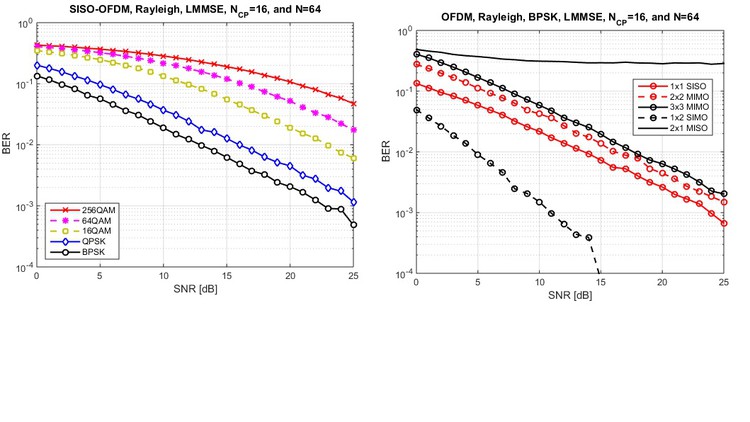
How to estimate the Bit-Error-Rate (BER) performance over Single-Input-Single-Output Orthogonal Frequency Division Multiplexing (SISO-OFDM) communication system over a Rayleigh fading channel?
How to extend this work for different Multiple-Input-Multiple-Output (MIMO) configurations like 2×2, and 3×3 MIMO-OFDM communication systems over a Rayleigh fading channel?
A general code for BER estimation in case of Nt×Nr configuration for OFDM communication system over a Rayleigh fading channel will be presented, where Nt, is the number of transmitting antennas, and Nr is the number of receiving antennas.
Finally, the BER estimation for Non-Orthogonal Multiple Access (NOMA), which used in the 5G communication systems will be presented.
Why take this course?
This is course is designed for under and post graduate students associated to the electronics and communication engineering department. It has 10 introductions of 30 minutes, each introduction discusses the theoretical explanation and the simulated figures that obtained through the explanation of the course. This course saves many months of hard work.
Using the Matlab program, you will learn:
1-How to estimate the Bit-Error-Rate (BER) performance of different modulation schemes like BPSK, QPSK, 16QAM, 64QAM, and 256QAM over an Additive White Gaussian Noise (AWGN) channel?
2-How to generate and add a Rayleigh fading channel based on the Jakes model?
3-How to mitigate the Rayleigh fading channel effect using different linear equalizer schemes?
4-How to estimate the Bit-Error-Rate (BER) performance over Single-Input-Single-Output Orthogonal Frequency Division Multiplexing (SISO-OFDM) communication system over a Rayleigh fading channel?
5-How to extend this work for different Multiple-Input-Multiple-Output (MIMO) configurations like 2×2, and 3×3 MIMO-OFDM communication systems over a Rayleigh fading channel?
6-A general code for BER estimation in case of Nt×Nr configuration for OFDM communication system over a Rayleigh fading channel will be presented, where Nt, is the number of transmitting antennas, and Nr is the number of receiving antennas.
7-Finally, the BER estimation for Non-Orthogonal Multiple Access (NOMA), which used in the 5G communication systems will be presented.
Overview: From Theoretical Chaos to Simulation Clarity
If you’ve spent any time in the trenches of RF or wireless engineering, you know the struggle: the distance between a textbook formula for Bit Error Rate (BER) and a functioning simulation in Matlab is a mile wide. Most academic resources give you the “what,” but very few give you the “how” when it comes to actual implementation. This course, focused on Matlab for wireless communication engineering, is a breath of fresh air for those of us who need job-ready skills rather than just another lecture on Shannon’s Law.
What sets this course apart isn’t just the code snippets; it’s the logical progression. It starts with the basics of AWGN channels and then throws you into the deep end with Rayleigh fading and MIMO-OFDM architectures. I particularly appreciated the focus on NOMA (Non-Orthogonal Multiple Access), which is a massive talking point in 5G and 6G circles right now. If you’re looking to move beyond simple BPSK scripts and start building real-world projects that mirror what industry-standard tools actually require, this is where you start. It’s a beginner to advanced journey that feels less like a classroom and more like a series of hands-on labs guided by someone who has actually had to debug a transceiver chain at 2 AM.
Prerequisites: What You Actually Need to Know
Don’t jump into this if you’ve never opened Matlab before, but you don’t need to be a PhD candidate either. To get the most out of these modules, you should have:
- A solid grasp of linear algebra (if you aren’t comfortable with matrix multiplication, MIMO will be a nightmare).
- Basic understanding of digital signal processing concepts like sampling and Fourier transforms.
- A working installation of Matlab (the Signal Processing and Communications toolboxes are your best friends here).
- An appetite for troubleshooting; the code is “step-by-step,” but the real learning happens when you tweak the SNR values and see the BER curve tank.
The Toolkit: Skills & Industry-Standard Tools
This isn’t just about writing scripts; it’s about building a library of reusable modules for wireless system design. By the end of this course, your technical arsenal will include:
- Modulation Mastery: Implementing everything from BPSK to 256QAM. In the real world, knowing how to simulate 256QAM is vital for high-throughput career growth.
- Channel Modeling: Building a Jakes model for Rayleigh fading from scratch. This is a huge differentiator during certification prep or technical interviews.
- Equalization Strategies: Learning how to actually undo the damage of a fading channel using linear equalizers.
- MIMO Scalability: The general Nt x Nr configuration code is worth the price of admission alone. Being able to scale from 2×2 to any antenna configuration is a high-value skill in SDR (Software Defined Radio) roles.
Career Benefits & Job Roles
Let’s talk about the bottom line: will this get you hired? In a competitive market, having a portfolio of BER estimation simulations is a power move. This course positions you for several high-impact roles:
- Wireless Systems Engineer: Where you’ll design and validate OFDM-based waveforms.
- DSP Engineer: Focusing on the algorithmic side of equalization and signal recovery.
- RF Simulation Analyst: Using Matlab to predict system performance before a single piece of hardware is built.
- 5G/6G Researcher: Leveraging NOMA and MIMO concepts to push the boundaries of spectral efficiency.
This is high-level career growth material. When you can explain—and simulate—the performance impact of 64QAM over a fading channel, you cease to be a “user” of technology and become a “creator.”
The Pros: Why This Works
- No-Nonsense Implementation: It skips the fluff. You get right into the Matlab codes for BER estimation, which is what we actually need for real-world projects.
- Scalability: The transition from SISO to MIMO-OFDM is handled beautifully. Most courses stop at SISO, but the Nt x Nr general code is a game-changer.
- Modern Relevance: Including NOMA shows that the instructor is keeping pace with current 3GPP standards, making this great for certification prep.
The Cons: An Honest Critique
The only real drawback is the sheer density of the mathematical logic in the MIMO sections. While it is “step-by-step,” if you aren’t brushed up on your matrix-based signal representations, you might find yourself hitting the “pause” button frequently. It’s an intensive beginner to advanced track, and the learning curve in the final third of the course is steep. It could benefit from a few more “why we do this” conceptual bridges between the hands-on labs.